
Anna of Novgorod
The Holy Right-believing Princess Anna of Novgorod
Righteous · Princess · b. c. 1001, in Sweden — d. 1050 (some accounts 1056), at Novgorod
Commemorated 10 February — Repose at Novgorod, 4 October — With the Synaxis of the Hierarchs of Novgorod (and her uncovering of relics)
Anna of Novgorod (c. 1001 – 1050) was a Swedish princess who became Grand Princess of Kiev and is venerated as one of the first canonised women saints of the Russian land. Born Ingegerd, daughter of the first Christian king of Sweden, Olof Skötkonung, she was given in marriage in 1019 to Yaroslav the Wise, Grand Prince of Kiev, taking in Rus' the name Irene; she bore him the children through whom his dynasty was bound to half the courts of Europe. A woman of deep faith and learning, she raised her children in the Christian way, shared in her husband's building of the great churches of Kiev and Novgorod, and at the end of her life received the monastic tonsure with the name Anna — the name by which the Church remembers her. She died at Novgorod and was buried in its cathedral of Holy Wisdom, and is honoured as the first of the princely women of Rus' to be glorified, kept on February 10 and among the Hierarchs of Novgorod on October 4.

Ingegerd of Sweden
She was born about the year 1001, the daughter of Olof Skötkonung, the first baptised king of the Swedes, and grew up at a Christian court on the northern edge of Latin Europe. Her hand was at one time promised to Olaf II of Norway (the later Saint Olaf), but the marriage that history records was to the ruler of the Rus': in 1019 Ingegerd was given to Yaroslav Vladimirovich, son of Vladimir the Baptiser of Rus' and Grand Prince of Kiev, who would be remembered as Yaroslav the Wise. On coming to Rus' she took the Slavonic-Christian name Irene (Irina). Tradition holds that her dowry included the town of Ladoga and its lands, which she governed.
Grand Princess of Kiev
As Yaroslav's consort through the long central decades of his reign, Irene stood at the heart of the golden age of Kievan Rus'. She bore him a large family, and the marriages of her children knit the house of Kiev into the royalty of the Christian world: her daughters became queens — Anna of France, Anastasia of Hungary, Elisabeth (Elisiv) of Norway — and her sons, among them Vladimir of Novgorod, Izyaslav, Svyatoslav, and Vsevolod (father of Vladimir Monomakh), carried the line forward. The chroniclers and the later tradition praise her as a wise counsellor to her husband, a peacemaker, and a woman devoted to the Church: she is associated with the founding of the first women's monastery in Rus' (Saint Irene's in Kiev, named for her patron), and shared in Yaroslav's great works of building and learning — the raising of the cathedrals of Holy Wisdom at Kiev and at Novgorod, and the gathering of books and translators that made his reign a fountainhead of Slavonic Christian culture. Above all the Church remembers her for the Christian upbringing she gave her children, forming in them firm faith, love of labour, integrity, and learning.
Repose and glorification
Toward the end of her life she withdrew from the world and received the monastic habit — in the tradition the great schema — taking the name Anna, the name under which she is venerated. She died in 1050 (some accounts place her repose in 1056, after that of Yaroslav) and was buried in the Cathedral of Holy Wisdom at Novgorod, the church her son Vladimir had built, where her son too was laid. Her memory was kept at Novgorod as one of the holy founders of the see; her relics were uncovered and her local veneration established in the mid-fifteenth century under Archbishop Euthymius, and she came to be numbered among the saintly Hierarchs and Founders of Novgorod. She is honoured as the first princely woman of Rus' to be glorified as a saint.
Feast and commemoration
Anna of Novgorod is commemorated on February 10 (church date; Old Calendar civil February 23), the day of her repose, chiefly in the Russian Church and at Novgorod. She is kept also on October 4, with the uncovering of her relics and among the Synaxis of the Hierarchs of Novgorod (a local synaxis also observed on the third Sunday after Pentecost). Her feast is a local Russian commemoration rather than a universal one; the Greek calendars do not keep her.
Hymns
Troparion — Tone 4
Having forsaken thy royal homeland and all its glory, and shining forth in Christ with faith and good works, thou didst raise up godly children and adorn the land of Novgorod, O right-believing mother Anna; and receiving the angelic habit at the last, thou wast translated to the heavenly Kingdom. Pray thou to Christ our God, that our souls may be saved.
Original translation from the Slavonic
Iconography
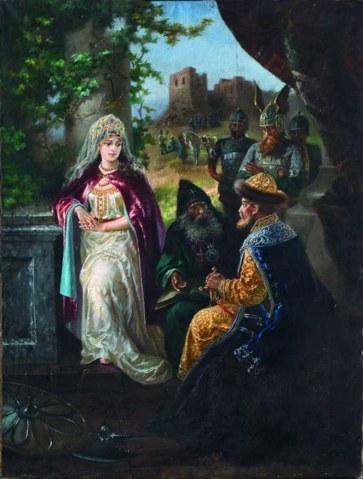
Anna of Novgorod is depicted as a princess-nun: crowned or veiled in the royal manner in some images, but most characteristically in the dark monastic habit and mantle she took at the end of her life, holding a scroll or a cross, an older woman of grave and gentle aspect. She appears also among the assembled Hierarchs and Saints of Novgorod in the local group-icons of that see. The stored image is a Western-style historical painting (Trankovsky, late 19th c.): Yaroslav the Wise with Ingigerd — Anna by her monastic name — stored per §34 as a labelled historical image; an Orthodox icon of the princess-nun remains wanted.
Disputed questions
- The identity of Ingegerd and the nun Anna. That the Swedish princess Ingegerd-Irene is one and the same as the "Blessed Princess Anna" buried at Novgorod is the received tradition and the basis of her cultus, but the equation rests on the monastic renaming and has been questioned by some historians, a minority distinguishing an "Anna" of the Novgorod tomb from Yaroslav's Swedish consort. The Church venerates them as one.
- The year of repose. Sources divide between 1050 and 1056; the entry gives 1050 with the alternative noted.
- Not to be confused with the Prophetess Anna who greeted the infant Christ in the Temple (kept February 3 and with the Meeting), nor with the righteous Anna the mother of the Theotokos: a medieval princess of Rus', not a figure of the Gospel.