
Anna the Prophetess
The Holy and Righteous Anna the Prophetess, daughter of Phanuel
Prophet · Righteous · d. 1st century
Commemorated 3 February — The aged prophetess of the Temple; with Symeon, leader of the afterfeast of the Meeting, 28 August — Synaxis of the Fathers of the Kiev Far Caves
Anna the Prophetess (Ἄννα ἡ Προφῆτις) is the aged widow of the tribe of Asher who, with the righteous Symeon, witnessed to the infant Christ at his Presentation in the Temple (Luke 2:36–38). "A prophetess, the daughter of Phanuel," she had lived with a husband seven years and remained a widow to a great age, "which departed not from the temple, but served God with fastings and prayers night and day." Coming forward at the very hour Symeon held the Child, "she gave thanks likewise unto the Lord, and spake of him to all them that looked for redemption in Jerusalem." She is one of the few women the Scriptures call a prophetess, and the Church honours her as the last prophetess of the Old Covenant and the first evangelist of the Temple, proclaiming the Redeemer to the waiting remnant. With Symeon the God-receiver she leads the afterfeast of the Meeting, commemorated on February 3. She is not to be confused with Anna the mother of the Theotokos, nor with Hannah the mother of Samuel.

The witness of the Gospel
Anna, like Symeon, is known wholly from the single scene of Luke's Gospel, and the Evangelist draws her portrait in three verses of unusual detail:
And there was one Anna, a prophetess, the daughter of Phanuel, of the tribe of Aser: she was of a great age, and had lived with an husband seven years from her virginity; and she was a widow of about fourscore and four years, which departed not from the temple, but served God with fastings and prayers night and day. And she coming in that instant gave thanks likewise unto the Lord, and spake of him to all them that looked for redemption in Jerusalem. (Luke 2:36–38)
Every phrase is weighed. She is named a prophetess (prophētis) — one of the very few women so styled in the whole of Scripture, standing in the line of Miriam, Deborah, and Huldah — and the title is the Church's warrant for reckoning her among the prophets. She is given her father's name, Phanuel ("the face of God"), and her tribe, Asher — a tribe of the northern kingdom, so that the last prophetic witness of Israel gathers into itself the scattered tribes as well as Judah. She had been married seven years and was widowed thereafter; "a widow of about fourscore and four years" is read either as her age — eighty-four — or, in an ancient and common reading, as the length of her widowhood, so that she had kept her long vigil in the Temple perhaps into her hundredth year and beyond. And she "departed not from the temple," serving God "with fastings and prayers night and day" — the very type of the consecrated widow whom the apostolic Church would honour, "she that is a widow indeed, and desolate, trusteth in God, and continueth in supplications and prayers night and day" (1 Timothy 5:5).
The thanksgiving and the proclamation
Anna's part in the Meeting complements Symeon's and completes it. Where Symeon receives the Child and sings his release, Anna, "coming in that instant" — at the very moment of Symeon's song — does two things. First, she "gave thanks likewise unto the Lord": her response to the sight of the Salvation of God is the eucharist of praise, the aged watcher's Gloria answering the elder's Nunc Dimittis. Second, and this is her particular office, she "spake of him to all them that looked for redemption in Jerusalem" — she became the herald, carrying the news of the Redeemer's coming from the Temple out to the faithful remnant, to all who, like herself, were "waiting for the consolation of Israel." The Church reads in this the first evangelisation: before ever the Child had spoken, an aged prophetess of the Temple was already proclaiming him to those with ears to hear. For this the tradition calls her not only prophetess but the herald and evangelist of the Meeting, the woman who, having fasted and prayed night and day through a long widowhood, was found watching at the hour of the Lord's coming and sent to tell of it.
Repose and memory
Of Anna's death the Scriptures and the tradition say nothing certain; having borne her witness she passes out of the record, and the Church keeps her memory in the office of the Meeting and its afterfeast. She stands in Christian tradition as the pattern of the holy widow and the watchful elder — old age consecrated to prayer and fasting, and rewarded with the sight of the Salvation of God — and, with Symeon, as one of the two hinges on which the Old Covenant turns into the New: the whole expectation of Israel, in these two aged saints, receiving at last the One for whom it had waited.
Not to be confused
Several holy women of the tradition bear the name Anna (Hebrew Hannah), and they are readily confused:
-
Anna the Prophetess of this entry — the widow of the tribe of Asher, of the Gospel of Luke, kept February 3.
-
Anna the mother of the Theotokos — wife of Joachim, grandmother of Christ, "Ancestor of God," kept with Joachim on September 9, with her Dormition on July 25 and her Conception of the Theotokos on December 9. A different person, of the generation before the Nativity.
-
Hannah the mother of Samuel — the barren wife of Elkanah in the First Book of Kingdoms (1 Samuel 1–2), whose song of thanksgiving prefigures the Magnificat. An Old-Testament figure, not the same as the Gospel prophetess, though the shared name and the shared motif of thankful song invite the confusion.
-
Anna of Novgorod — the eleventh-century princess (Ingegerd of Sweden), wife of Yaroslav the Wise, kept February 10. A medieval saint of Rus', not a figure of the Gospel.
The Gospel prophetess belongs to the moment of the Meeting alone.
Feast and commemoration
Anna is commemorated on February 3 (church date; Old Calendar civil February 16), together with Symeon the God-receiver, as the two leaders of the afterfeast of the Meeting of the Lord in the Temple (February 2). The Antiochian, Greek, and Slavic calendars keep the day in common. She has no proper office distinct from the afterfeast hymns of the Meeting; her figure is honoured within the feast, and her thanksgiving is remembered beside Symeon's song.
Hymns
Troparion — Tone 1
In thee, O mother, was the divine image surely preserved; for thou didst take up the cross and follow Christ, and by thy deeds thou didst teach us to despise the flesh, for it passeth away, but to care for the soul as a thing immortal. Wherefore thy spirit, O righteous Anna, rejoiceth with the angels.
Original translation from the Greek
Appointed readings
Gospel — Luke 2:36–38 (Anna gives thanks in the Temple)
36And there was one Anna, a prophetess, the daughter of Phanuel, of the tribe of Aser: she was of a great age, and had lived with an husband seven years from her virginity; 37And she was a widow of about fourscore and four years, which departed not from the temple, but served God with fastings and prayers night and day. 38And she coming in that instant gave thanks likewise unto the Lord, and spake of him to all them that looked for redemption in Jerusalem.
Iconography
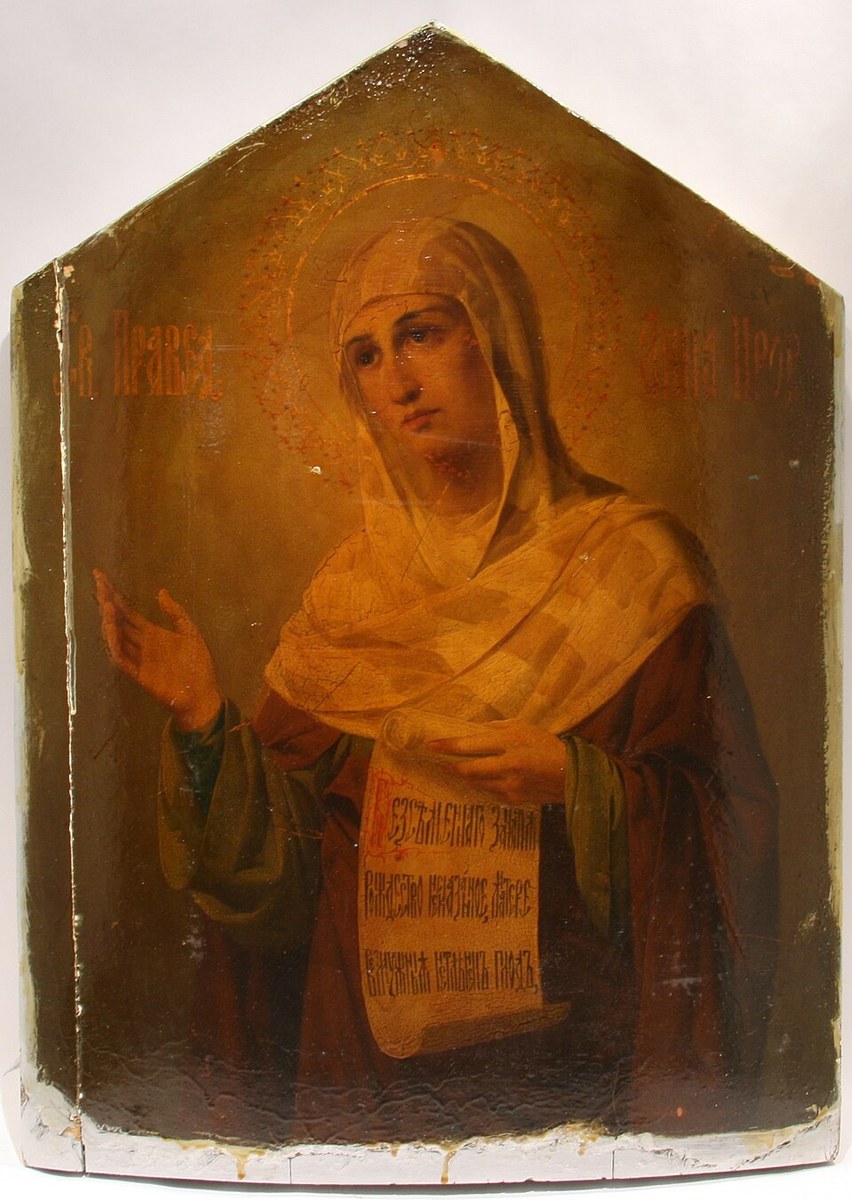
Anna appears within the icon of the Meeting, standing behind or beside Symeon as the fourth of the group (with the Virgin and Joseph), an aged woman — her hair veiled in the manner of a widow — who raises her hand or unrolls a small scroll toward the Christ-child, the visible sign of her proclamation "to all them that looked for redemption." In her own portrait type she is shown as a venerable grey-haired woman in the dark robe and maphorion of a widow, often holding a scroll inscribed with words of her witness — the icon that distinguishes her, by the scroll and the aged widow's habit, from the younger Anna the mother of the Theotokos, who is shown with the infant Mary.
The stored image is a 19th-century Russian icon of the Holy Righteous Anna the Prophetess, "daughter of Phanuel," shown as an aged veiled widow bearing a scroll (source, public domain, pd-old-work).