
Anoub the Sign-bearer
Our Venerable Father Anoub the Sign-bearer, of the Egyptian Desert
Venerable · Wonderworker · d. 5th century, in the Egyptian desert
Commemorated 6 June — Repose in peace in the Egyptian desert
Anoub, called σημειοφόρος, "the sign-bearer" — the Greek epithet for one through whom God works signs — is one of the desert fathers of Egypt whose sayings are gathered in the Apophthegmata Patrum, the Lausiac History and the Evergetinos. St Nikodemos the Hagiorite, summarising his notice, lists seven marks of his attainment: that from the day he first named the name of Christ no lie ever came out of his mouth; that in the deep desert he ate only what an angel brought him; that he desired nothing in the world but God alone; that God made known to him what was done on earth; that his one occupation night and day was the enjoyment of God; that whatever he asked of God was given him; and that he was taken up in ecstasy and saw the choirs of the saints singing before God, and Satan delivered to the eternal fire. Three days after that vision he departed, and those present heard angels singing as his soul was received.
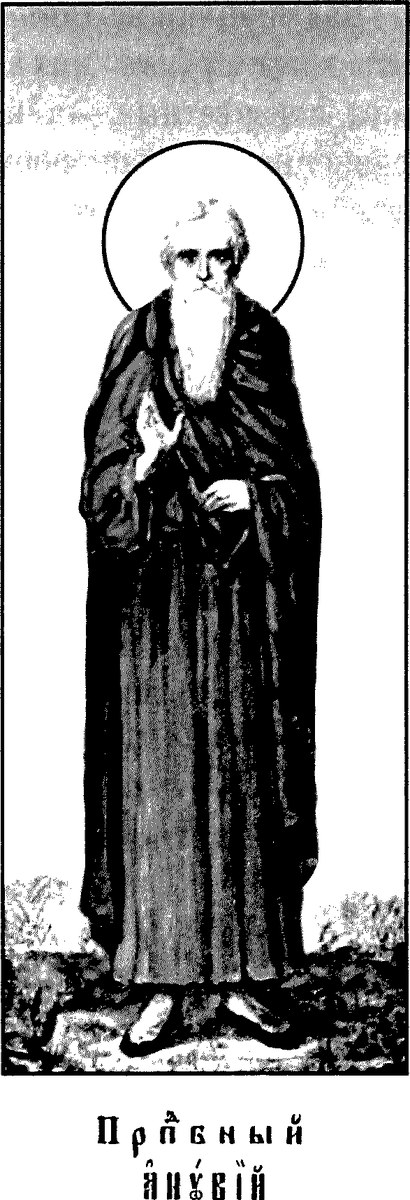

The desert setting
Anoub belongs to the Egyptian desert of the late fourth and fifth centuries — the generation of Scetis, Nitria and the Cells whose words the Apophthegmata preserve. He is a father of the Sayings rather than of a Life: there is no biography of him, and what the tradition transmits is a handful of anecdotes and a summary of his virtues, copied from collection to collection and reaching the Greek service-books through the Paradise of the Fathers and the Evergetinos.
Abba Anoub in the Sayings
In the Apophthegmata Anoub appears as the elder brother of Abba Poemen and the head of a small company of brothers who, driven from their place by the barbarian raids on the Nile valley, took shelter in a ruined pagan temple. There Anoub taught his brethren by an enacted parable. For seven days he went out each morning and threw stones at the face of a stone idol that stood in the ruin, and each evening came back and asked its forgiveness. When Poemen at last asked what he meant, he answered that he had done it for their sake: they had seen that the statue was neither angered by the insult nor moved by the apology, and if they could not live together in that spirit — unprovoked by injury and unlifted by honour — they should separate into different cells. It is one of the most quoted lessons of the desert on the common life, and it is Anoub's.
The same cycle records his verdict that it is better to be sinned against than to be the one who sins, and preserves him as an elder consulted on discernment and on the guarding of the tongue — which is the ground of the first of the marks Nikodemos lists, that no lie was ever heard from him after his baptism into the name of Christ.
The gifts
The Greek notice for his day sets out his attainments in a sevenfold list, and it is worth noting what kind of claims they are. Two are ascetic (truthfulness; the single desire of God). Two are charismatic in the ordinary desert sense (food brought by an angel when he had withdrawn beyond the reach of men; knowledge given him of what passed on the earth). Two are contemplative (unceasing prayer; the enjoyment of God as his sole occupation). One is the boldness of the friends of God — that whatever he asked was granted him. Taken together they define the word sēmeiophoros: not a wonderworker who performs marvels for the crowds, but a man through whom signs pass because nothing in him obstructs them.
The vision and the repose
At the end of his life Anoub was taken out of himself in ecstasy. He saw, the notice says, the multitudes of the saints — martyrs, the righteous, the ascetics — standing before God and singing with a gladness that cannot be told; and he saw Satan given over to the eternal fire. He told what he had seen, and three days later he reposed; and those who stood by his body heard the singing of angels as his soul was taken up. He is commemorated as one who fell asleep in peace, not as a martyr.
Feast and commemoration
June 6 (church date; Old Calendar civil June 19). Anoub is commemorated in the Greek synaxaria of the day among the venerable fathers, together with Hilarion the New of Dalmatia, Bessarion the Wonderworker, Attalus and Photius — a day unusually thick with Egyptian and Constantinopolitan ascetics. He has no proper office; the day is sung with the common of a venerable father and his notice is read at the synaxarion. Where the Evergetinos is read in monasteries, his sayings are met far more often than his feast is kept.
Hymns
Apolytikion — Tone 8 (common of a venerable father)
By the streams of thy tears thou didst make the barren desert to bear fruit, and by thy sighings from the depths thou didst bring thy labours to hundredfold increase; and thou wast made a beacon to the world, shining with miracles, O Anoub our father: intercede with Christ God that our souls may be saved.
Iconography
Anoub has no developed individual iconography and no pre-1900 image of him has been identified for this collection. In the painted menologia for June he would stand in the rank of the Egyptian fathers, in the type of the desert ascetic: an aged monk, gaunt, in the mantle and analavos over a worn tunic, bare-headed, with a long white beard, one hand raised in blessing and the other holding a scroll. Two attributes could be drawn from his tradition — the ruined temple with the stone idol, the setting of his most famous teaching, and the angel bringing bread, which is the visual form of the epithet sign-bearer; neither, however, is attested in surviving painting.
The stored image is the captioned plate of the illustrated Zhitiya Svyatykh (1903–1911).
Disputed questions
- Dating. Anoub is placed by his association with Abba Poemen (†c. 450), whose elder brother he is called, and therefore in the fifth century, with a life reaching back into the fourth. No year of his repose is transmitted.
- The name. Anoub is a Coptic name (compare the many Egyptian Anoub- forms), and the Greek books spell it variously Ἀνούβ, Ἀνοὺβ, Ἀνούβιος. He is not to be confused with Abba Anoub of the Historia Monachorum where that work names a different Egyptian of similar name, nor with Anempodistos or other similarly abbreviated desert names; and the epithet sēmeiophoros is his own in the Greek calendars, distinguishing him from namesakes.
- Which collection. The Greek notice cites both the Lausiac History of Palladius and the Evergetinos. The stone-idol anecdote, which is his most famous, stands in the alphabetical Apophthegmata under Anoub; the sevenfold list of his gifts is the work of the later synaxarists, drawing on the Paradise of the Fathers.
- Absent from the Slavonic calendars. He is kept on June 6 in the Greek books; the Russian calendars for the day commemorate their own saints and omit him.