
Anterus of Rome
The Holy Hieromartyr Anterus, Pope and Bishop of Rome
Hieromartyr · Bishop · d. January 3, 236, at Rome
Commemorated 5 August — Commemorated with his successor Fabian in the Eastern synaxaria
Anterus was bishop of Rome for about forty days, from November 235 to January 236 — one of the shortest reigns in the history of that see, and one of the least documented. He was elected in the middle of the persecution of Maximinus Thrax, when his predecessor Pontian had been deported to the mines of Sardinia; the tradition remembers him chiefly for a single characteristic act, the collection and preservation of the acts of the martyrs from the public registers, and holds that it cost him his life. He was buried in the papal crypt of the cemetery of Callixtus on the Appian Way, where his Greek epitaph — the oldest of the papal epitaphs recovered there — was found in the nineteenth century. The East keeps him on August 5, with his successor Fabian.

Election in a persecution
The emperor Maximinus Thrax (235–238), who came to the throne by the murder of Alexander Severus, turned at once against the leaders of the Christian churches — not, Eusebius says, against the whole body of the faithful, but against the clergy, as the men responsible for the household of his predecessor's Christian sympathies. At Rome the consequence was the removal of both parties to the schism that had divided the city: the bishop Pontian and the presbyter and antipope Hippolytus were both deported to the deadly quarries of Sardinia, where they were reconciled and where both died. Pontian, before he went, resigned his see — the first bishop of Rome known to have abdicated — so that the Roman church should not be left leaderless.
Into that vacancy, on 21 November 235, the Romans elected Anterus. The oldest lists give his name in the Greek form Ἄνθηρος, and he was in all likelihood a Greek by birth, as several of the bishops of Rome in that century were; a later tradition makes him the son of a man named Romulus, of Magna Graecia.
The acts of the martyrs
The one act attributed to him is the one the Church has kept. The Liber Pontificalis records that Anterus caused the acts of the martyrs to be diligently sought out and written down, gathering the records of their trials from the notaries of the city, and laid them up in the archives of the Roman church. The purpose is transparent: in a persecution the official court minutes were the only unimpeachable record of what a confessor had actually said, and a church that preserved them possessed both the memory of its dead and the evidence of their constancy. The same care was taken up and organised on a larger scale by his successor Fabian, who appointed seven subdeacons over the seven districts of the city to superintend the notaries in exactly this work.
The tradition adds that it was for this that he was arrested and put to death, the prefect of the city regarding the collection of such records as an offence. He died on 3 January 236, having held the see some forty days.
Burial and epitaph
He was buried in the papal crypt of the cemetery of Callixtus on the Via Appia, the burial-place of the third-century bishops of Rome. In 1854 Giovanni Battista de Rossi, excavating that crypt, recovered the fragmentary marble slab of his grave, inscribed in Greek letters ΑΝΤΕΡΩC ΕΠΙ — Anteros epi[scopos], "Anterus, bishop." It is the earliest of the papal epitaphs found in the crypt, and the discovery of it, in the very chamber the pilgrim itineraries had described, was one of the decisive moments of Christian archaeology.
Feast and commemoration
August 5 (church date; Old Calendar civil August 18), the forefeast of the Transfiguration and within the Dormition fast. In the Eastern books he is listed immediately before Fabian, whom he ordained and who succeeded him, and the two Roman bishops are commemorated as a pair, so that the day carries a small Roman appendix to its Antiochene and Cappadocian saints. The Roman calendar keeps him on January 3.
Hymns
Apolytikion — Tone 4 (common of a hieromartyr)
As a sharer in the ways and a successor to the thrones of the Apostles, O divinely-inspired one, thou didst find in contemplation the means to ascend to divine heights; rightly dividing the word of truth, thou didst struggle for the faith even unto blood, O hieromartyr Anterus: intercede with Christ God that our souls may be saved.
Iconography
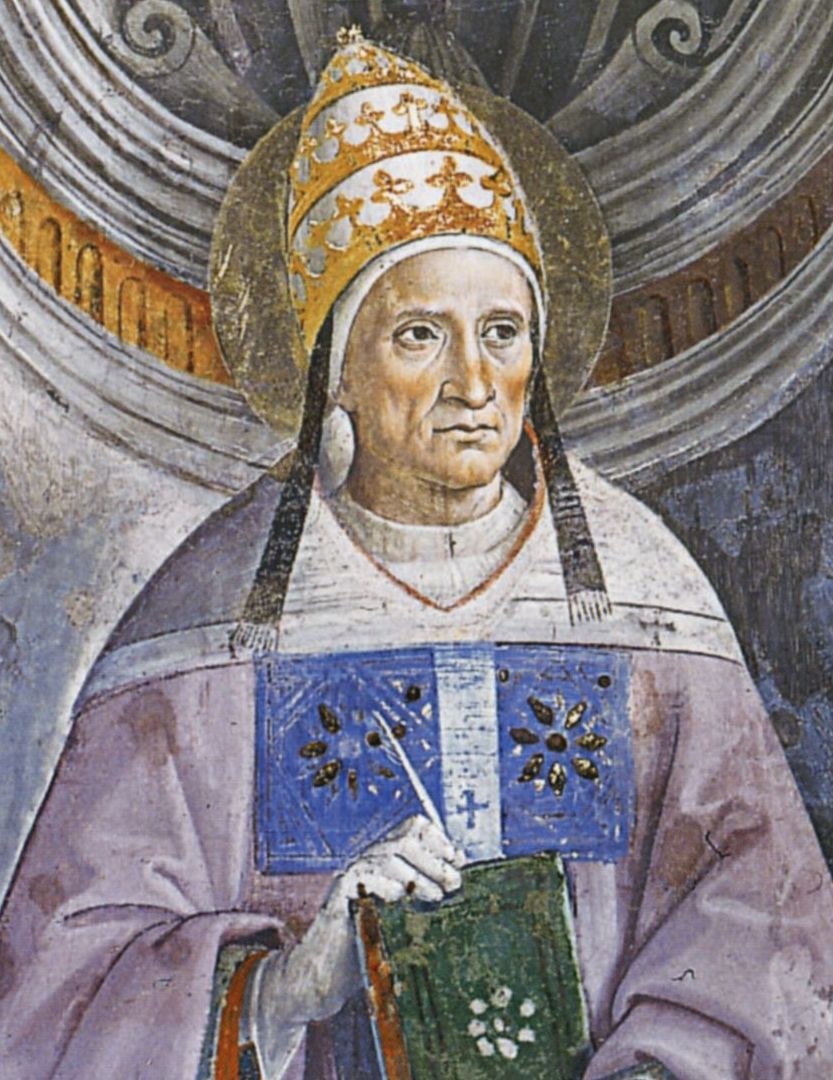
Anterus is painted, on the rare occasions he is painted alone, as a bishop of the early Church: dark-haired or greying, of middle years, in the phelonion and omophorion, with the Gospel book in his left hand and the right raised in blessing, and as a hieromartyr he may hold the cross. Western art gives the popes of this period the tiara and the keys, which are anachronisms for the third century and are not used in Orthodox usage; where he appears in the Roman catacomb-inspired cycles he is shown simply as a bishop among the bishops of the Callixtan crypt. He is often paired with his successor Fabian. The stored image is a Western work per §34: Perugino's portrait of the pope from the Sistine Chapel's papal series (c. 1481). An Eastern image remains wanted and is listed among the upgrade-wanted icons.
Disputed questions
- Was he a martyr? The oldest documents call him episcopus and not martyr: his own epitaph gives him no title of martyrdom, whereas the epitaph of Fabian a few paces away adds the letters ΜΡ. The forty days of his episcopate, moreover, fell in a lull — Maximinus's measures struck Pontian and Hippolytus in 235 and the Roman church was able to elect and bury a bishop in the ordinary way. Modern historians therefore generally hold that Anterus died a natural death, and that his title of martyr was acquired later, perhaps by attraction to the martyred bishops around him in the crypt and by the legend of the acts of the martyrs. The Church's liturgical tradition, East and West, has nevertheless kept him as a hieromartyr, and this reference records both the veneration and the archaeological objection to it.
- The date of his commemoration. The West keeps him on 3 January, the day of his death, in the company of the popes of the Callixtan crypt. The Eastern synaxaria place him on 5 August, immediately before Fabian, evidently because the two were transmitted together as a pair of Roman bishops. Neither day is a translation of relics; they are simply two independent traditions of the same saint.
- The spelling of his name. Greek Ἄνθηρος gives the English Antherus used by the Orthodox Church in America; the Latin lists give Anterus or Anteros, and his own Greek epitaph reads ΑΝΤΕΡΩC. All are the same man.