
Hippolytus of Rome
The Holy Hieromartyr Hippolytus, Bishop of Rome, and the Martyrs with him
Hieromartyr · Bishop · b. c. 170 — d. c. 235 (traditional; the Eastern martyr-account is undated — see Disputed questions)
Commemorated 30 January — Martyrdom of Hippolytus, Bishop of Rome, with Censorinus, Sabinus, the virgin Chryse, and the companions
Hippolytus of Rome, a bishop and martyr of the third century, is commemorated on January 30 together with a company of Roman martyrs — the official Censorinus, the virgin Chryse ("the golden one"), Sabinus, and some twenty others. The Eastern synaxarion tells of Censorinus and his fellow-prisoners, of the many soldiers and citizens converted by the miracles worked in the prison, and of the aged Hippolytus who, hearing of their sufferings, came before the judge, openly confessed Christ and rebuked the persecutor, and was put to death with them. This Hippolytus the tradition identifies with Hippolytus the writer (c. 170 – c. 235), the most learned churchman of third-century Rome — a disciple of the school of Irenaeus, a prolific exegete and theologian, and the central figure in one of the earliest Roman schisms, reconciled to the Church and dying a confessor in exile on Sardinia. The relationship of the martyr of the synaxarion to the writer, and to the several other Roman Hippolyti, is one of the tangled questions of early hagiography, and is set out below.
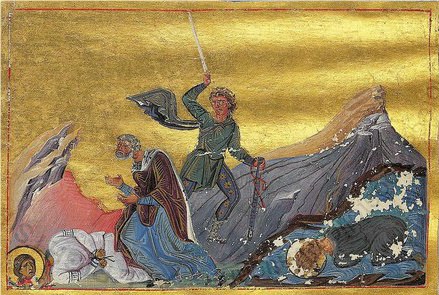

The company of martyrs (the synaxarion account)
The account read in the Byzantine synaxarion for January 30 is a Roman martyr-legend of the third century. Its centre is Censorinus, a man of high rank at Rome — the sources make him a magistrianus, an officer of the imperial service — who was arrested and imprisoned for the confession of Christ. In prison, the account relates, the wonders of God broke out: at the prayers of the confessors a dead youth was raised to life, and at the sight of it the twenty-and-more soldiers and officials set to guard them, together with others of the city, believed and confessed Christ, and so were themselves condemned. Among those who came forward was the virgin Chryse (Χρυσῆ, "the golden") — the jewel of the company — who under a succession of hideous tortures (the account dwells, in the manner of the Roman passiones, on the wheel, the fire, the stones, and the sword) would not deny her Lord, and was at last beheaded; with her suffered Sabinus and the rest.
Into this scene the tradition brings the elder Hippolytus, a bishop and teacher of the Roman church. Learning of the martyrs' constancy and of the tortures inflicted on them, the aged man came of his own will before the governor, confessed himself a Christian, and rebuked the persecutor to his face for his cruelty. He too was condemned, and won the martyr's crown with the company he had come to strengthen. Later Western embroidery of the Hippolytus legends — drawing on the poet Prudentius, who in his Peristephanon sang a Roman Hippolytus torn apart by wild horses (a death the hagiographers found in the saint's own name, that of the Hippolytus of Greek myth whom his maddened horses dragged to death) — attached the same manner of death to this bishop in some retellings; the Byzantine synaxarion itself is sober about the mode of his end and keeps him simply as a hieromartyr. The whole company is honoured together on January 30.
Hippolytus the writer
The Hippolytus whom the tradition sets at the head of this company is identified with the greatest Roman churchman of his age, Hippolytus the writer (c. 170 – c. 235). Of his origins little is certain — he wrote in Greek, the language still of the Roman church in his day, and stood in the theological succession of Irenaeus of Lyons, whose pupil (directly or at a remove) he seems to have been. He was a presbyter of the Roman church and its most productive scholar: an exegete who wrote the earliest surviving Christian commentary on a book of Scripture (on the Book of Daniel) and a commentary on the Song of Songs; a chronographer; a controversialist against the heresies of his day; and the probable author of the great heresiological work the Refutation of All Heresies (the Philosophumena) and of the church order long known as the Apostolic Tradition, one of the earliest witnesses to the shape of the Church's Liturgy, ordinations, and baptismal rite — though the attribution of that text to him is now much debated.
His learning was matched by his rigour, and it drew him into schism. Hippolytus attacked the Roman bishops Zephyrinus and Callistus (Callixtus) — the latter a former slave whom he despised — both for a laxity he judged fatal to the Church's discipline (Callistus admitted to penance sins that the rigorists held unforgivable) and for a doctrine of the Trinity he condemned as modalist, as blurring the distinct persons of the Father and the Son. In the heat of the quarrel Hippolytus was set up, or set himself up, as a rival bishop of Rome — so that the later Western tradition numbers him, with some awkwardness, among its antipopes, and the first of them of whom anything is known. The breach outlasted Callistus and his successors Urban and Pontian.
Exile, reconciliation, and repose
The schism was healed under persecution. In 235, in the reign of the emperor Maximinus Thrax, both the reigning bishop Pontian and the rival Hippolytus were arrested and deported together to the mines of Sardinia, the "island of death" — a sentence that was itself a slow martyrdom. There, the tradition holds, the two were reconciled: Pontian resigned his see for the peace of the Roman church, and Hippolytus was restored to its communion, so that the long rift ended in the concord of the two exiles. Both died of the hardship of the mines. Their bodies were afterwards brought back to Rome, and the Roman church kept Hippolytus's memory from early times — the fourth-century Depositio Martyrum already names his burial — and honoured him as a saint and martyr, the schismatic of his lifetime received back at last as a confessor of the Church. The Eastern Church, receiving the Roman commemoration, keeps him among the martyrs of January 30.
Feast and commemoration
Hippolytus and the martyrs with him are kept on January 30 (church date; Old Calendar civil February 12) throughout the Byzantine calendars — the same day as the Synaxis of the Three Holy Hierarchs, under whose great feast this commemoration is a secondary memory. The Greek and Slavic synaxaria agree on the day; the OCA and Russian calendars style Hippolytus "Bishop (or Pope) of Rome" and name the martyrs Censorinus, Sabinus, and the virgin Chryse with their companions (the number of the company is variously given as about twenty). The Western (Roman) calendar keeps its Hippolytus of Rome on August 13 — the day associated with the Prudentian martyr and with the translation of the writer's relics — and the divergence of the Eastern January 30 from the Western August 13 is one aspect of the confusion of the several Hippolyti (see below).
Hymns
Troparion — Tone 4
And having shared in their ways, thou hast succeeded to their thrones, O inspired of God; for having found in action an ascent to divine vision, thou didst rightly divide the word of truth, and didst contend for the faith even unto blood, O Hieromartyr Hippolytus. Intercede with Christ God that our souls be saved.
Original translation from the Greek
Kontakion — Tone 2
Robed in the vesture of the priesthood, thou didst pour out thy blood, O blessed and God-wise Hippolytus, and hast passed over rejoicing to Christ thy Master; entreat him without ceasing on behalf of us all.
Original translation from the Greek
Iconography
Hippolytus is depicted, when shown alone, as an aged hierarch in bishop's vestments — the phelonion or polystavrion and the omophorion — holding the Gospel-book or a scroll and blessing, of grey and venerable aspect, as befits the elder who came forward to die with the younger martyrs. In the West a wholly different image attaches to "Hippolytus": the soldier or jailer of the Prudentian legend, shown in armour and torn apart by four horses, the death the poet gave him — an iconography proper to that figure and not to the bishop and teacher. Of the writer, antiquity has left the celebrated marble statue (now in the Vatican Library) of a seated figure, on the sides of whose chair is carved a computus for calculating the date of Pascha and a list of his works — a third-century monument long taken for a portrait of Hippolytus and still the most famous image associated with his name, though modern scholars debate whom it was first made to represent.
The stored image is the miniature of the Menologion of Basil II (Constantinople, 985) for the January 30 commemoration — that is, for exactly the Eastern bishop-martyr this entry describes, not the Western soldier-Hippolytus: the aged hierarch kneels for the sword while the drowned of the Censorinus–Chryse company lie in the sea beside him, the manuscript depicting the passio the synaxarion tells. The available scan is small; a higher-resolution reproduction is listed among the upgrade-wanted icons.
Disputed questions
- Which Hippolytus? The name gathered around itself, by the early Middle Ages, at least three figures whom the sources tangle together: (1) the learned presbyter and writer of Rome (c. 170 – c. 235), rival bishop reconciled in exile, who died in the Sardinian mines; (2) the Roman martyr of Prudentius's Peristephanon (XI), a figure torn apart by horses, whose very death seems drawn from the mythological Hippolytus, son of Theseus; and (3) the soldier and jailer of the legend of Saint Laurence (August 10), said to have been converted by the deacon and martyred (also kept August 13 in the West) — for whom see Hippolytus the Jailer, the Hippolytus named in the Greek heading of August 10 and entered separately from this one. Already in antiquity these were confused, and the Eastern synaxarion's Hippolytus — the bishop who joins the company of Censorinus and Chryse on January 30 — is a further strand again, the head of a distinct Roman martyr-legend. The Byzantine and Slavic tradition identifies its January 30 Hippolytus with the writer, "Pope (or Bishop) of Rome," and this entry follows that identification while recording that the martyr-account of the day belongs to the Censorinus–Chryse passio and cannot be securely tied to the historical churchman. The scholarship (from Döllinger onward) has never fully untangled the several Hippolyti.
- Bishop, pope, or presbyter? The historical Hippolytus was a presbyter of Rome who functioned as a rival bishop during the schism; the Eastern calendars, receiving him as a hieromartyr, style him "Bishop" or even "Pope of Rome," and azbyka's Slavic notice names him "Bishop of Ostia." This entry types him hieromartyr, bishop in accord with the liturgical styling, while the Life records the more exact "presbyter and rival bishop."
- The date and manner of death. Whether Hippolytus died in the Sardinian mines about 235 (as the writer) or was martyred at Rome with the Censorinus company (as the synaxarion tells), and whether by the sword, by the mines, or — in the borrowed Prudentian manner — by wild horses, cannot be resolved from the conflicting sources; the entry gives the traditional c. 235 with the caution that the synaxarion's martyr-narrative is undated and legendary in form.