
Fabian of Rome
The Holy Hieromartyr Fabian, Pope and Bishop of Rome
Hieromartyr · Bishop · d. January 20, 250, at Rome
Commemorated 5 August — Martyrdom at Rome in the persecution of Decius, kept in the East with Pope Anterus and the martyr Pontius
Fabian was bishop of Rome for fourteen years, from 236 to 250 — the longest and one of the most consequential episcopates of the pre-Constantinian Church. He was elected, the oldest account says, by an unmistakable sign: a countryman with no ambition and no party, standing at the edge of the assembly, on whose head a dove descended, whereupon the whole people acclaimed him. He organised the Roman church into seven districts under seven deacons, set notaries to record the acts of the martyrs, brought home from the mines of Sardinia the bodies of his exiled predecessor Pontian and of Hippolytus, sent bishops into Gaul, and governed through a long peace which he used to build. When the emperor Decius issued the first general edict of sacrifice, Fabian was the first man in Rome to die under it, on 20 January 250. His epitaph, ΦΑΒΙΑΝΟC ΕΠΙ ΜΡ, still exists in the crypt of the popes.

The dove
The story of his election is preserved by Eusebius, writing within eighty years of it, and is the best-attested extraordinary election in early Church history. After the death of Anterus in January 236 the Roman clergy and people gathered to choose a successor. Several distinguished men were canvassed. Fabian was not among them; he had come in from the country and stood in the crowd, unnoticed and unknown to most. Then, Eusebius writes, a dove flew down and settled upon his head, as the Spirit had descended upon the Saviour at the Jordan — and the whole assembly, as though moved by one spirit, cried out that he was worthy, and set him at once upon the episcopal throne.
Whatever a modern reader makes of the dove, the sociological point of the story is exact and is why it was told: the bishop of Rome in 236 was chosen by acclamation and not by faction, and the choice fell on an outsider. The Roman church, freshly scarred by the schism of Hippolytus and the deportation of Pontian, needed precisely that.
Fourteen years of building
The reign of Gordian III (238–244) and still more that of Philip the Arab (244–249) gave the Church something it had rarely had: a long stretch without persecution. Fabian used it. The tradition credits him with:
- The division of Rome into seven ecclesiastical regions, each under one of the seven deacons, with a subdeacon attached to each to supervise the notaries — the origin of the regionary organisation of the Roman church and of its record-keeping. The subdeacons were charged specifically with collecting and preserving the acts of the martyrs, continuing and systematising what Anterus had begun.
- Extensive work in the catacombs: the Liber Pontificalis says he "caused many buildings to be erected in the cemeteries," which the excavations of the Callixtan complex have amply borne out.
- The return of the exiles' relics. His predecessor Pontian and the presbyter Hippolytus, deported together to the Sardinian mines and there reconciled, had both died there. Fabian had their bodies brought back to Rome and buried with honour — Pontian in the papal crypt of Callixtus, Hippolytus on the Via Tiburtina. It was an act of reconciliation as much as of piety: the schismatic and the bishop he had opposed were brought home together.
- The mission to Gaul. Gregory of Tours reports that in the year 250 seven bishops were sent from Rome into Gaul, among them Dionysius to Paris, Saturninus to Toulouse and Gatianus to Tours; the sending is attributed to Fabian, and it belongs to the last months of his life.
- Discipline and correspondence across the Mediterranean: he condemned the African heretic Privatus of Lambaesis; he received into communion the doubts of others about Origen, who is said to have written to him in his own defence; and his authority is invoked with unusual warmth after his death by Cyprian of Carthage, who calls his administration "incomparable" and says that the glory of his death answered to the purity of his life.
The persecution of Decius
In the autumn of 249 Decius overthrew Philip and took the empire; in January 250 he published the edict that required every inhabitant of the empire to sacrifice and to obtain a certificate of having done so. It was not, like the local outbreaks of the third century, a proceeding against individuals: it was the first attempt to compel universal conformity, and it fell first and hardest on the heads of the churches.
Fabian was the first to die — on 20 January 250, at Rome. Cyprian's letters give the fact plainly and immediately, and the Roman clergy's own letter to Carthage, written in the following weeks, speaks of the church being without a bishop; no successor could be elected for sixteen months, until Cornelius in March 251, so heavy was the pressure on the city. Whether Fabian was beheaded, as later accounts say, or died under the conditions of his imprisonment, the sources do not agree; that he died in the persecution, at once and as its first Roman victim, is certain.
He was buried in the crypt of the popes in the cemetery of Callixtus. His grave-slab was found there by de Rossi in 1854 — the Greek letters ΦΑΒΙΑΝΟC ΕΠΙ, "Fabian, bishop," with the two further letters ΜΡ for martyr cut afterwards, in a different hand. Nothing in Christian archaeology states the case so economically: the community that buried him added the word when they knew how he had ended.
Fabian and Pontius in the Eastern tradition
The synaxaria of the East transmit Fabian in a different key from the Roman records, and the difference should be stated plainly rather than harmonised. In the Greek and Slavonic notices, Fabian is remembered above all as the presbyter who had fearlessly buried the bodies of the martyrs before his election; and he is joined inseparably to the martyr Pontius, a young Roman of senatorial family whom he loved as a son and with whom he distributed alms. The notice goes on to say that Pontius's preaching converted the emperor Philip and his son, that Fabian baptised them, that with imperial permission the two saints threw down a statue of Jupiter and built a church in its place, and that the Church enjoyed four years of peace before Decius murdered Philip and seized the throne.
Behind this lies a genuine historical puzzle. Eusebius himself reports the tradition that Philip the Arab was a Christian, and that a bishop refused him entry to the Paschal vigil until he had done public penance among the penitents — the earliest claim of a Christian emperor, made a century before Constantine and generally doubted by modern historians, who point to Philip's public paganism as emperor. The Eastern notice has attached that tradition to Fabian and to Pontius and made a narrative of it. This reference records the notice as the East transmits it, and records equally that the Roman sources know nothing of the baptism of Philip.
Feast and commemoration
August 5 (church date; Old Calendar civil August 18), the forefeast of the Transfiguration and within the Dormition fast. The Eastern synaxaria give the day, in order, to Anterus and then to Fabian with Pontius, so that the three Roman commemorations stand together after the martyr Eusignius; the Greek listings for the day name him Ἅγιος Φάβιος ὁ Ἱερομάρτυρας, ἐπίσκοπος Ῥώμης. In the Roman calendar his day is January 20.
Hymns
Apolytikion — Tone 4 (common of a hieromartyr)
As a sharer in the ways and a successor to the thrones of the Apostles, O divinely-inspired one, thou didst find in contemplation the means to ascend to divine heights; rightly dividing the word of truth, thou didst struggle for the faith even unto blood, O hieromartyr Fabian: intercede with Christ God that our souls may be saved.
Kontakion — Tone 2
The Spirit chose thee in the likeness of a dove, and set thee, unlooked-for, upon the throne of the elder Rome; thou didst gather the bodies and the words of the martyrs, and when the tyrant rose up thou wast the first to be numbered with them, O hieromartyr Fabian: pray thou for us who honour thee.
Original translation from the Greek
Iconography
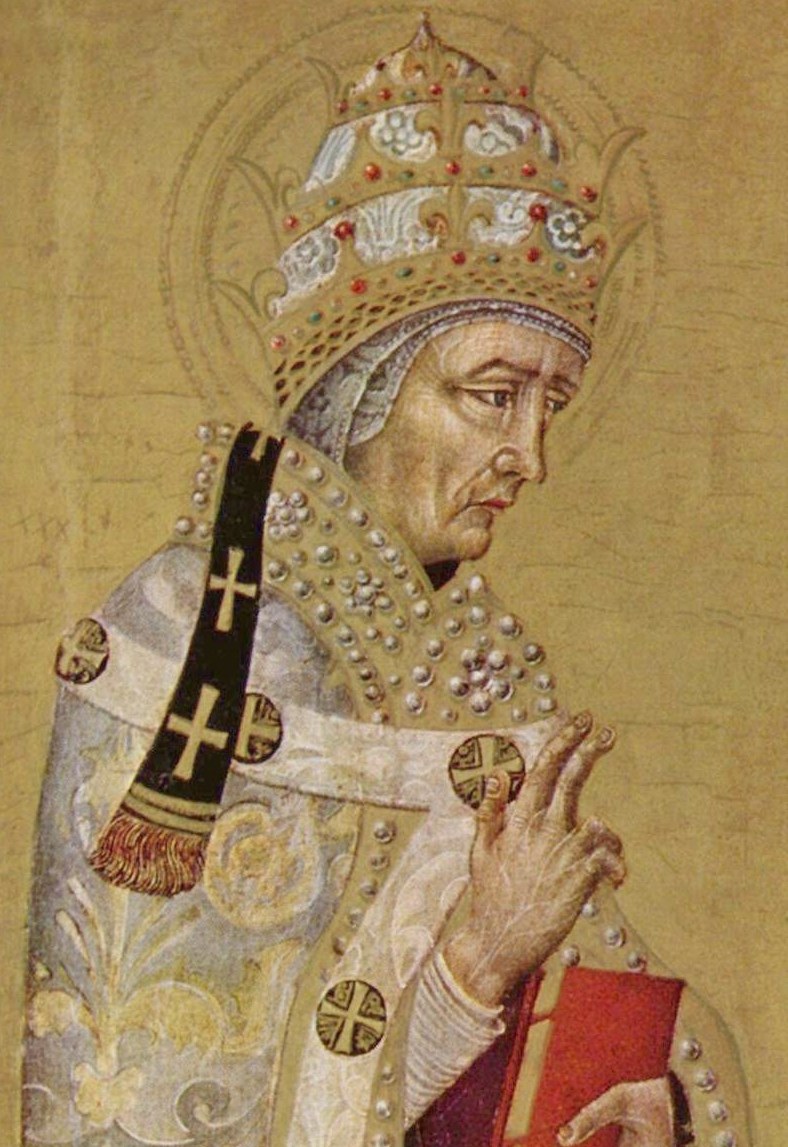
Fabian is shown as a bishop of the early Church — in the phelonion and omophorion, blessing and holding the Gospel, of middle age, the beard short and dark or greying. Two attributes distinguish him where they are used: the dove above or beside his head, for his election, and the sword of his martyrdom. Western art of the late Middle Ages pairs him almost invariably with Sebastian, whose feast he shares on January 20 in the Roman calendar, and gives him the tiara and the triple cross, which have no place in an Orthodox image of a third-century bishop. In the East he is a plain hierarch-martyr, and appears chiefly in menologion sequences for August 5, generally beside Anterus.
No pre-1900 image securely identified as Fabian has been located for this reference. The Commons search under his name and under the Greek form returns anonymous "holy pope" frescoes, the Perugino panel whose identification is disputed, and photographs of his catacomb grave-slab — which is an inscription and not a depiction, and in any case a three-dimensional object photographed in situ.
The stored image is a Western work per §34: a mid-15th-century Italian panel of the pope-martyr in the jewelled tiara, catalogued as Saint Fabian — the identification is the museum's, no inscription being in frame. An Eastern image remains wanted and is listed among the upgrade-wanted icons.
Disputed questions
- The manner of his death. Beheading is the later tradition; the contemporary evidence (Cyprian, the Roman clergy's letter, his epitaph) establishes only that he died on 20 January 250 as a martyr under Decius.
- The baptism of Philip the Arab. See above: transmitted in the Eastern synaxarion and reflected in Eusebius's report of a Christian Philip, but not corroborated, and rejected by most modern historians.
- The date of his feast. The West keeps him on 20 January, the day of his death, together with Sebastian. The East keeps him on 5 August with Anterus and Pontius. The Greek books sometimes give his name as Φάβιος, Fabius.
- The dove. Eusebius reports it as the account current in the Roman church; it is a hagiographic sign, and the historical residue of it is that Fabian's election was unexpected and by popular acclamation.