
Anthony the Roman of Novgorod
Our Venerable Father Anthony the Roman, Founder and Abbot of the Monastery of the Nativity of the Most Holy Theotokos at Novgorod, Wonderworker
Venerable · Wonderworker · b. c. 1067, at Rome — d. 3 August 1147, at his monastery on the Volkhov at Novgorod
Commemorated 17 January — Name-day commemoration with his patron Anthony the Great, 3 August — Repose at the Monastery of the Nativity of the Theotokos, Novgorod
Anthony (c. 1067 – 3 August 1147) is the saint who came to Novgorod on a stone. The Life has him born at Rome of Orthodox parents, orphaned at seventeen, giving away his inheritance and sealing the rest in a barrel which he threw into the sea; driven from his monastery by the Latin persecution, he stood praying for a year on a rock at the sea's edge until a storm tore the rock away and carried him — over the Mediterranean, round Europe, up the Neva, across Ladoga and up the Volkhov — to the bank above Novgorod on the eve of the Nativity of the Theotokos, 1106. There he founded the monastery of the Nativity, and there the fishermen's net brought up his barrel, whose contents he described before the judges and with which he bought the monastery its land. He built the stone church that still stands, was made abbot in 1131 by St Niphon, and reposed on 3 August 1147. The chronicles confirm the monastery, the church, the abbacy and the death; the Roman origin and the voyage on the stone appear only four centuries later, and the entry records both the tradition and the problem.

Rome, and the barrel in the sea
The Life opens at Rome about 1067, in a wealthy household that had kept the Orthodox faith after the separation of the Churches. Anthony's parents died when he was seventeen or eighteen. He learned Greek, read the Fathers and the canons — the Life is insistent on his learning — and disposed of what he had inherited in two portions: one he gave away to the poor; the other, gold and silver and vessels of the church, he sealed into a wooden barrel and cast into the sea, wanting neither to keep it nor to leave it to be taken. Then he was tonsured, and spent, by the account, twenty years in a monastery in the wilderness.
The persecution of the Orthodox in the West broke that life up: the monastery was scattered and the brethren went into hiding. Anthony went out to the shore and took his stand on a great rock at the sea's edge, where he lived a year in prayer and fasting.
The stone
On 5 September 1105, the Life says, a violent storm came up, tore the rock from the shore with the saint upon it, and carried it out to sea. It did not sink. For a year — the chronology of the narrative is deliberately impossible, and its authors knew it — the stone travelled: out of the Mediterranean, round the coasts of Europe, into the Gulf of Finland, up the Neva, over Lake Ladoga, up the Volkhov, and finally, after three days on the river, to rest against the eastern bank two versts above Novgorod, on the eve of the Nativity of the Most Holy Theotokos, September 1106.
The tradition is not embarrassed by the physics. A stone that floats is a sign of the same order as an axe-head that swims, and the point of it in the narrative is that the founder of the house arrived by no human agency and owed the land nothing. Anthony understood nothing of the speech around him and had at first to use interpreters; he prayed, the Life says, and received the Russian tongue.
Novgorod: the monastery and the barrel
Anthony was brought to Nikita, bishop of Novgorod (†1108) — himself a saint of the Russian calendar, the former recluse of the Kiev Caves — who heard his account, blessed him, and gave him the ground where the stone had come ashore. There Anthony founded the monastery of the Nativity of the Most Holy Theotokos, the house known ever since as the Antoniev monastery.
The most characteristic episode of the Life follows. Fishermen working the Volkhov drew up in their net, with the fish, a sealed barrel. They claimed it; Anthony claimed it; the matter went before the city's judges. He was required to say what was in it before it was opened, and he named the gold, the silver and the church vessels, item by item, as he had sealed them at Rome twenty years before and half a world away. The barrel was opened and he was given it, and with that money he bought the land for the monastery from the sons of a Novgorod boyar — a purchase for which a deed was long preserved in the house.
The building, the abbacy, the repose
The chronicles of Novgorod, which know nothing of Rome or of the stone, know the buildings precisely. In 1117 Anthony laid the foundation of a stone church of the Nativity of the Theotokos; it was finished in 1119, and in 1125 its walls were painted in fresco. The work is associated with the master Peter, one of the very few named architects of early Rus. The church stands to this day at the north edge of Novgorod, one of the oldest buildings in Russia, and the stone on which the saint is said to have come is kept in it, by the west door.
Anthony gave the house its rule and its temper: strict poverty within, and outside a continual charity to the needy, orphans and widows, which the Life singles out as his particular work. In 1131 Bishop — afterwards Saint — Niphon of Novgorod, against the saint's own wish, made him abbot. He governed sixteen years, and before his death named as his successor the monk Andrew, his disciple, to whom the Life is attributed. He reposed on 3 August 1147 and was buried by Niphon in his own church.
Relics, glorification, and the modern loss
Anthony's relics were uncovered in 1597 and he was glorified in the same year; they were placed in the cathedral of the Nativity in the monastery he founded. On 1 June 1860 Bishop Euthymius translated them into a new silver shrine made by F. A. Verkhovtsev.
In 1927, in the Soviet campaign against relics, the shrine was opened and the remains were carried off to an anti-religious museum, after which they were counted lost. In 2016 the anthropologist Denis Pezhemsky, after some twenty years of work on the unidentified osteological material held at the cathedral of the Holy Wisdom in Novgorod, identified the remains of the saint among them, and they were returned to the Novgorod metropolia. It is a strange coda to a life whose first miracle was a journey by water and whose last was a journey through a museum store-room.
Miracles and traditions
The healings recorded at the shrine are of the ordinary sort of a Russian wonderworking tomb, and the Life attaches to Anthony two enduring popular associations: he is invoked by those who travel by water, for obvious reasons; and the stone itself became an object of veneration, with pilgrims touching it as they entered the church. The two documents preserved in the monastery — his spiritual testament (dukhovnaya gramota) and the deed of purchase for the land — were read as his own words and are among the oldest private documents claimed for Rus.
Feast and commemoration
August 3 (church date; New Calendar civil August 3, Old Calendar civil August 16) is the day of his repose and his principal feast, kept in the Russian Church, in the Orthodox Church in America, and in the Greek synaxaria, which style him Ὁ Ὅσιος Ἀντώνιος ὁ Θαυματουργός Ρωμαῖος ἐκ Νοβογορδίας. He is also commemorated on January 17 with his patron Anthony the Great, and among the Saints of Novgorod.
The uncovering of his relics in 1597 is kept on the first Friday after the feast of the holy Apostles Peter and Paul (June 29) — a commemoration whose civil date moves from year to year with the day of the week, and which therefore belongs to the rule-based commemorations rather than to a fixed calendar day; it is not listed under August 3.
August 3 falls within the Dormition fast (August 1–14), and the feast does not lift it.
Hymns
Apolytikion — Tone 8
With the streams of thy tears thou didst make the barren desert to bring forth, and with sighs from the depths thou didst render thy labours fruitful a hundredfold; thou becamest a beacon shining upon the world by miracles, O Anthony our father: intercede with Christ God that our souls may be saved.
Kontakion — Tone 8
Thou didst leave the city of the Romans and the inheritance of thy fathers, and the sea bore thee upon a stone as upon a ship, to the river of the Novgorodians; and where the stone came to land thou didst raise a house to the Mother of God. Wherefore, O father Anthony, do thou guide us also over the waves of this life to a quiet harbour.
Original translation from the Slavonic
Iconography
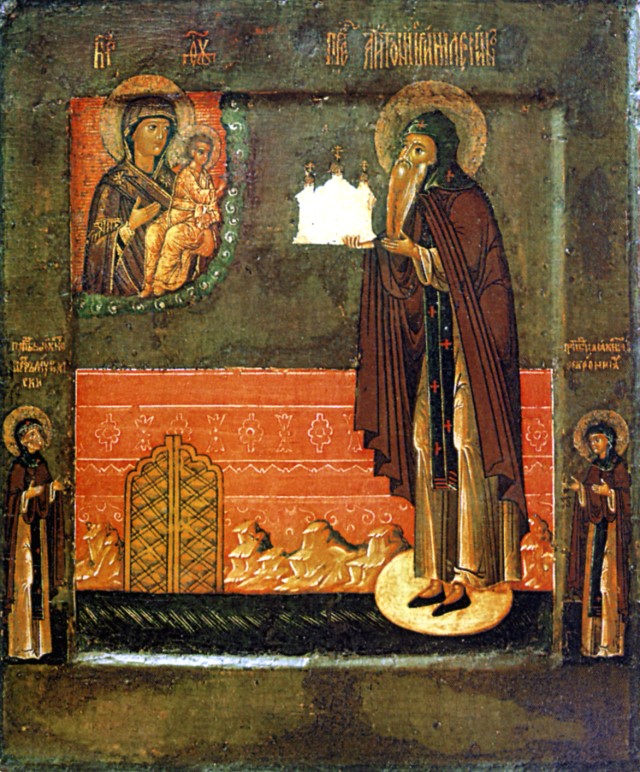
Anthony is painted as a monastic of middle or great age, brown- or grey-bearded, in the dark mantle and the cowl of the schema, and he is one of the small class of Russian saints identified at sight by a held object: he carries in his hands a model of his monastery church, the white five-domed Nativity cathedral, offering it to the Theotokos. Above and to one side is set the icon of the Mother of God to whom he offers it — commonly the Hodegetria — in a cloud or medallion. Where the full type is given, the saint is shown standing on the stone, a pale slab beneath his feet, and behind him the wall and gate of the monastery; narrative border-scenes of the Life give the barrel drawn up in the fishermen's net, the judgement before the Novgorod court, and the arrival on the Volkhov. He is also included among the crowded ranks of the Saints of Novgorod.
The stored image is a seventeenth-century Russian panel icon (Ikonen-Museum, Recklinghausen) of exactly this type: the saint stands full-length in dark cowl and mantle on a gold-hatched slab, holding out a white church with three cupolas; the Hodegetria appears in a green-rimmed cloud at the upper left; the monastery wall with its gate fills the ground behind him; and the inscription along the top reads ПРПБ АНТОНИИ РИМЛѦНИН — "the Venerable Anthony the Roman." Two small standing saints, separately inscribed, flank the panel in the margins, as often on a family icon.
Disputed questions
- Was he Roman? This is the whole question. The Novgorod chronicles, which are contemporary or nearly so, record the building of the church in 1117–1119, the frescoes of 1125, Anthony's appointment as abbot in 1131 and his death in 1147 — and say nothing whatever about Rome, about the persecution, or about the stone. The epithet "Rimlyanin" and the whole Roman narrative are not attested before the middle of the sixteenth century, when the Life was compiled — the surviving text is generally assigned to the monk Nifont of the monastery, writing under the guise of the disciple Andrew. Modern scholarship therefore treats the voyage as a late legend, and dates its formation to the period after Novgorod's loss of independence to Moscow, when the city had a strong motive for claiming a founder who brought sanctity, wealth and legitimacy from Rome itself rather than from Moscow or Kiev. It is further pointed out that in twelfth-century usage Rimlyanin need not mean "of the city of Rome": it could designate a man from the lands of the Holy Roman Empire, from the Germanic or Baltic trading world with which Novgorod dealt constantly, or simply a Latin-rite Westerner. That a Western monk came to Novgorod and founded a house is entirely plausible; that he came from Rome on a rock is a hagiographic construction. The repository records the tradition in full and the criticism with it.
- The documents. The testament and the deed of purchase survive only in sixteenth-century copies. Some historians — including scholars of the Novgorod archaeological school — have argued that genuine twelfth-century texts underlie them; others hold them to be compositions of the same sixteenth-century campaign that produced the Life, made to secure the monastery's estates. The question is open.
- The dates of the voyage. The Life has the stone torn away on 5 September 1105 and arriving at Novgorod on the eve of 8 September 1106 — a year and three days at sea. Some redactions compress this to the three days on the Volkhov alone. The internal chronology of the Life is in any case not reconcilable with itself.
- Not to be confused with Anthony the Great (January 17), his patron; nor with Anthony of the Kiev Caves (July 10), the father of Russian monasticism; nor with Anthony of Dymsk (June 24), another Novgorod ascetic of the following century.