
Antony of the Kiev Caves
Our Venerable and God-bearing Father Antony of the Kiev Caves, First Founder of Monasticism in the Land of Rus'
Venerable · b. 983, at Liubech near Chernigov — d. 1073, at the Kiev Caves
Commemorated 10 July — Repose at the caves above the Dnieper, 1073, 2 September — Joint commemoration with Theodosius of the Kiev Caves, 28 September — Synaxis of the Venerable Fathers of the Kiev Caves who rest in the Near Caves, Second Sunday of Great Lent — Synaxis of all the Venerable Fathers of the Kiev Caves
Antony of the Kiev Caves (983–1073) is the father of monasticism in the land of Rus'. Born at Liubech near Chernigov and baptised Antipas, he went as a young man to Mount Athos, was tonsured there, and was sent back by his abbot with the word that he should carry the Holy Mountain's way of life to his own people. Settling in a cave dug in the wooded hill above the Dnieper at Berestovo, he lived on bread and water and drew disciples he had not sought; from that hole in the earth grew the Monastery of the Caves, the mother-house of Russian and Ukrainian monasticism, whose second founder and organiser was his disciple Theodosius. Antony himself never governed it: he appointed abbots and withdrew again into seclusion, and to the end preferred the cave to the church he had caused to be built. He reposed in 1073, and by a providence the tradition has never tried to explain away, his relics have never been uncovered.
.jpg)
Origins and early life
Antony was born in 983 at Liubech, a town on the Dnieper in the principality of Chernigov, and received in baptism the name Antipas. The sources say almost nothing of his family or his childhood beyond the note that the fear of God was in him from his youth and that he desired the monastic habit while still young. He belonged to the second generation after the baptism of Rus' under Vladimir in 988: a Church existed, with bishops, clergy and princely foundations, but there was as yet no native monasticism worth the name — the few communities attached to city churches were, in the judgement of the chronicler, houses set up by princes rather than by tears and labour.
Mount Athos
Antipas left Rus' and travelled south to Mount Athos. There he was received, tonsured with the name Antony, and formed in the Athonite discipline. The Kievan Caves Paterikon names the monastery only vaguely; the later tradition — accepted at Esphigmenou, where a cave on the shore is shown as his — identifies it with that house, and the Paterikon has him tonsured by an abbot commonly given as Theoktistos. Whatever the house, the decisive fact is the one on which all the sources agree: Antony learned to be a monk on the Holy Mountain, and what he brought back to the Dnieper was Athonite, not improvised.
When he was formed, his abbot sent him home. The words are given in the Paterikon in substance thus: go back to Rus', and let the blessing of the Holy Mountain be upon you, for from you many shall become monks. It is the hinge of the whole story. Russian monasticism does not begin with an institution founded by a prince, but with one man carrying a tradition across two thousand miles and putting it into a hole in the ground.
The cave above the Dnieper
Antony came to Kiev, looked over the monasteries then existing, and was not satisfied by any of them. He went out to the wooded hills above the river near the princely village of Berestovo, and found there a small cave that had been dug by the priest Hilarion, who used to withdraw to it for prayer — the same Hilarion whom Yaroslav the Wise raised to the metropolitan throne of Kiev in 1051, the first native-born metropolitan and the author of the Sermon on Law and Grace. The cave being empty, Antony took it, and there began the life that the Paterikon describes with a kind of awe: dry bread and water, and that not daily but every other day, and sometimes a whole week without food; digging; psalmody; and no rest by day or night.
He was found out, as such men are. Word of him spread through Kiev; people came for his blessing and his prayers; the prince Izyaslav Yaroslavich himself came with his retinue. And men came to stay. The first of note was Nikon, already a priest, who became Antony's right hand and, being in orders, could tonsure those whom Antony received. Through Nikon's hand Antony clothed Theodosius, a young man of Kursk, in about 1032 — the disciple who would give the community its rule and its shape — and Barlaam, son of the boyar Ioann, and Ephraim, a eunuch of the prince's household, whose tonsures brought the anger of Izyaslav down on the brotherhood for a time.
The founding of the monastery
When the brethren numbered twelve, they dug out a larger cave, with a church and cells within the earth. Antony then did the thing that most defines him: he handed the community over. He set Barlaam at their head as abbot and withdrew to dig himself a fresh cave in a neighbouring hill — the origin of the distinction, still kept at the Lavra, between the Near (Antoniev) Caves and the Far (Feodosiev) Caves. When Barlaam was taken away by the prince to head the new monastery of St Demetrius in the city, the brethren came again to Antony, and with his blessing chose Theodosius, meek and unsparing of himself, who governed the house until his death in 1074 and under whom the brotherhood grew to something near a hundred and received the cenobitic rule of the Studion.
The community had outgrown the earth. Antony sent to Izyaslav to ask for the hill above the caves; the prince gave it, and a wooden church and cells were raised on the surface, and the place was walled. From the caves the monastery took, and keeps, its name.
The building of the Great Church
The most celebrated tradition of Antony's later years concerns the Great Church of the Dormition, the stone cathedral of the monastery. The Paterikon relates that four Greek master-builders of Constantinople were summoned to the Blachernae church by two elders who gave them gold for three years' work and sent them to Kiev to build a church to the Mother of God; that the Queen of Heaven herself appeared and promised to come and dwell in it; and that when the masters reached Kiev and were brought to Antony and Theodosius they recognised them at once as the two elders who had hired them — though neither had left the monastery. The tradition is joined to a second: that the Varangian Shimon (Simon), delivered from death in battle by the prayers of Antony, gave to the monastery the golden belt and crown from a crucifix of his father's house, and that the belt served as the measure by which the church was laid out. The foundation was laid in 1073, in Antony's last year; the church was finished under his successors and consecrated in 1089, and the relics of Theodosius were translated into it in 1091.
Prophecy, exile and return
Antony was held to have the gift of foresight, and it cost him. In 1068, before the battle on the river Alta against the Polovtsy, he foretold to the princes of Yaroslav's house that they would be defeated — as they were. When Izyaslav returned to Kiev in 1069 after the brief usurpation of Vseslav of Polotsk, the elder fell under the prince's suspicion of having favoured Vseslav. Svyatoslav Yaroslavich, prince of Chernigov, had Antony brought away by night to his own city for safety. There Antony did what he always did: he found a hill — the Boldin Hills above the Desna — and dug a cave, and out of that cave grew the Yeletsky Dormition monastery of Chernigov. Reconciled with Izyaslav, he returned to Kiev and to his own cave.
Repose and the hidden relics
Antony reposed in 1073, at the age of about ninety, and was buried in the cave in which he had lived, in the Near Caves that bear his name. What follows is peculiar to him among the fathers of the Caves. The relics of nearly all his disciples lie open and venerated in the two cave systems; Antony's have never been uncovered. The tradition of the Lavra holds that this was his own asking and God's granting of it, and that the attempts made to dig for them were stopped — by fire bursting out upon the diggers in one telling, by water rising in another. The monastery has been content to leave him where he put himself. It is a fitting end for a man who twice gave away a community he had founded in order to get back underground.
Veneration
The Church of Rus' called him from early on the first founder (nachal'nik) of monastic life in the Russian land, and the Caves monastery — the Kiev Caves Lavra — became the model and the seed-bed of Russian monasticism: the Paterikon counts the bishops it gave to the sees of Rus' by the dozen. His name stands with that of Theodosius in nearly every Russian and Ukrainian office where the fathers of the Caves are invoked, and the pair are commemorated jointly on September 2 as well as on their own days.
Feast and commemoration
July 10 (church date; Old Calendar civil July 23) is his principal feast, kept in the Russian, Ukrainian and Greek calendars and by the OCA, which styles him "of the Kiev Far Caves" although his relics lie in the Near Caves that bear his name. He is commemorated again on September 2 together with Theodosius, and on September 28 in the Synaxis of the Venerable Fathers of the Kiev Caves who rest in the Near Caves. He is further numbered in two movable synaxes: the Synaxis of all the Venerable Fathers of the Kiev Caves on the Second Sunday of Great Lent, and the Athonite synaxes that claim him as one of the Holy Mountain's own. He is not commemorated in the Antiochian calendar, which does not carry the Slavic local fathers; this entry follows the Russian and Ukrainian usage in which he belongs.
Hymns
Troparion — Tone 4
Having gone forth from the tumult of the world, and having followed Christ after the manner of the Gospel by the renunciation of all things, thou didst live a life like the angels' and didst come to the quiet haven of the Holy Mountain of Athos; and thence, with the blessing of the fathers, thou camest to the hill of Kiev, and finishing thy course there in labour, thou didst enlighten thy fatherland, and having shown to a multitude of monastics the path that leads to the Kingdom of heaven, thou didst bring them to Christ. Him do thou entreat, O venerable Antony, that He may save our souls.
Original translation from the Slavonic
Kontakion — Tone 8
Having offered thyself to God, whom thou didst love above all from thy youth, O venerable one, thou didst choose to follow Him with thy whole soul before all things else, and counting the beauties of the world as nothing, thou didst make thee a cave in the earth, and struggling well therein against the devices of the unseen enemies, thou didst shine upon all the land of Rus' like the sun in its splendour. Wherefore, standing now with boldness before Christ God, pray for thy flock, O father, and for all who come to thee, that we may cry to thee: Rejoice, O Antony our father.
Original translation from the Slavonic
Appointed readings
Epistle — Galatians 5:22–6:2
22But the fruit of the Spirit is love, joy, peace, longsuffering, gentleness, goodness, faith, 23Meekness, temperance: against such there is no law. 24And they that are Christ’s have crucified the flesh with the affections and lusts. 25If we live in the Spirit, let us also walk in the Spirit. 26Let us not be desirous of vain glory, provoking one another, envying one another. 1Brethren, if a man be overtaken in a fault, ye which are spiritual, restore such an one in the spirit of meekness; considering thyself, lest thou also be tempted. 2Bear ye one another’s burdens, and so fulfil the law of Christ.
Gospel — Matthew 4:25–5:12
25And there followed him great multitudes of people from Galilee, and from Decapolis, and from Jerusalem, and from Judaea, and from beyond Jordan. 1And seeing the multitudes, he went up into a mountain: and when he was set, his disciples came unto him: 2And he opened his mouth, and taught them, saying, 3Blessed are the poor in spirit: for theirs is the kingdom of heaven. 4Blessed are they that mourn: for they shall be comforted. 5Blessed are the meek: for they shall inherit the earth. 6Blessed are they which do hunger and thirst after righteousness: for they shall be filled. 7Blessed are the merciful: for they shall obtain mercy. 8Blessed are the pure in heart: for they shall see God. 9Blessed are the peacemakers: for they shall be called the children of God. 10Blessed are they which are persecuted for righteousness’ sake: for theirs is the kingdom of heaven. 11Blessed are ye, when men shall revile you, and persecute you, and shall say all manner of evil against you falsely, for my sake. 12Rejoice, and be exceeding glad: for great is your reward in heaven: for so persecuted they the prophets which were before you.
Iconography
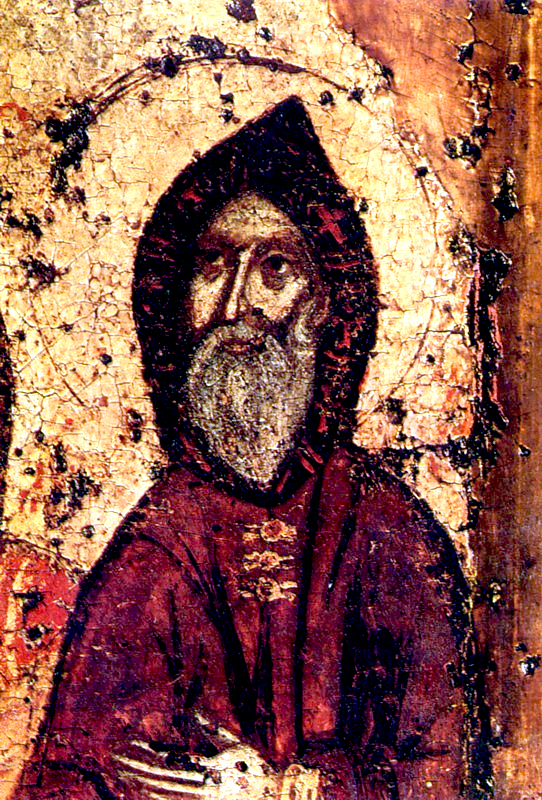
Antony is painted as an aged monk of the great schema: a long grey or white beard tapering to a point, the koukoulion drawn up over the head and marked with red crosses, the analavos over the dark habit, and in his hand a scroll. He is very rarely shown alone. The overwhelmingly common composition is the pair — Antony and Theodosius standing on either side of the Mother of God, bowed towards her in supplication, which is the type of the Svenskaya (Pecherskaya) icon; Antony is regularly the elder of the two, hooded in the schema, while Theodosius stands bare-headed with an open scroll. Behind or beneath them the wooded hill and the mouths of the caves, or the Lavra with its Great Church, may be drawn. Scenes from the life appear in the border of vita-icons and in the illustrated Paterikon: Antony digging his cave, the Athonite abbot sending him home, the appearance to the Greek masters at Blachernae, and the belt of Shimon measuring out the church. Because the relics were never uncovered, there is no reliquary iconography of the kind that grew up around the other fathers of the Caves.
The stored image is a detail of the Svenskaya (Pecherskaya) icon of the Mother of God, dated 1288 (Tretyakov Gallery), showing the figure of Antony: the elder in the cross-marked koukoulion of the great schema, white-bearded, in the dark red mantle. The inscription falls outside the crop, and the identification rests on the composition — in this icon type Antony is the hooded elder and Theodosius the bare-headed one — and on the source's own labelling.
Disputed questions
- The date of the repose. July 10 is the day the Church keeps, and the OCA states the repose itself as July 10, 1073. A strong Russian tradition, however, gives 7 May 1073 as the day of his death, understanding July 10 as the day of his commemoration rather than of his falling asleep — the Paterikon connects the July date with an appearance of the Mother of God foretelling his end. The corpus records the disagreement and keeps the feast where the calendars keep it.
- How many journeys to Athos? The Paterikon can be read as describing two journeys — an early one, a first return to Kiev in the troubled years after Vladimir's death, a second withdrawal to the Holy Mountain, and a final return under Yaroslav. Other readings, and the Primary Chronicle's notice under the year 1051, allow a single journey. The sources are not decisive.
- Which Athonite house? The identification with Esphigmenou is later than the earliest sources and rests on the monastery's own tradition and its cave; it is widely repeated and cannot be verified from the eleventh-century record.
- The birth date. 983 is the traditional year, giving him ninety years at his repose; it is a round figure derived from the age at death rather than from an independent record.