
Philemon, Archippus, Onesimus and Apphia
The Holy Apostles of the Seventy Philemon and Archippus, the Martyr Apphia Equal-to-the-Apostles, and Onesimus
Apostle of the Seventy · Apostle · Equal to the Apostles · Bishop · Martyr · d. c. 68
Commemorated 19 February — Archippus, Philemon and Apphia, 22 November — The apostles of the Colossian church
Philemon and his wife Apphia were a Christian couple of Colossae in Phrygia whose house became the church addressed in the Apostle Paul's shortest surviving letter, the Epistle to Philemon; Archippus, greeted in the same letter as Paul's "fellow soldier," is remembered as their son, and Onesimus is the runaway slave whose return the letter pleads for, later himself a bishop and martyr. Counted among the Seventy Apostles, Philemon and Archippus laboured for the Gospel throughout Phrygia — Philemon becoming, by the tradition, bishop of Gaza — and under Nero the three of Colossae received the crown of martyrdom, Archippus cut down with knives and Philemon and Apphia stoned. They are commemorated together on November 22 and again on February 19; Onesimus keeps his own principal feast on February 15.
.jpg)
The household at Colossae
Philemon (Greek Φιλήμων) was a man of substance in Colossae, a city of the Lycus valley in Phrygia, converted with his wife Apphia (Ἀπφία) through the preaching of the Apostle Paul. The New Testament preserves their memory in a single document of extraordinary intimacy: the Epistle to Philemon, addressed by Paul "to Philemon our dearly beloved and fellow labourer, and to our beloved Apphia, and to Archippus our fellow soldier, and to the church in thy house" (Philemon 1–2). That last phrase fixes the character of the household — like many of the earliest Christian communities, the Colossian believers gathered for prayer and the breaking of bread in Philemon's own house, which the tradition remembers as made over wholly to the service of the Church and to the care of the sick and the destitute.
Archippus, named third in the letter's greeting and charged in the sister Epistle to the Colossians to "take heed to the ministry which thou hast received in the Lord, that thou fulfil it" (Colossians 4:17), is held by the Byzantine tradition to have been the son of Philemon and Apphia. The commission laid on him — and Paul's soldierly epithet — mark him out as an active minister of the Colossian church, and he is numbered, with his father, among the Seventy Apostles sent out by Christ (Luke 10).
Onesimus, the runaway slave
The occasion of the Epistle to Philemon is Onesimus (Ὀνήσιμος, "useful"), Philemon's slave, who had run away — the tradition and most readers of the letter add, after some theft — and made his way to Paul, then a prisoner. Paul converted and baptized him, and sent him back to his master carrying the letter, in which the Apostle asks Philemon to receive the fugitive "not now as a servant, but above a servant, a brother beloved" (Philemon 16), playing tenderly on the slave's name: "which in time past was to thee unprofitable, but now profitable to thee and to me" (Philemon 11). The letter is the New Testament's most sustained meditation on the transformation of a worldly bond into a bond in Christ.
Onesimus went on to a long life in the Church. The tradition, supported by the mention of "Onesimus, a faithful and beloved brother" in Colossians 4:9 and by a notice in the letters of Ignatius of Antioch, makes him afterward bishop of Ephesus, and he ended his life a martyr under Trajan. Because his veneration is distinct and his repose falls later, Onesimus keeps his own principal commemoration on February 15, where his full life is authored; he is remembered with Philemon's company here and named in the day's kontakion.
Apostolic labours and the see of Gaza
Beyond the Scriptural record the synaxaria relate that Philemon and Archippus, with Apphia, gave themselves to the spread of the Gospel through Phrygia after Paul's departure. A widespread strand of the tradition, followed by the OCA, makes Philemon bishop of Gaza — a memory that sits awkwardly beside his firm attachment to Colossae and is best understood as recording a wider apostolic ministry rather than a settled Palestinian see. The whole Colossian household is presented as a single missionary enterprise: preaching, catechising, and maintaining the house-church that was the community's centre.
Martyrdom
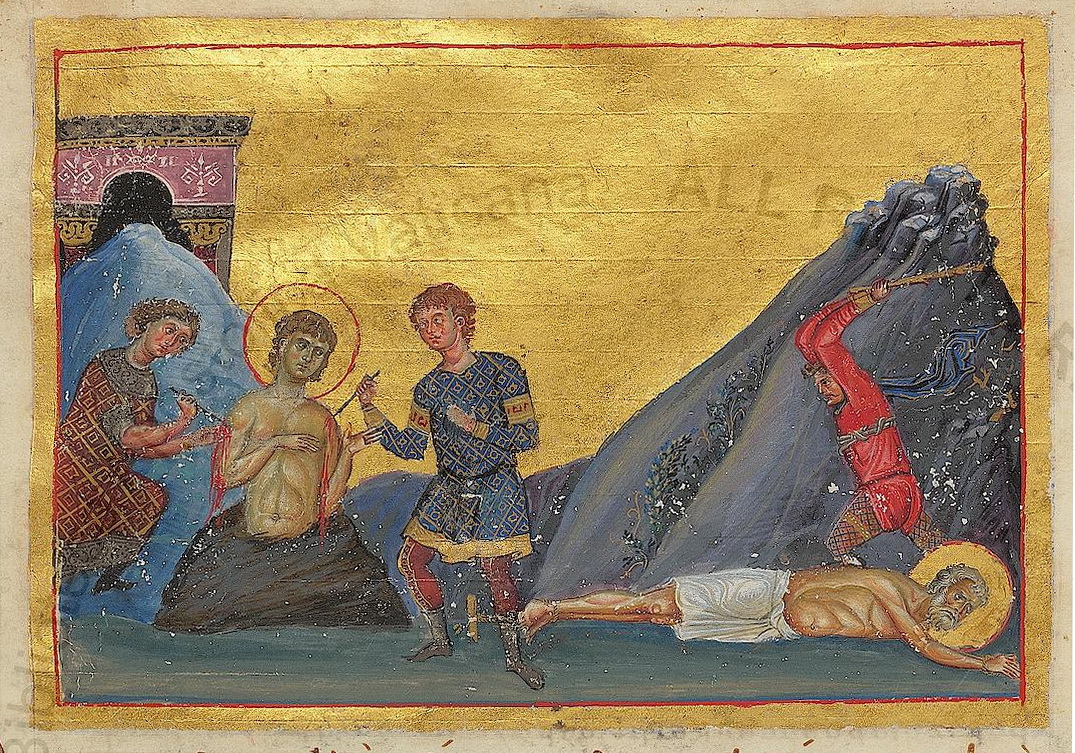
The martyrdom is placed under Nero (54–68). The account relates that during a pagan festival — the feast of Artemis in the Menaion tradition — an enraged crowd burst into the house-church while the Christians were at prayer. Most fled; Philemon, Archippus and Apphia stood their ground and were seized and dragged before the prefect of the city. Archippus was beaten and stabbed with knives by the mob and died of his wounds on the way to judgment; Philemon and Apphia were stoned to death by the prefect's sentence. The Byzantine hymnography for Archippus, however, sings of his own death by stoning ("thou didst receive the stoning as a precious adornment"), a small divergence from the prose synaxarion that is noted here rather than resolved.
Feast and commemoration
November 22 (church date; Old Calendar civil December 5), the principal commemoration of the Colossian company, falling within the afterfeast of the Entry of the Theotokos into the Temple and within the Nativity Fast. Archippus, Philemon and Apphia are commemorated again on February 19, which is kept as the apostle-feast of Archippus, led in the Greek Menaion by his name and furnished with proper hymns addressed to him; because those hymns have no home in this November company-entry, Archippus's February 19 feast is authored separately at Archippus of Colossae, which cross-links back to this household for the shared Life. Onesimus keeps February 15. The Greek and Slavic Menaia agree on the November date, on which the day's proper kontakion gathers the whole apostolic company — Philemon, Archippus, Onesimus, and with them Mark and Apollos and "Apphia the all-wise."
Hymns
Troparion — Tone 3
Holy Apostles, intercede with the merciful God, that he grant to our souls the forgiveness of offences.
Original translation from the Greek
Kontakion — Tone 2
As stars of many rays enlightening the ends of the earth, let us praise the apostles of Christ — Philemon the glorious and Archippus the sacred, Onesimus and Mark and Apollos, and with them Apphia the all-wise — crying out to them: Pray without ceasing for us all.
Original translation from the Greek
Iconography
The company has no fixed group type; the members appear singly or in pairs in apostle-rows and in synaxarion miniatures. Philemon and Apphia are painted together as an elder apostle and his wife; Archippus as a young apostle; Onesimus as a bishop. The stored image is the miniature for November 22 from the Menologion of Basil II (c. 985, Vatican Library, Vat. gr. 1613): it shows the martyrdom, one haloed apostle being stabbed with a knife at the left and a second lying dead at the right — the death of Archippus and Philemon as the synaxarion relates it. The file is catalogued on Wikimedia Commons under a description of the Miracle at Chonae (the September 6 commemoration of the other Archippus), an error of exactly the kind noted under Disputed questions; the image itself, depicting a knife-martyrdom and not the Archangel and the flood, is the apostles' miniature and is stored here on that identification.
Disputed questions
- Two Archippi — the apostle and the sacristan. The Archippus of this company (Colossians 4:17; Philemon 2), a first-century apostle of the Seventy martyred at Colossae, is not to be confused with Archippus of Herapolis, the fourth-century sacristan of the church of the Archangel Michael at Chonae near Colossae, commemorated September 6 with the Miracle at Chonae. The coincidence of name and place — both belong to the Colossian district — makes the confusion frequent, and it has crept even into image collections: the Menologion miniature stored with this entry is catalogued on Wikimedia Commons under a Chonae-miracle description, though the miniature plainly depicts a martyrdom (see Iconography).
- Onesimus commemorated twice. Onesimus of the epistle is the same saint commemorated on February 15 as Onesimus the Apostle, the bishop and martyr; there his full life is kept. He is included in this company as one named in the Epistle to Philemon and in the November 22 kontakion, not as a second person.
- Two Philemons — the apostle and the flute-player. The Philemon of this company, apostle of the Seventy and recipient of St Paul's Epistle, is not to be confused with Philemon the flute-player of Antinoöpolis, a martyr of the Diocletianic persecution (†c. 305) commemorated December 14 with Apollonius and Arrian.
- Philemon's see. The tradition of Philemon as bishop of Gaza is transmitted by the Slavic calendars and the OCA; it is difficult to reconcile with his Colossian household and is recorded here as received.
- Apphia's title. The Slavonic and OCA calendars style Apphia Equal-to-the-Apostles (равноапостольная) as well as martyr, honouring her share in the apostolic labour of the household; the term is carried in this entry's classification for her sake.