
Arethas and the Martyrs of Najran
The Holy Great-martyr Arethas and the Martyrs with him of Najran
Great Martyr · Martyr · b. c. 427 — d. 523
Commemorated 24 October — The massacre of the Christians of Najran under Dhu Nuwas
Arethas (al-Harith) and the martyrs of Najran suffered around the year 523 in the Christian city of Najran in Himyar (South Arabia), when the Jewish Himyarite king Yusuf, called Dhu Nuwas — Dunaan in the Greek and Slavonic service books — set out to destroy Christianity in his realm. After the city surrendered on a sworn promise of safety, the king broke his oath and demanded that its Christians renounce Christ. Arethas, the aged chief of Najran, was beheaded with the leading men, and the whole confessing community — the tradition numbers them 4,299 — perished by the sword and by fire, among them the noblewoman Syncletica (Ruhm) with her daughters. Their massacre, uniquely well documented for so early a martyrdom, resounded through the Christian world and moved the Ethiopian king Elesbaan to cross the sea and overthrow the persecutor.
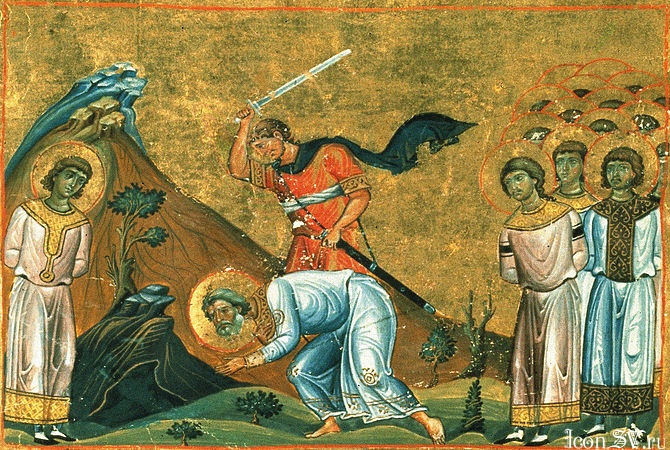
_and_over_4,000_with_him_(Menologion_of_Basil_II).jpg)
Christianity in Himyar and the city of Najran
By the opening of the sixth century the kingdom of Himyar — the southern highlands of Arabia, roughly the Yemen of today, with its capital at Zafar — stood at the meeting-point of the great powers and religions of late antiquity. Rome and Sassanid Persia contended for its trade; Judaism had struck deep root among its ruling class, and Christianity, carried by Syrian and Ethiopian missionaries and by the merchants of the Red Sea routes, had taken hold above all at Najran, an oasis city on the caravan road of the north (near the modern Saudi–Yemeni border). Najran had its church, its clergy, and its bishop, and its Christians were bound by faith and kinship to the Miaphysite churches of Syria and to the Christian kingdom of Aksum (Ethiopia) across the water. It was a confident and organised community, and it is this that made it the chosen target when the throne of Himyar passed to a zealous adversary of the Cross.
Dhu Nuwas and the war on the Christians
The Himyarite king of the sources — Yusuf As'ar Yath'ar in his own inscriptions, Masruq to the Syrians, Dhu Nuwas ("the man of the hanging sidelocks") in Arabic memory, and Dunaan in the Greek Passion and the Byzantine calendars — was a convert to Judaism who seized power amid the rivalry of Aksum and Persia for the region. Resenting the Christians as agents of the Ethiopians and of Rome, he opened his reign, according to the sources, by falling upon the Aksumite garrison and the Christians of Zafar, burning their church, and then turning against the strongest Christian centre of his kingdom, Najran. He laid siege to the city.
The fall of the city and the breaking of the oath
Unable to take Najran by storm, Dhu Nuwas offered terms, swearing — by the tradition, on the Torah and by oaths binding on a Jew — that if the city opened its gates no harm would come to its people. Trusting the royal word, the citizens admitted him; and the king at once broke his oath. He seized the notables, exhumed and burned the bones of the bishop Paul who had died before the siege, and set before the Christians the choice of apostasy or death. The community held firm. The men were assembled; a great trench or pit was dug and filled with fire, and those who would not deny Christ were cast into it or put to the sword — an atrocity that stamped itself so deep on Arabian memory that the Qur'an itself is widely read as alluding to it in the Sura of the Constellations (al-Buruj 85:4–8), "Slain were the Men of the Trench (Ashab al-Ukhdud)."
The martyrdom of Arethas
At the head of the martyrs stood Arethas — al-Harith ibn Ka'b, sayyid and chief of Najran, an old man of the tradition's reckoning some ninety-five years. Brought before the king with the leading citizens, he answered the demand to apostatise with an open confession of Christ and an exhortation to his people to stand fast, counting it the crown of a long life to die for the faith he had served. He was beheaded with the elders of the city; the number of those who perished with him in the whole persecution is given in the Greek and Slavonic tradition as 4,299, a figure the sources of the event render variously as some two thousand men with women and children besides.
Syncletica and the women of Najran
The Passion dwells especially on the courage of the women. A noblewoman of high family — Syncletica (Σιγκλητική) in the Greek Passion, Ruhm (Ruma) in the Syriac letters — widowed young and living in chastity and almsgiving, was dragged before the king, who hoped that so prominent a lady's fall would break the resolve of the rest. She reviled his apostasy to his face before the women of the city, refused every inducement, and, when her daughters were killed before her eyes — the sources relate the horror that their blood was poured into her mouth — went to her own death unbroken, giving thanks. Her defiance became, in the retelling, the emblem of the whole company: the martyrs of Najran are remembered not as a passive multitude but as a city that chose, household by household, to die confessing.
Vindication
News of the massacre travelled fast along the same trade routes that had carried the faith. A survivor's report and the letters of Syrian churchmen reached Constantinople; the emperor Justin I and the patriarch, and the Alexandrian church, pressed the Christian king of Aksum, Elesbaan (Kaleb Ella Asbeha), to act. Within a year or two — about 525 — Elesbaan crossed the Red Sea with an army, defeated and killed Dhu Nuwas, and re-established Christianity in Himyar, rebuilding the church of Najran over the relics of the martyrs. The Church keeps king and martyrs together on the same day.
Feast and commemoration
October 24 (church date; Old Calendar civil November 6). The commemoration is kept universally in the Byzantine rite and is the chief feast of the day, joined in the calendar to that of the righteous king Elesbaan who avenged the martyrs and, in the Greek and Slavonic synaxaria, to the separate memory of the martyr Syncletica and her daughters (see Sources and Disputed questions). The Roman Martyrology commemorates "the holy martyrs of Najran" on the same October 24. The Ethiopian and Syriac churches, to whose communion the martyrs belonged, keep their memory with particular honour on their own days.
Hymns
Troparion — Tone 1
Having shown yourselves valiant in Christ against the godless king, O holy martyrs, and having convicted his Jewish unbelief in Christ, ye endured the torment of tortures and the severing of your heads; therefore the angels praised you, and the generations of the faithful glorify thee, O Arethas, and those who suffered with thee, as ye ever pray for our souls.
Original translation from the Slavonic
Kontakion — Tone 4
The light-bearing feast of the passion-bearers hath dawned this day as the herald of our gladness; keeping which, let us glorify the Lord who dwelleth in the highest.
Original translation from the Slavonic
Magnification
We magnify you, O holy passion-bearers, Arethas and those who suffered with thee, and we honour your precious sufferings which ye endured for Christ.
Original translation from the Slavonic
Iconography
The martyrs are shown as a company: Arethas, an aged, white-bearded man in the dress of a nobleman or in a chlamys, at their head, and behind or beneath him the massed Christians of Najran, often depicted at the moment of beheading or being cast into the trench of fire, with the king Dhu Nuwas enthroned to one side. The stored image is the miniature for October 24 from the Menologion of Basil II (Constantinople, c. 1000): Arethas and the martyrs of Najran gathered before their executioners, the archetypal Byzantine image of the commemoration.
Disputed questions
- Confessional identity. The Christians of Najran belonged to the non-Chalcedonian (Miaphysite) communion of the Syrian and Ethiopian churches, and their earliest advocates — Simeon of Beth Arsham above all — were Miaphysite bishops. They are nonetheless venerated as martyrs by the whole Church, Chalcedonian and non-Chalcedonian alike; the Byzantine synaxaria received their memory without reserve, as a martyrdom for Christ against a persecutor of the Cross.
- Numbers and date. The received figure of 4,299 martyrs is the calendar's; the contemporary sources give varying counts (commonly about two thousand men, with the women and children additional). The massacre is dated 523 in most reckonings (some place it in 524); the Aksumite reprisal follows in about 525.
- Syncletica / Ruhm. The Greek Passion's Syncletica and the Syriac letters' Ruhm are the same noblewoman of Najran. The Greek and Slavonic calendars list "the martyr Syncletica and her two daughters" as a distinct entry on this same day; her story is treated here as part of the one martyrdom. This martyred Syncletica of Najran is not to be confused with Syncletica of Alexandria, the Desert Mother (†c. 350, kept January 5) — a different saint of a different age and country.