
Aristarchus of the Seventy
The Holy Apostle Aristarchus of the Seventy, Bishop of Apamea
Apostle of the Seventy · Apostle · Bishop · Martyr
Commemorated 4 January — Synaxis of the Seventy Apostles, 15 April — With the apostles Pudens and Trophimus, 27 September — With the apostles Mark and Zenas
Aristarchus of the Seventy was a Macedonian of Thessalonica and one of the most constant companions of the apostle Paul: seized by the Ephesus mob in the riot of the silversmiths, he accompanied Paul through Greece and to Jerusalem, sailed with him on the prisoner's voyage to Rome, and is greeted in the epistles as Paul's "fellow prisoner" and "fellow worker." The Byzantine tradition numbers him among the Seventy and makes him bishop of Apamea in Syria; the tradition of his April feast holds that he was beheaded at Rome under Nero, at the time of Paul's own martyrdom. He is commemorated on September 27 with the apostles Mark and Zenas, on April 15 with Pudens and Trophimus, and with all the Seventy on January 4.

Companion of Paul
Aristarchus was of Thessalonica in Macedonia (Acts 20:4; 27:2). He appears first in the riot at Ephesus, when the crowd stirred up by Demetrius the silversmith rushed into the theatre dragging with them "Gaius and Aristarchus, men of Macedonia, Paul's companions in travel" (Acts 19:29). He accompanied Paul on the return through Macedonia and Greece and toward Jerusalem (Acts 20:4), and when Paul was sent under guard to Rome, Aristarchus embarked with him on the ship of Adramyttium and shared the whole of the voyage and shipwreck (Acts 27:2). In the epistles of the Roman captivity Paul greets the churches from "Aristarchus my fellow prisoner" (Colossians 4:10) and names him among his fellow workers (Philemon 24) — the term συναιχμάλωτος suggesting that Aristarchus shared the apostle's bonds, whether by arrest or by voluntary companionship.
Bishop of Apamea
The Byzantine tradition counts Aristarchus among the Seventy sent out by the Lord (Luke 10:1) and records that he became bishop of Apamea, the great city on the Orontes in Syria Secunda. The tradition attached to his April commemoration, which joins him with the apostles Pudens and Trophimus, holds that all three were beheaded at Rome under Nero on the day the emperor put the apostle Paul to death — the constant companion following his teacher to the end. The September commemoration styles him simply apostle and bishop.
Feast and commemoration
September 27 (church date; Old Calendar civil October 10), jointly with the apostles Mark and Zenas of the Seventy, by synaxarion notice in the received Greek Menaion, whose sanctoral service belongs to the martyr Callistratus; the Russian calendar styles him "Aristarchus of Apamea." He is commemorated again on April 15 with the apostles Pudens and Trophimus, and with all the Seventy at their synaxis on January 4.
Hymns
Troparion — Tone 3
Holy Apostles, intercede with the merciful God, that he may grant our souls forgiveness of offences.
Original translation from the Greek
Iconography
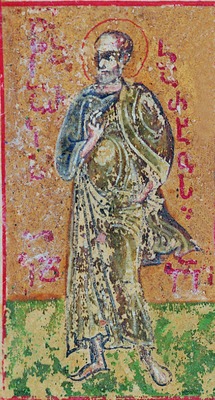
Aristarchus is painted as an apostle in tunic and himation, dark-bearded, with a scroll — in bishops' vestments in later Russian images, and among the Seventy in synaxis icons. The stored image is a fifteenth-century Georgian manuscript miniature of the apostle, a small full-length figure; a higher-resolution pre-modern image remains wanted.
Disputed questions
- Two commemorations, one man. September 27 (with Mark and Zenas) and April 15 (with Pudens and Trophimus) commemorate the same Aristarchus; the hymnography of neither day transmits a separate biography, and the martyrdom under Nero belongs to the April tradition. This corpus treats September 27, the day the fuller synaxarion notice, as his principal feast, with April 15 as the joint commemoration with his fellow martyrs.
- Which Mark is his companion? The Mark named with Aristarchus and Zenas on September 27 is, in the received calendars, the apostle Mark "also called John," bishop of Byblos, whom the synaxaria distinguish from Mark the Evangelist (April 25) and from Mark the cousin of Barnabas (October 30). Much modern scholarship identifies all three, in which case Aristarchus's September companion is the Evangelist himself — with whom, in Colossians 4:10, Aristarchus is in fact greeted in the same verse. The three-Marks question is set out in full in those three entries.
- Scriptural citation. The OCA's September Life cites "Acts 16:29" for his travels with Paul; the verse intended is Acts 19:29.