
Arsenius of Konevits
Our Venerable Father Arsenius, Abbot of Konevits, Wonderworker of Novgorod
Venerable · Wonderworker · b. Novgorod (date unknown) — d. 12 June 1447, at Konevets
Commemorated 12 June — Repose on Konevets island in Lake Ladoga
Arsenius of Konevits was a coppersmith of Novgorod who became a monk, spent three years on Mount Athos making copper vessels for the brethren, and came home in 1393 with an icon of the Mother of God — the Konevskaya, in which the Christ Child holds a fledgling dove. He settled alone on the island of Konevets in Lake Ladoga, a place still used by the Karelian fishermen for sacrifice at a great boulder called the Horse-Stone, and by his prayer the island was cleansed of that worship; and in 1398, with the blessing of the archbishop of Novgorod, he founded there the coenobitic monastery of the Nativity of the Theotokos, one of the northern outposts of Russian monasticism. Flood destroyed the first buildings in 1421 and he rebuilt higher on the island. He reposed on June 12, 1447, and is honoured as a wonderworker of the Novgorod land; his monastery's heritage passed in the twentieth century into the Orthodox Church of Finland, so that he is venerated on both sides of that border.

The coppersmith of Novgorod
Arsenius was born at Novgorod the Great — the year is not transmitted — and learned the trade of a coppersmith, which he never abandoned and which shapes the whole of his story. He was tonsured at the monastery of the Nativity of the Theotokos "on Lisya Gora" (the Lisitsy or Lisogorsk monastery) outside Novgorod, and lived there, the Life says, eleven years in obedience, working at his craft for the community.
Mount Athos
In 1373 he went to the Holy Mountain. He stayed three years, going from house to house and living by his hands: the account has him making copper vessels for the brethren of the monasteries, which is both a plain fact and, in the Life's telling, the reason he was so well received. He asked leave to remain and end his days there; but he was sent home instead, to plant on the northern lakes what he had learned on Athos. At his departure, the tradition says, the abbot John Zidon gave him an icon of the Mother of God to take with him. He returned to Novgorod in 1393.
Konevets and the Horse-Stone
Looking for a place of solitude, he came to Lake Ladoga and to the island of Konevets, near its western shore. He built a cell and lived there — the accounts say some five years — alone.
The island was not empty of religion. On it stands an enormous granite boulder, the Kon-kamen, the "Horse-Stone," under which, the local memory ran, an evil spirit dwelt; the Karelian fishermen and herdsmen who pastured beasts on the island sacrificed a horse there each year for the safety of their animals, and the island's name comes from the practice. Arsenius, coming upon it, prayed, blessed the rock, and — in the received account — the demons went out from it in the form of ravens or crows and fled across the water to the mainland bay still called the Bay of the Devil. A cross and afterwards a chapel were set on the stone, and they stand there still. Whatever one makes of the crows, the episode records something historically ordinary and important: the Christianisation of a Baltic-Finnic cult site by a Russian hermit at the end of the fourteenth century.
The monastery of the Nativity of the Theotokos
Brethren gathered, and in 1398 Arsenius went to Novgorod for a blessing. Archbishop John received him, blessed the foundation, and gave him goods for it; and Arsenius laid out on Konevets a coenobitic monastery under the patronage of the Nativity of the Most Holy Theotokos, with the icon he had brought from Athos as its treasure. He made a second journey to Athos to obtain the prayers and blessing of the Holy Mountain for the new community — an act which says plainly what he thought he was founding.
In 1421 Lake Ladoga rose and the flood destroyed the monastery's buildings. Arsenius moved the whole establishment to higher ground on the island, where it has stood since. He was absent in Novgorod when a famine struck the community and the brethren were on the point of dispersing; he returned with a shipload of provisions, and the Life counts this among his wonders.
Repose, relics and cultus
Arsenius reposed on June 12, 1447, and was buried in the monastery church, where his relics rest under the altar of the lower church. His Life was written in the sixteenth century by the Konevets abbot Barlaam, and was printed — with the service composed for him — in 1850, which is when his veneration became widely known outside the north. The Konevskaya (Golubitskaya) icon of the Mother of God, in which the Child holds two nestling doves or a fledgling dove, is his other memorial and has its own commemoration in the Russian books.
The monastery's later history carried his name abroad: Konevets fell within Finland after 1917, and when the brethren were evacuated in the Second World War they took the Konevskaya icon with them; the community was eventually absorbed into New Valamo, and churches in Finland — at Keitele and elsewhere — are dedicated to Pyhittäjä Arseni Konevitsalainen. The monastery on the island was restored from 1991.
Feast and commemoration
June 12 (church date; Old Calendar civil June 25), the day of his repose. His is a Russian commemoration — kept in the Moscow Patriarchate, in the Orthodox Church in America, and, as a founder-saint, in the Orthodox Church of Finland, which inherited his monastery's community and its icon. He is also named in the local synaxis of the saints of Novgorod. Because the Konevets monastery kept the Old Calendar, Finnish and Russian usage of the day has at times diverged in civil reckoning while agreeing on the church date.
Hymns
Troparion — Tone 8 (common of a venerable father)
In thee, O father Arsenius, was that which is according to the image kept surely; for taking up the cross thou didst follow after Christ, and by thy deeds thou didst teach us to despise the flesh, for it passeth away, but to have care for the soul, a thing immortal. Therefore doth thy spirit rejoice with the angels.
Original translation from the Slavonic
Iconography
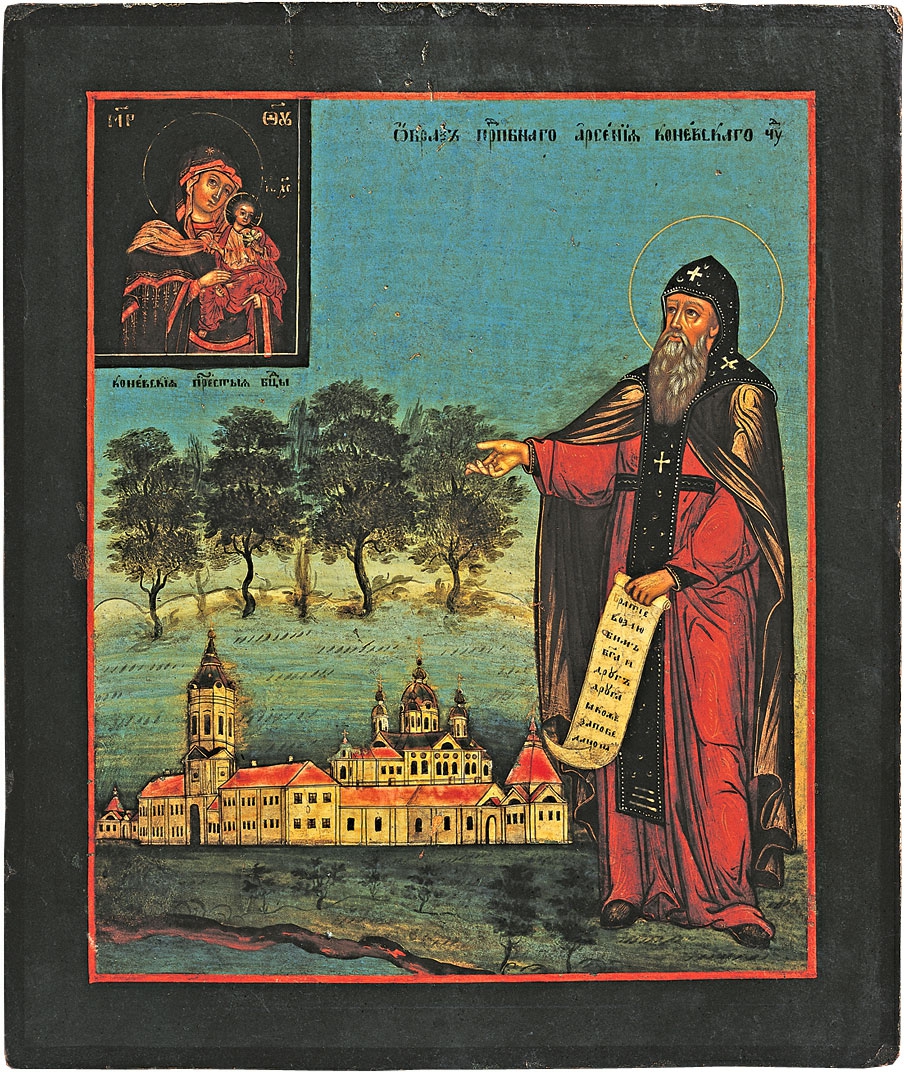
Arsenius is painted as an abbot and monastic founder: an elderly man with a long grey beard divided at the point, in the black mandyas and koukoulion of the schema with the schema-cross showing, one hand blessing or extended in prayer and the other holding an unrolled scroll with a word of counsel to his brethren. The two attributes that identify him are the Konevskaya icon of the Mother of God, set in the upper corner of the field with its own inscription, and the monastery on its island with Lake Ladoga behind it, painted in the lower part; the birches or firs of Konevets and sometimes the Horse-Stone appear as well. He is often shown pointing from the monastery up toward the icon — the whole programme of his life in one gesture.
The stored image is a nineteenth-century Russian icon from the collection of the State Russian Museum, inscribed Ѡбразъ прп[о]добнаго Арсенїя Коневскаго чу[дотворца] — "Image of the venerable Arsenius of Konevits, wonderworker": the saint stands at the right in the black mantle and schema, the Konevskaya icon (labelled Коневскїя Прес[вя]тыя Б[огороди]цы) in the upper left corner, and the buildings of the Konevets monastery on the shore of Ladoga below.
Disputed questions
- Chronology. The dates of the Life (tonsure and eleven years at Lisya Gora, Athos 1373–1376, return 1393, foundation 1398, flood 1421, repose 1447) come from a sixteenth-century composition and are not all independently documented; the seventeen-year gap between the return from Athos as sometimes reported and the foundation is variously filled. His year of birth is unknown, and calculations of his age at death are guesswork.
- The Athonite abbot's gift. The identification of the giver of the Konevskaya icon as the abbot John Zidon rests on the Life alone.
- Not to be confused with the other saints of his name: Arsenius the Great of Egypt (May 8), Arsenius of Tver (†1409), Arsenius of Corfu, Arsenios of Paros, and Arsenius the Lover of Labour of the Kiev Caves.