
Augustine of Canterbury
Our Father among the Saints Augustine, First Archbishop of Canterbury, Apostle of the English
Bishop · Venerable · Wonderworker · b. mid-6th century, in Italy — d. 26 May 604 (or 605), at Canterbury
Commemorated 26 May — Repose at Canterbury
Augustine (†26 May 604 or 605) was the Roman monk whom Gregory the Dialogist sent from the monastery of St Andrew on the Caelian Hill to preach Christ to the pagan English, and who became the first archbishop of Canterbury. Landing in Kent in 597 with some forty companions, he was received by King Æthelberht, whose Frankish queen Bertha was already a Christian, was given the old Roman church of St Martin outside Canterbury for his prayers, baptised the king and, within a year, great numbers of his people, and set the shape of the English Church: the cathedral of Christ Church at Canterbury, the abbey of Saints Peter and Paul outside the walls, and the sees of Rochester and London. His attempt at unity with the ancient British bishops failed over the Paschal reckoning and over his own bearing, and he did not live to see it mended. Wonders were worked through him in his lifetime — Gregory wrote to warn him not to be lifted up by them — and the English Church, which has never called him anything but its apostle, keeps his memory on the day of his repose.
_(cropped).jpg)
Origins and early life
Of Augustine before his mission almost nothing is known but his monastery. He was an Italian, born about the middle of the sixth century, and a monk of the community which Gregory — before his elevation to the Roman see — had founded in his own ancestral house on the Caelian Hill at Rome, under the patronage of the Apostle Andrew. There Augustine was prior (praepositus), the abbot's second, when Gregory chose him. That Gregory chose a man of his own house, and one whose temper he knew, is the single most important fact about the mission's beginnings: everything Augustine afterwards did in Britain he did in constant correspondence with Rome, and almost everything now known of him is known because Gregory's letters were kept and because Bede used them.
The sending of the mission
The tradition of Gregory's love for the English was already fixed in Bede's day: the pope, still a monk, had seen fair-haired boys for sale in the Roman market, learned that they were Angli, and answered that they were rightly named, having the faces of angels. As pope he acted on it. In 595–596 he wrote to his agents in Gaul to buy English slave-boys to be trained for the Church, and in the summer of 596 he sent out a band of some forty monks from St Andrew's under Augustine's charge.
The mission very nearly failed before it began. Somewhere in southern Gaul the monks lost heart — the reports they heard of the ferocity of the English, and their own ignorance of the language, appalled them — and they sent Augustine back to Rome to ask Gregory to release them from a journey "so perilous, so toilsome and so uncertain." Gregory refused, gently and immovably: he sent Augustine back with a letter (dated 23 July 596) exhorting them to finish what they had begun, telling them it were better never to have begun than to turn back, and appointing Augustine abbot over them so that obedience would carry them forward. He wrote also to the Frankish kings and bishops to speed them on their way, and the party took Frankish interpreters with them from Gaul.
The landing in Kent, 597
They came ashore in 597 on the Isle of Thanet, at the eastern edge of Kent — by tradition at Ebbsfleet near Richborough. Kent was the likeliest of the English kingdoms to receive them: its king, Æthelberht, held an overlordship among the southern English, and his queen, Bertha, daughter of the Frankish king Charibert of Paris, had been given him in marriage on condition that she keep her faith freely. She had brought with her a Frankish bishop, Liudhard, and they used for their worship a small church east of Canterbury built in Roman times and dedicated to St Martin of Tours — the building which still stands, and in which the Christian worship of the English begins.
Æthelberht would not meet the strangers under a roof, for fear of sorcery, but heard them in the open air on Thanet. Augustine and his monks came before him in procession, carrying a silver cross and a painted board of the Saviour, chanting the litanies. The king answered with the caution of a wise man and the courtesy of a generous one: their words and promises were fair, but new and uncertain; he could not abandon what he and his nation had long held; yet since they had come so far and plainly believed what they said to be good and true, he would do them no harm, would give them lodging in his royal city of Canterbury and their necessary provision, and would not forbid them to preach and to win whom they could.
They entered Canterbury in procession, chanting — Bede preserves the words of their petition, that God would turn away his anger from the city — and there they lived after the manner of the apostolic Church: constant in prayer, vigil and fasting, preaching to whoever would hear, accepting from those they taught only what was necessary for life, ready to suffer for the truth they proclaimed, and practising themselves everything they urged on others. Some believed and were baptised. The king, admiring both their lives and their promises, and moved by the signs God worked through them, was himself baptised — the day is not recorded, and the tradition that it fell at Pentecost, 2 June 597, is a later and reasonable guess — and from then the mission grew rapidly, though Æthelberht, having learned from his teachers that the service of Christ must be voluntary, compelled none. Gregory wrote in 598 to Eulogius of Alexandria that more than ten thousand of the English had been baptised at Christmas; the number is the mission's own report and may be generous, but the scale of the turning is not in doubt.
Archbishop of the English
Once the work was established, Augustine crossed again to Gaul and was consecrated bishop — Bede says by Aetherius, archbishop of Arles — as archbishop of the English, and returned to Canterbury. He recovered there an ancient church built by Roman Christians, restored and consecrated it in the name of the Saviour — Christ Church, the mother church of England and the seat of his successors ever since — and made himself a dwelling for his monks beside it. Outside the eastern walls, on land the king gave, he began the monastery of the Apostles Peter and Paul, to be the burial place of the archbishops and the kings of Kent; Peter, one of his own monks, was its first abbot. A school at Canterbury was founded to raise up native clergy, and Augustine's hand is generally seen in the earliest written laws of Æthelberht, the first laws set down in the English tongue, whose opening clauses protect the Church.
In 601 Gregory sent a second party — Mellitus, Justus, Paulinus and Rufinianus — with the pallium for Augustine, and with sacred vessels, altar cloths, vestments, relics and books, and a sheaf of letters that amount to a constitution for the new Church. Gregory laid out a plan of twelve bishops under the metropolitan of the English, with a second metropolitan at York who should in time have twelve of his own; the intended southern metropolis was London, and that Canterbury kept the primacy is the accident of Augustine's dying there.
To Augustine's list of questions Gregory replied in the document Bede transcribes, the Libellus responsionum. Its answers are the mind of the Gregorian mission: on how a bishop should live with his clergy and how the offerings should be divided; on the degrees of kindred within which the newly converted might marry; on the irregularities of conscience and of the body that do or do not bar a man from the Mysteries; and — most famously — on liturgical diversity, where Gregory tells Augustine not to import the Roman use for its own sake but to gather from the Roman, the Gallican or any other Church whatever is most pleasing to Almighty God, and to plant that in the young English Church. In the same year Gregory wrote to Mellitus the letter which more than any other shaped the Christianising of the English countryside: the temples of the idols were not to be destroyed but purified, sprinkled with holy water, furnished with altars and relics and turned into churches, and the people's customary festal slaughter of oxen transferred to the feasts of the martyrs, so that men who found the houses of their worship still standing should the more readily change what was done in them. Gregory wrote also to Augustine himself about the miracles God was working through him, warning him with great tenderness that the gift was given for the salvation of the people and not for his own glory, and that he should fear as he rejoiced.
Augustine consecrated two bishops for the growing Church in 604: Justus for Rochester, and Mellitus for the East Saxons at London, where Æthelberht built the church of St Paul.
The conferences with the British bishops
There were older Christians in Britain than the English: the British (Welsh) churches west of the Severn, which had survived the pagan conquest of the east and which kept an archaic Paschal reckoning and a different form of tonsure and of baptismal rite. Twice Augustine met their bishops and teachers, at a place long remembered as Augustine's Oak on the border of the Hwicce and the West Saxons. He asked of them three things: to keep Pascha at the catholic time, to complete the rite of baptism after the Roman manner, and to join him in preaching the Gospel to the English. They would not. At the first conference, after long and fruitless argument, Augustine proposed that the matter be left to God, and — Bede relates — a blind Englishman whom the British clergy prayed over without effect received his sight at Augustine's prayer; the Britons acknowledged the justice of his teaching but said they could not forsake their own customs without the consent of their people.
At the second conference seven British bishops came, with many learned men from the monastery of Bangor. Before setting out they had asked counsel of a hermit of great reputation, who told them that if Augustine were a man of God they should follow him, and that they might know it by his humility: let them come to the meeting late, and see whether he rose from his seat to greet them. Augustine remained seated; they judged him proud, and contradicted everything he said. He warned them that if they would not have peace with their brethren they would have war from their enemies, and if they would not preach the way of life to the English they would suffer death at English hands. Bede, writing well over a century later, saw the warning fulfilled in the slaughter of the monks of Bangor by the pagan Æthelfrith at the battle of Chester. Whether the fault lay in Augustine's Roman stiffness or in the Britons' unwillingness to evangelise the people who had dispossessed them has been argued ever since; the failure was real, and the Paschal question was not settled in Britain for another lifetime, until the Synod of Whitby (664) and the ordering of the English Church under Theodore of Tarsus.
Repose
Augustine consecrated Laurence, one of his original companions, as his successor while he still lived, so that the young Church should not be left leaderless for a day, and reposed on the seventh of the Kalends of June — 26 May — in the reign of Æthelberht; the year was 604 by the reckoning Bede's dates imply, though 605 is defensible and is preferred by some. He was buried at first by the wayside beside the still unfinished church of Saints Peter and Paul, and when that church was consecrated his body was translated into its northern porch. Bede transcribes the epitaph carved over him: that here rested Augustine, first archbishop of Canterbury, sent hither of old by the blessed Gregory, pontiff of the city of Rome, and upheld by God with the working of miracles, who brought King Æthelberht and his people from the worship of idols to the faith of Christ, and who, having fulfilled the days of his office in peace, died on the seventh of the Kalends of June, the same king reigning.
Relics and later cultus
The monastery of Saints Peter and Paul became St Augustine's Abbey, and its church, rebuilt after the Norman conquest, received the saint's relics in a great translation in 1091, when the tomb was opened and the body found and enshrined behind the high altar. The abbey and its shrine were destroyed in the Reformation and the relics dispersed; a new shrine was established at the church of St Augustine at Ramsgate in 2012. His cultus in England was universal from Bede's time; Canterbury kept the day of his death, the day of his translation, and the day of the mission's landing.
Feast and commemoration
May 26 (church date; Old Calendar civil June 8), the day of his repose, kept by the Orthodox Church in America, by the Orthodox of the British Isles (where the Russian churches abroad have kept the native saints of the islands since the mid-twentieth century), and by the Church of England. The Roman calendar observed 26 May until 1969 (and continues to do so in England and Wales, where he is kept as apostle of the nation); the general Roman calendar moved the feast to 27 May in 1969, and the older Roman books outside Britain had 28 May. Canterbury formerly kept also the translation of the relics (in the older English kalendars, 6 September) and the landing of the mission. In Orthodox usage his commemoration falls within the Pentecostarion, or in years of the earliest Pascha in the week after Pentecost, according to the date of Pascha in the given year.
Hymns
Troparion — Tone 4 (common of a hierarch)
The truth of things hath shown thee forth to thy flock as a rule of faith, an image of meekness and a teacher of temperance; therefore hast thou obtained the heights by humility, and riches by poverty. O Father and Hierarch Augustine, intercede with Christ God that our souls may be saved.
Original translation from the Greek
Kontakion — Tone 2 (common of a hierarch and teacher)
Thou didst carry the light of the Gospel to a people sitting in the shadow of death, and didst turn the idol-worshippers to Christ; wherefore the isle of Britain honoureth thee, O all-blessed Augustine, as the first shepherd of its faith, and crieth: cease not to intercede for us who praise thee.
Original translation from the Greek
Iconography
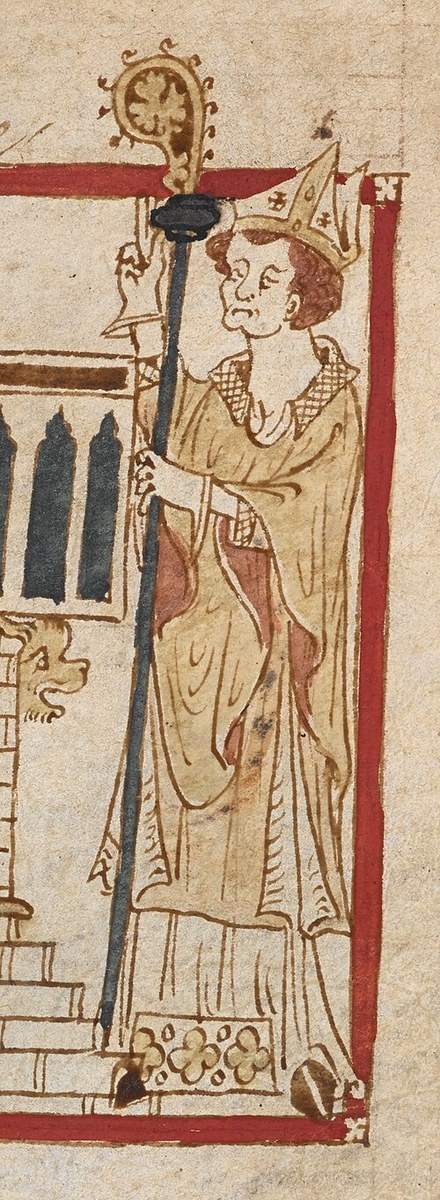
Augustine is painted in the West as a mitred archbishop with the crozier and the pallium, often with a book, and in scenes of the baptism of Æthelberht or of the mission's landing; the fourteenth- and fifteenth-century English glass and manuscripts give him this type without variation. Orthodox iconographers of the last century, painting the saints of the British Isles for the parishes there, have adapted him to the hierarch's type: the phelonion and the crossed omophorion, the right hand blessing and the Gospel-book in the left, and sometimes a model of Canterbury cathedral held in the hand after the manner of founder-icons, with the inscription "Apostle of the English." Those images are modern works of living or recently reposed painters, and none has been stored here; a Russian icon of the saint circulating on the internet as "public domain" is in fact a twentieth-century painting whose uploader had no right to license it, and it was rejected on that ground.
The stored image is therefore a medieval English one, and the earliest good representation available in the public domain: the figure of St Augustine from a miniature in Wace's Roman de Brut, an Anglo-Norman manuscript of about 1325–1350 (British Library MS Egerton 3028, f. 55r). He stands at the right of the scene in mitre and chasuble, both hands on the tall crook of his crozier, his face turned in address; the miniature as a whole — the second stored image below — shows the baptism of Æthelberht, the king standing in a great arcaded font raised on steps with a lion-headed spout, an attendant with a rod at the left, and the Anglo-Norman verses above naming Æthelberht of Kent, "seint Austin," and the regenerating font.
Disputed questions
- The year of the repose — 604 or 605. Bede gives the day (26 May) and ties it to Æthelberht's reign but is not decisive on the year; the chronology of the consecrations of Justus and Mellitus, and of Laurence's succession, has been read both ways. Both years are given in the literature; this entry keeps 604 and records 605.
- Where Augustine was consecrated, and by whom. Bede names Aetherius, archbishop of Arles; the archbishop of Arles in 597 was in fact Virgilius, and Aetherius was bishop of Lyons. Bede's slip is generally corrected in favour of Arles as the place and Virgilius as the consecrator, but the point is not certain.
- The authenticity of the Libellus responsionum. Doubted in the nineteenth century as a later English forgery, chiefly because of its answers on marriage within the degrees of kindred, it is now generally accepted as substantially Gregory's, transmitted independently of Bede in canonical collections. The scholarly discussion continues over particular clauses.
- The date of Æthelberht's baptism. Not recorded by Bede. Pentecost 597 (2 June) is a widely repeated conjecture; Christmas 597, when the mass baptisms occurred, is another possibility.
- The site of Augustine's Oak. Unidentified. Aust on the Severn, Down Ampney and other places have been proposed; nothing decides it.
- The Orthodox reception of a Roman saint. Augustine belongs wholly to the undivided Church: he was sent by a pope whom the East honours as one of its own great fathers and whose feast it keeps, and he died four and a half centuries before the schism. He is accordingly commemorated without difficulty in the Orthodox calendars of the British Isles and by the Orthodox Church in America. He does not appear in the Greek Menaion or in the classical synaxaria, which know few Western saints of the seventh century, and there is no ancient Byzantine service for him; his Orthodox propers are all modern compositions.
- Not to be confused with Augustine of Hippo, the great African father, son of St Monica and author of the Confessions (†430), with whom the name is far more commonly associated; nor with the later archbishops of Canterbury venerated as saints — Theodore of Tarsus (†690) among them.