
Auxentius of Bithynia
Our Venerable Father Auxentius of the Mountain in Bithynia
Venerable · b. late 4th / early 5th century, in Syria — d. c. 470, on the mountain near Chalcedon
Commemorated 14 February — Repose of Auxentius on the mountain in Bithynia
Auxentius (late fourth century – c. 470) was a Syrian-born ascetic who rose from the imperial guard of Constantinople to become one of the most celebrated hermits of his age. A soldier of the Scholarian guard at the court of the emperor Theodosius the Younger, honoured for his piety and his friendship with the holy men of the capital, he left the world for the monastic life and withdrew across the Bosphorus to a mountain near Chalcedon in Bithynia — the height that would afterwards bear his name — where he lived as a recluse in a cliffside cell. Sought out against his will by crowds who came for healing and counsel, he became a wonderworker and a spiritual father, guided communities of monks and nuns, and was summoned to bear witness to the Orthodox faith at the Fourth Ecumenical Council of Chalcedon (451). His disciple Vendemianus continued his life on the mountain for forty-two years after him. Auxentius reposed about the year 470 and is kept on February 14.
.jpeg)
From the imperial guard to the monastic life
Auxentius was a Syrian by birth, born toward the end of the fourth century, who came young to Constantinople and entered imperial service. He was enrolled in the Scholarians — the palace guard — under the emperor Theodosius II (408–450), and won a name at court not for arms but for holiness: the tradition remembers him as a man of prayer and continence amid the luxury of the palace, learned in the Scriptures, and bound in friendship to the devout and to the monks and clergy of the city. This double life — courtier and ascetic — he could not long sustain, and in time he laid down his place in the guard, received the monastic tonsure, and (the tradition holds) was ordained. Drawn to solitude, he crossed the strait into Bithynia.
The mountain near Chalcedon
Some little distance inland from Chalcedon, on the Asian shore opposite the capital, Auxentius climbed a mountain — Mount Oxeia, as the sources call it — and made his cell in a narrow place among the rocks, walling himself into a hermitage open to the weather, where he gave himself to unbroken prayer, fasting, and vigil. He had sought to be hidden; he was not permitted to be. Shepherds and countryfolk discovered the recluse on the height, and word spread, and soon a stream of the sick, the troubled, and the merely curious was climbing the mountain to his cell. He would speak to them through the small window of his enclosure, teaching, correcting, and praying over them, and — the Life insists — sending many away healed of diseases and freed from unclean spirits. He taught the crowds to sing the psalms and the Church's hymns in alternating choirs, so that his mountain rang with worship. Against his desire, the hermit had become a father to multitudes.
The Council of Chalcedon
Auxentius lived through the great Christological crisis that the Fourth Ecumenical Council was called to settle, and the tradition places him at its very centre for a moment. In the ferment before and around the Council of Chalcedon (451), the fame — and, some said, the theological leanings — of the mountain hermit drew the notice of the authorities, and he was summoned down to give an account of his faith. Before the assembled fathers, or before the emperor's commissioners, Auxentius confessed the Orthodox doctrine of the one Christ in two natures, and any suspicion against him was dispelled; he is numbered among the witnesses of Chalcedon and returned to his mountain vindicated. The episode fixes his life firmly in the middle of the fifth century and binds his memory to the Council that the Church keeps as the fourth of the seven.
Father of monks and nuns
From his mountain Auxentius came to govern, at a distance, a widening spiritual family. A community of nuns grew up under his direction at the foot of the height — the sisters whom the tradition calls the Trichinarai ("those clothed in hair") — for whom he appointed a rule of prayer and to whom he gave counsel; and monks gathered to imitate his life, so that the wild mountain became a lavra. Foremost among his disciples was Vendemianus of Bithynia, a young man of Mysia who attached himself to the saint and, after Auxentius's death, shut himself in a rock-cell on the same mountain and continued the ascetic life there for forty-two years (kept in the calendar on February 1). Through such disciples Auxentius's manner of life was carried on, and the mountain itself — Mount Auxentius — remained a holy place and a monastic centre of Bithynia for centuries, one of the cradles of the monasticism that would later flower on the neighbouring Mount Olympus.
Repose
Full of years and of labours, Auxentius reposed on his mountain about the year 470. His grave on the height became a place of pilgrimage, and his memory a fixed star of the Bithynian tradition. The mountain that had been his hermitage kept his name, and the monasteries that grew upon and around it looked back to the Scholarian who had exchanged the emperor's guard for the service of the King of all.
Feast and commemoration
Auxentius is kept universally on February 14 (church date; Old Calendar civil February 27), and in the Greek Menaion he leads the day, his office the fullest of the saints commemorated — sung together with the hermit Maron of Syria and the bishop Abraham of Carrhae. The Greek books give him a proper kontakion; his apolytikion is the common hymn of a venerable wonderworker. His disciple Vendemianus is kept thirteen days before him, on February 1.
Hymns
Troparion — Tone 1
A citizen of the wilderness, an angel in the body, and a wonderworker wast thou shown to be, O God-bearing father Auxentius; for by fasting, vigil, and prayer thou didst receive heavenly gifts, and thou healest the sick and the souls of those who run to thee in faith. Glory to Him who gave thee strength; glory to Him who crowned thee; glory to Him who through thee works healing for all.
Original translation from the Greek
Kontakion — Tone 6
Having delighted, O godly-minded one, in the sweetness of self-control, and having bridled the desires of the flesh, thou wast seen ever increasing in thy faith, and like a plant in the midst of Paradise thou didst blossom forth, O Auxentius, most sacred father.
Original translation from the Greek
Iconography
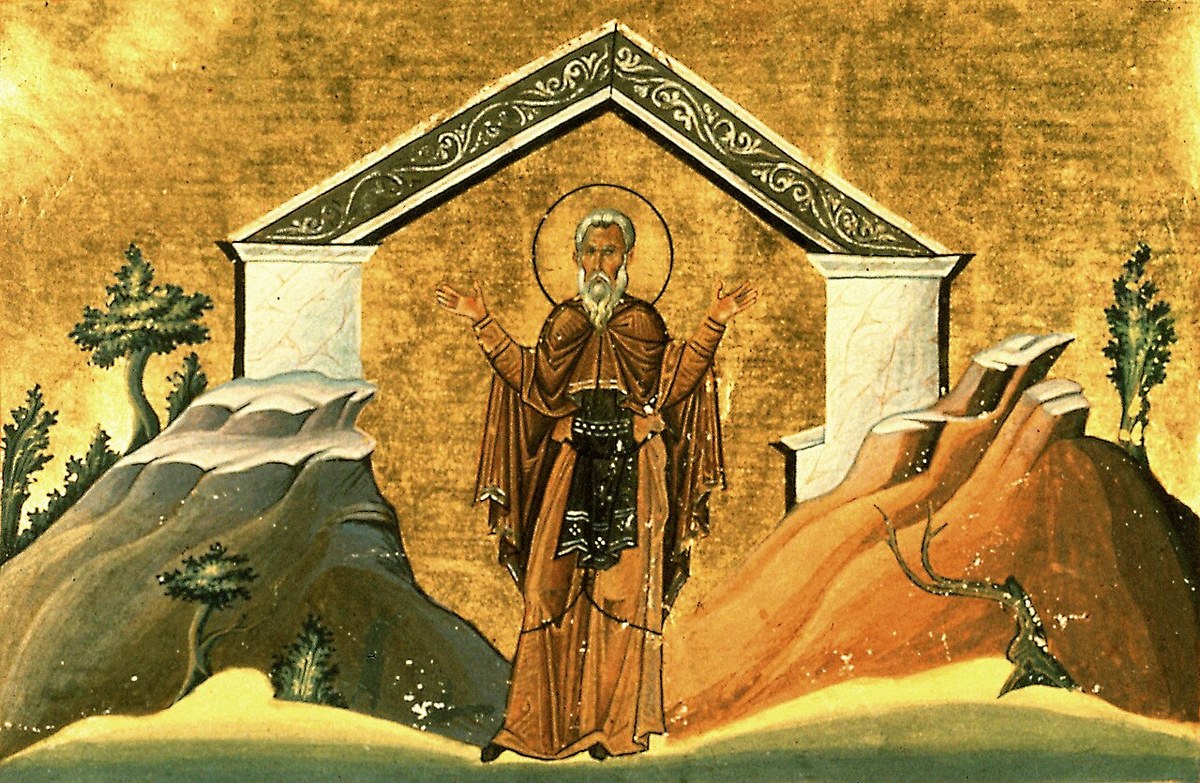
Auxentius is depicted as an aged monk-hermit — long-bearded, in the monastic schema — often shown upon or before his mountain, at the window of his cliff-cell, sometimes with suppliants below him or an angel above, and frequently holding a scroll. The mountain setting is his distinguishing mark, recalling the enclosed hermitage from which he healed the crowds.
The stored image is the miniature for February 14 from the Menologion of Basil II (Constantinople, c. 985; Vatican, Vat. gr. 1613), showing the venerable Auxentius as a monastic elder (source, public domain, pd-old-work).
Disputed questions
- The name of the mountain. The sources locate Auxentius on a height near Chalcedon variously called Oxeia or simply "the Mountain"; later it was known as Mount Auxentius after him (the modern Kayışdağı, east of Kadıköy). The identification is secure even where the name varies.
- Not to be confused with Auxentius the New Martyr of Constantinople (†1720, a Greek neomartyr under the Ottomans, kept January 25) — a wholly different saint of a far later age; nor with the other bearers of the name in the calendar. This Auxentius is the fifth-century hermit of the mountain in Bithynia.