
Maron the Hermit
Our Venerable Father Maron the Hermit of Syria
Venerable · b. mid-4th century, in the region of Cyrrhus — d. c. 410, near Cyrrhus in Syria
Commemorated 14 February — Repose of Maron the hermit
Maron (mid-fourth century – c. 410) was a Syrian hermit of the region of Cyrrhus, north-east of Antioch, and one of the great fathers of the ascetic movement of Syria whose life is recorded by his near-contemporary Theodoret of Cyrrhus. He embraced an open-air asceticism on a mountaintop, sheltering only in a small tent, and gave himself to prayer, fasting, and vigil under the naked sky; God granted him a striking gift of healing — of fevers and chills, of bodily disease, and of those tormented by demons — so that crowds streamed to him from the whole country. Around him grew a garden of ascetics, disciples who carried his manner of life through the hills of Cyrrhus, and he was honoured as a friend and correspondent of John Chrysostom, who wrote to him in tender affection from his exile. When Maron died, the neighbouring villages contended for his body as for a treasure. From the monastery that later bore his name — Beth-Maron on the Orontes — descends the great Christian community of Lebanon that still calls itself, after him, the Maronites. He is kept in the Byzantine calendar on February 14.

The witness of Theodoret
Almost everything securely known of Maron comes from a single, precious, and early source: the Religious History (Philotheos Historia, or History of the Monks of Syria) of Theodoret, bishop of Cyrrhus, written about the year 440 — within a generation of Maron's death, in the very district where Maron had lived and where his disciples still flourished. Theodoret devotes his sixteenth chapter to Maron, and writes not from hearsay but from the living memory of the region he governed. This gives the account of Maron an unusual solidity among the lives of the desert fathers: it is contemporary, local, and sober.
The open-air ascetic
Maron, Theodoret tells us, "adorned the choir of the holy men" of the Cyrrhestica — the upland country between Antioch and the Euphrates. He chose a form of asceticism that the Syrians particularly loved: the hypaethral or open-air life, lived without a roof, exposed to sun and rain, frost and heat. Taking to the summit of a hill once held sacred by pagan worship, he cleansed it and consecrated it to the true God, and there he dwelt in the open, with only a small tent or hut of skins to shelter him — and that, Theodoret says, he used rarely. To the customary labours of the ascetic — standing, fasting, sleepless prayer — he "added others of his own devising," pressing his body with a rigour that his biographer marvels at. He sought not the applause of men but the hiddenness of God, and yet, as so often, the more he hid the more he was sought.
The gift of healing
For God "granted him so rich a spring of grace," Theodoret writes, "that his fame ran everywhere." Sufferers came to Maron's hilltop from far off, and he sent them away healed: those burning with fever and those shaking with chills and ague, those wasted by long disease, and those bound and tormented by demons, whom he freed. Nor did he heal only bodies. Theodoret is careful to add that Maron "cured not only the ailments of the body but also those of the soul" — quenching greed in one, anger in another, teaching temperance here and justice there, correcting the disordered passions of those who came, so that his medicine reached the inner man. His mountaintop became a place of resort for the whole region, a clinic and a confessional under the open sky.
The garden of disciples
Maron's greatest work, in Theodoret's reckoning, was not any single wonder but the community of ascetics he raised up. "Having planted for God the garden that now flourishes in the region of Cyrrhus," Theodoret writes, "he received the reward of his labour." From his teaching and example came a whole generation of Syrian holy men — Theodoret names, among the fruit of Maron's planting, the ascetic James and others whom he treats in his own chapters — and through them the manner of life Maron had shaped spread through the hills. He was, in the truest sense, a father of monks, and the network of ascetic settlements that looked to his memory would in time give rise to a monastery and a people.
Friend of John Chrysostom
To this Syrian ascetic the tradition attaches one of its most cherished friendships. Among the surviving letters of John Chrysostom, written from the loneliness of his exile (after 404) at Cucusus in the Armenian mountains, is a short and affectionate note — Letter 36 — addressed "To Maron, priest and monk" (presbyteros kai monazon). In it the exiled patriarch tells Maron that he holds him bound in love and remembrance, that he counts him among his truest friends, and begs the prayers of "so watchful and wakeful a soul." The Church has long identified this Maron with the hermit of Cyrrhus, and it is on this letter above all that his title "friend of Chrysostom" rests — a bond between the golden-mouthed preacher of Antioch and Constantinople and the barefoot ascetic of the Syrian hills. (The identification, though ancient and probable, is not beyond question; see Disputed questions.)
Repose and the contested relics
Maron died after a short illness, about the year 410 — Theodoret says he "endured the toil of virtue for many years" and then passed to the life without toil. His death set off an event that measures the veneration he had won in life: the neighbouring villages fought over his body. The people of the region, each community desiring the blessing of his remains, came in numbers and all but to blows; in the end, Theodoret reports, the most populous of the villages carried off the holy body, drove away the rest, and raised over it a great shrine, from which — the bishop adds — they still reaped the benefit, honouring the martyr-like hermit with a public festival. His grave became, and remained, a centre of pilgrimage and healing.
Beth-Maron, and the people who bear his name
Here the history of the man opens into the history of a Church, and it must be told plainly and charitably. Around the memory and — the tradition holds — the relics of Maron there grew, on the Orontes near Apamea, the great monastery of Beth-Maron ("the House of Maron"), which by the fifth and sixth centuries had become one of the leading monasteries of Syria Secunda and a firm defender of the Council of Chalcedon (451) against the anti-Chalcedonian (Miaphysite) party that prevailed in much of the Syriac world. The monks and the faithful gathered around Beth-Maron came to be called, after their patron, Maronites.
Through the upheavals of the following centuries — the Arab conquest, the isolation of the Lebanese mountains, the theological quarrels over the wills of Christ — the Maronites emerged as a distinct Church and people, with their own patriarch (traditionally traced to a John Maron of the late seventh century) and their own Syriac-Antiochene liturgy, sheltering in the fastnesses of Lebanon. A historical controversy attends their middle centuries: certain Byzantine and later writers charged the community with Monothelitism (the teaching of a single will in Christ, condemned in 681), while the Maronite Church has consistently held that it was never other than orthodox and Chalcedonian and never in schism from the faith of the councils. From the era of the Crusades the Maronite Church entered, and has since maintained, full communion with Rome, and it remains today the largest Christian community of Lebanon. These later divisions — Chalcedonian and non-Chalcedonian, Roman and Byzantine — are the inheritance of the centuries after Maron, and none of them is his doing. Maron himself belongs to the undivided age: a Syrian saint of the one Church, honoured by the Orthodox in the Byzantine synaxarion on February 14, by the Maronite Catholic Church as its father and patron (kept in their calendar on February 9), and reverenced by all who look to the ascetic springtime of Syria. In him the traditions that later parted still meet.
Feast and commemoration
Maron is kept in the Byzantine calendar on February 14 (church date; Old Calendar civil February 27), together with the venerable Auxentius of Bithynia and the bishop Abraham of Carrhae — a day, in the Greek reckoning, weighted toward the ascetic and monastic fathers of Syria and Bithynia. The Greek Menaion gives him a synaxarion notice and commemorative verses but no proper hymnody, appointing the common office of a venerable; the Slavonic books supply proper hymns (a troparion in Tone 8 and a kontakion in Tone 5). In the Maronite Church his feast is the ninth of February, kept as the principal feast of the community's patron. The double observance — Orthodox and Maronite — is one of the quiet witnesses to a sanctity older than the divisions that followed.
Hymns
Troparion — Tone 8
In thee, O Father, was the divine image kept secure; for taking up thy cross thou didst follow Christ, and by thy deeds thou didst teach us to despise the flesh, for it passeth away, but to care for the soul, a thing immortal. Therefore doth thy spirit, O venerable Maron, rejoice together with the angels.
Original translation from the Greek
Kontakion — Tone 5
Thou didst quench the furnace of the passions, O venerable one, with the dew of abstinence, and wast enriched by God with the gift of healings, O Maron…
Original translation from the Slavonic
Iconography
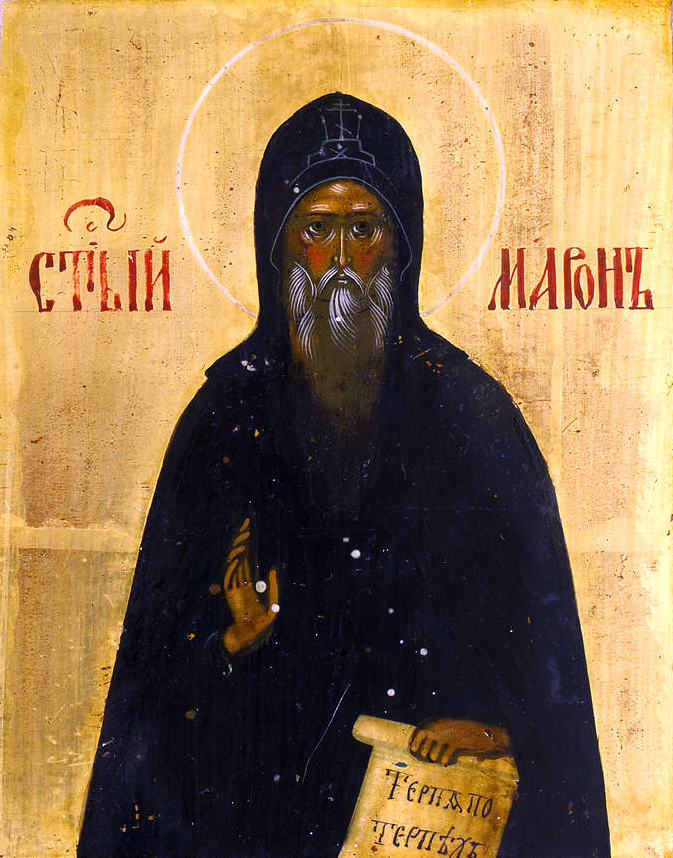
Maron is depicted as an aged Syrian ascetic — long-bearded, in the monastic schema, often gaunt from his austerities — sometimes shown in the open air upon his hill, with the small tent that was his only shelter, and frequently holding a scroll or raising his hand in blessing. In the iconography of the Maronite tradition he is portrayed with the distinctive liturgical staff and stole, or before his hilltop hermitage, and above all as the healer to whom the sick are brought; a familiar Maronite image sets him beside a small domed shrine or church, the emblem of the community that bears his name. Byzantine and Slavic menologia show him simply as a hermit-father among the ascetics of February.
The stored image is a Russian icon of about 1850 (tempera, gold, and gesso on wood) inscribed to Saint Maron the Syrian hermit, depicting him as an elder ascetic in monastic habit (source, public domain, pd-old-work).
Disputed questions
- Identity with Chrysostom's correspondent. The equation of Theodoret's hermit of Cyrrhus with the "Maron, priest and monk" of John Chrysostom's Letter 36 is old and widely accepted, and grounds his title "friend of Chrysostom." It is not, however, certain: Maron (Marōn) was not a rare name, and Theodoret nowhere calls his Maron a priest. The identification is probable and is followed here, with the caution noted.
- The date of death (c. 410) is inferred: Theodoret, writing about 440, speaks of Maron as belonging to the recent past and of his disciples as still active; ranges from c. 407 to the 420s are given. The Byzantine and OCA notices variously style him "fourth-century"; the repose is best placed at the turn of the fourth and fifth centuries.
- Not to be confused with John Maron, the (semi-legendary) first Maronite patriarch of the late seventh century, a different and much later figure with whom the hermit is sometimes conflated; nor with the many other Syrian ascetics whose lives Theodoret records in the same work — among them James the hermit of Syria (James of Cyrrhus), reckoned in the tradition among Maron's own spiritual progeny.