
Barlaam and Josaphat of India
The Holy Venerable Barlaam the Hermit and Josaphat, Prince of India
Venerable · d. 4th century (traditional)
Commemorated 19 November
Barlaam and Josaphat are the two ascetic saints of one of the most widely translated and beloved stories of the medieval world: the hermit Barlaam, who in the guise of a merchant sought out the sheltered prince Josaphat (Ioasaph) of India and, through a chain of parables, brought him to faith in Christ; and Josaphat himself, the king's son, who was baptised, converted his father and people, renounced his throne, and ended his life in the desert beside his teacher. Their tale — passed to Byzantium in Greek, thence into Latin, Slavonic, and dozens of European and Eastern tongues — is now recognised by scholars as a Christianised retelling of the life of the Buddha, the Indian setting and the very name Josaphat (through Bodhisattva) preserving its origin. The Church commemorates the two saints together on November 19, within the Nativity Fast.
.jpg)
The legend of Barlaam and Josaphat
The story is set in India in the days when a king named Abenner (Abenner, Avenir) reigned over a people newly reached by the Gospel. Abenner hated the Christians, and above all the monks who were drawing his subjects to Christ, and raised a fierce persecution against them, driving many into the deserts and mountains and putting others to death. At the birth of his only son, Josaphat, the king summoned his astrologers to foretell the child's future; the wisest among them prophesied that the boy would indeed become great — but in a kingdom not his father's, and that he would embrace the Christian faith the king so hated.
To thwart the prophecy, Abenner shut the prince from birth in a splendid palace, attended only by chosen tutors, forbidding that anything sorrowful or troubling — sickness, old age, death, poverty — should ever come to the young man's notice, and above all that he should hear the name of Christ. Yet as Josaphat grew he pressed his companions until he was allowed out, and there encountered a blind man, a leper, and at last an aged and dying man; learning that suffering, decay, and death were the common lot of all, the sheltered prince fell into a great disquiet about the meaning of life.
Into this the hermit Barlaam was led by a revelation of God. An experienced ascetic from the desert of Senaar (Sennaar), filled with every virtue, he made his way to the prince's city disguised as a merchant, letting it be known that he carried a precious jewel that could give sight to the blind and wisdom to the foolish, but which could be shown only to one pure in body and sound of eye. Brought at last before Josaphat, Barlaam revealed that the priceless pearl was Christ himself, and unfolded the faith to the prince through a series of parables — the sower, the man fleeing the unicorn, the three friends, the king for a year — that became famous in their own right. He taught him of the creation, of Adam's fall and the promise of a Redeemer, of the Incarnation, the Cross, the Resurrection, and the Ascension; and Josaphat, recognising in this the answer to his disquiet, believed. Barlaam baptised him and, having offered the Bloodless Sacrifice, gave him the Holy Mysteries, then returned to his cave in the wilderness.
The king, learning of his son's conversion, tried every means to reclaim him — argument, a staged debate with a false "Barlaam," the enticements of luxury and the seductions of women — but Josaphat withstood them all, and by his steadfastness at length converted his own father. Abenner was baptised, resigned the kingdom to his son, and died in penitence. Josaphat ruled only briefly; then, longing for the ascetic life, he laid down his crown, gave the kingdom to a worthy man named Barachias, and went out into the desert. After long searching and many hardships he found the aged Barlaam again, and the two lived out their remaining years together in prayer. Barlaam died first; Josaphat buried him and continued in the same cave until his own repose, and the two were laid in one grave.
The seventeen monk-martyrs
The Byzantine narrative, and the Menaion after it, joins to the story the memory of a company of monks martyred under Abenner's persecution. When the king sent his counsellor Araches into the wilderness to hunt down Barlaam, the soldiers seized instead seventeen monks at the foot of a mountain and demanded that they betray the hermit's hiding-place. The monks refused; under torture, and then before the king himself, they were blinded and had their hands and feet cut off, exhorting one another to endure for Christ, and so received their crowns. The narrator — in the tradition, John of Damascus — likens the seventeen to the seven Maccabee brothers of the Old Covenant (August 1). They are commemorated with Barlaam and Josaphat on the day.
Veneration and later cultus
The Greek romance Barlaam and Ioasaph was long ascribed to John of Damascus (December 4), and it is under his name that the tale entered the Byzantine synaxaria and passed westward. Translated into Latin, it made Barlaam and Josaphat two of the most popular saints of the medieval West: the pair were entered in the Roman Martyrology (on November 27), churches and relics were dedicated to them, and the parables — especially that of the three caskets and that of the man in the well — were retold by Boccaccio, reworked in the Gesta Romanorum, and echoed as far as Shakespeare's casket-scene in The Merchant of Venice. In the East the story circulated in Georgian, Church Slavonic, Armenian, Arabic, and Ethiopic, and both saints are firmly kept in the Orthodox calendar on November 19.
Feast and commemoration
November 19 on the church calendar (Old Calendar civil December 2), within the Nativity Fast; the Roman Martyrology keeps the pair on November 27. In the Slavic service books Josaphat the Prince and Barlaam the hermit each receive proper hymns; the OCA commemorates them together as "Barlaam the monk and Prince Ioasaph of India."
Hymns
Troparion
Taught by thy spiritual guide to know God, O King Josaphat, and enlightened by holy Baptism, thou didst turn thy people to the faith; becoming thy own father's sponsor at the font, thou didst forsake thy kingdom and attain to the wilderness, and there didst labour diligently in the ascetic struggle. Pray to Christ God, together with thy teacher Barlaam, that our souls may be saved.
Original translation from the Slavonic
Kontakion
God alone, the Knower of hearts, beholding thy good will from thine infancy, O Josaphat, led thee from an earthly kingdom into the monastic life and granted thee to follow the great Barlaam. Having now with him the radiant heavenly Jerusalem for thy homeland, and delighting in the longed-for beauty of the Holy Trinity, we beseech thee, O royal adornment: remember us who honour thee with faith.
Original translation from the Slavonic
Troparion
Forsaking the fair things of the world and its glory, thou camest to a cave, where, advancing from strength to strength, thou didst become a guide of the flock of Christ, all-glorious Barlaam. As thou didst shepherd them well, shepherd us also, we entreat thee, keeping us from every evil, that we may call thee blessed.
Original translation from the Slavonic
Iconography
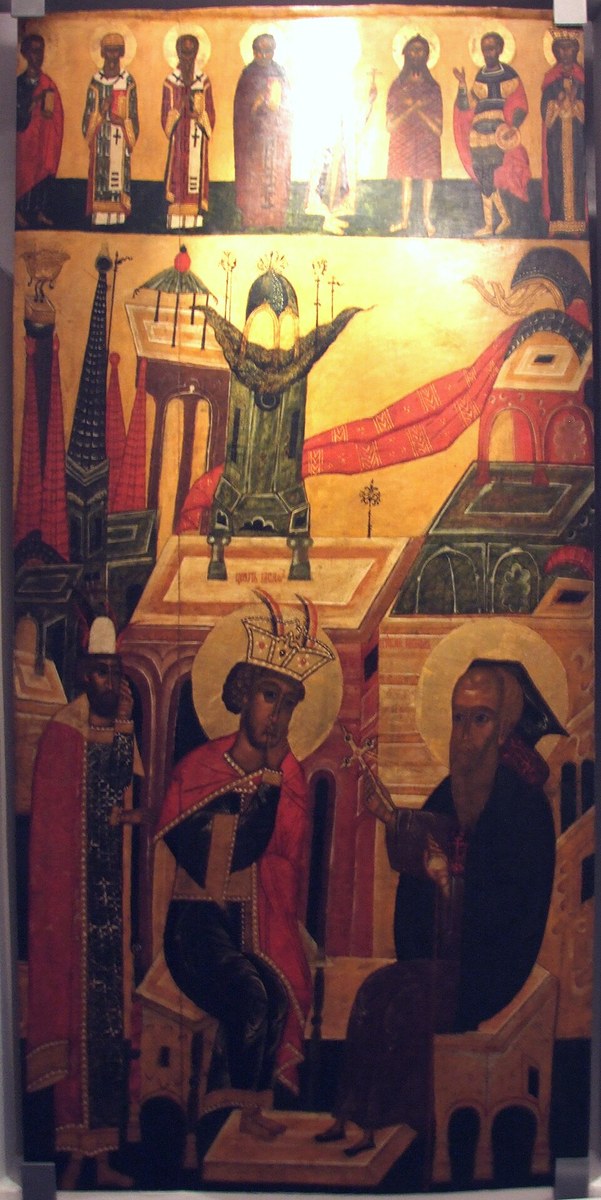
The two saints are shown together as monastics: Barlaam an aged hermit with a long white beard, Josaphat younger and often crowned or robed as a prince beneath the monastic habit, the pair frequently in conversation — Barlaam teaching, the prince listening — sometimes with the merchant's disguise, the baptism in the garden pool, or scenes of the parables set around them. The oldest surviving depiction is a miniature in a thirteenth-century Greek manuscript of the romance at the Iviron monastery on Mount Athos (cod. 463). The stored image is a seventeenth-century icon of the Russian North (Andrei Rublev Museum) showing the converse of the venerable Barlaam and the Indian prince Josaphat.
Disputed questions
- The saints and the Buddha-legend. It is now the settled judgment of scholarship that the story of Barlaam and Josaphat is, in its narrative substance, a Christianised recension of the life of Gautama the Buddha. The tale of the prince kept from all knowledge of suffering, who escapes his father's sheltering palace, meets a sick man, an old man, and a corpse, and renounces his kingdom for the ascetic life, is the frame of the Buddha's own legend; and the name Josaphat itself descends, through a chain of transmissions, from the Sanskrit title Bodhisattva — becoming Budhasaf / Bodisav in the Manichaean and Middle-Persian versions, Yūdasaf / Būdhāsaf in Arabic (the Ismaili Bilawhar wa-Būdhāsaf), Iodasaph in Georgian, and finally Ioasaph / Josaphat in Greek and Latin. The Christian romance most likely reached Byzantium through a Georgian intermediary, the Balavariani, whose Greek rendering the tradition attributes not to John of Damascus but, in the view of most modern scholars, to Euthymius the Athonite (†1028) of the Iviron monastery; the Damascene ascription is now generally regarded as secondary. This history is set out here honestly, as the origin of the material; it is recorded as a question of literary transmission and does not settle the theological question of the saints' historicity, on which the calendars and this entry follow the veneration of the Church.
- Historicity. Whether a historical Christian prince and hermit stand behind the legend cannot be established from the sources; what the Church venerates is the pattern of sanctity the story holds up — the renunciation of the world for Christ — and the two saints as the tradition transmits them. The Buddhist origin of the narrative frame is recorded above without prejudice to that veneration.
- Not to be confused with Barlaam of Antioch, the martyr of the burning hand commemorated the same day, nor with Barlaam of Khutyn, the Russian wonderworker (November 6). "Josaphat/Ioasaph" here is the Indian prince, distinct from the Russian venerables of the name (e.g. Joasaph of Belgorod) and from the martyr-prince Ioasaph named among the Twenty-Six of Zographou.