
Barlaam of Antioch
The Holy Martyr Barlaam of Antioch
Martyr · d. c. 304
Commemorated 19 November
Barlaam was an aged and unlettered Christian farmer martyred in the persecution of Diocletian, around the year 304. Arrested and unable to be argued or tortured out of his confession, he was carried to a pagan altar, where the judge had his right hand stretched out over the fire and a coal with a heap of burning incense laid upon the open palm — expecting that when the flame reached the flesh the old man would fling it down, and so, against his will, be seen to have offered sacrifice to the idol. Barlaam did not let it fall: he held his hand steady until it was burned away, and gave up his soul. His constancy so captured the imagination of the Church that both Basil the Great and John Chrysostom preached homilies in his honour. He is commemorated on November 19, within the Nativity Fast.
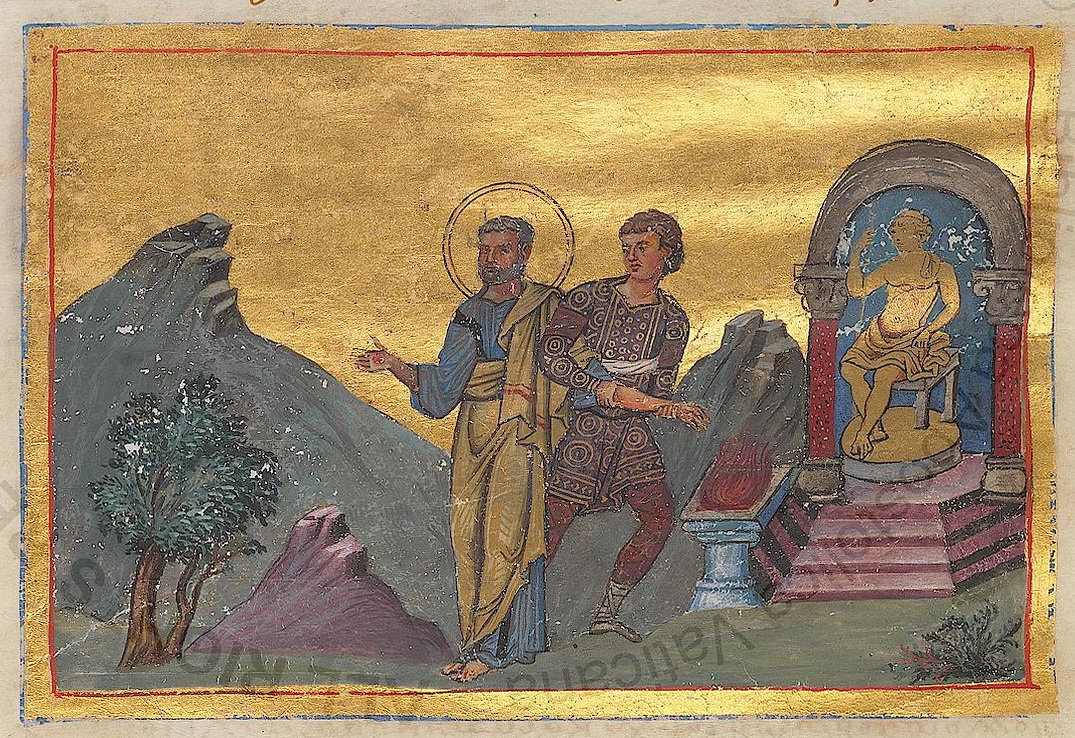

Martyrdom
The account the Church received is spare and vivid. Barlaam was an old man of the countryside, a farmer, without learning or eloquence but firm in the faith of Christ. In the Great Persecution under Diocletian he was seized, brought before the tribunal, and confessed himself a Christian. The judge, unable to break him by argument and finding that torture only hardened the old man's resolve, devised a stratagem to make Barlaam betray himself. He had the martyr brought to the pagan altar, forced his right hand open above it, and placed on the upturned palm a live coal and a mound of incense. The reasoning was precise and cruel: a weak old man could not hold burning coals against his bare flesh; when the pain grew unbearable he would jerk his hand aside and spill the incense onto the altar-fire, and thus be recorded as having offered sacrifice — a lapse wrung from him by his own body.
Barlaam defeated the calculation by simply not moving. He held his arm outstretched and steady over the altar while the coal and the incense burned down through his palm, letting nothing fall upon the idol's fire, until the hand itself was consumed and he surrendered his soul to God. The image of the motionless burning hand — the martyr's own body made the censer, but the incense offered to Christ and not to the demons — became the whole content of his veneration.
The homilies of Basil and Chrysostom
Barlaam's fame in the Church rests as much on his preachers as on his passion. A panegyric on the martyr survives under the name of Basil the Great (Homily on the Martyr Barlaam), which paints the scene of the outstretched hand and calls on the painters of the Church to depict what words cannot fully tell — an early and much-cited witness to the Christian defence of sacred images. John Chrysostom, preaching at Antioch, likewise delivered a homily on Barlaam. That two of the greatest fathers of the fourth-century Church — and in Chrysostom the supreme voice of Antioch — should each have honoured this obscure farmer with a sermon fixed his memory in the liturgical year and gave the Antiochene Church a particular claim on him. (The Basilian authorship of the homily has been questioned by some scholars, but the tradition of a Basilian and a Chrysostomic sermon on Barlaam is ancient and secure.)
Feast and commemoration
November 19 on the church calendar (Old Calendar civil December 2), joined in the Menaion with the Prophet Obadiah, and kept within the Nativity Fast. The Greek Menaion gives him a proper service with stichera and a canon; his memory is especially cherished in the Antiochene tradition on account of Chrysostom's homily.
Hymns
Troparion — Tone 4 (general troparion of a martyr)
Thy martyr Barlaam, O Lord, in his contest received an incorruptible crown from thee, our God; for possessing thy strength, he cast down the tyrants and shattered the feeble insolence of the demons. By his intercessions save our souls.
Original translation from the Greek
Kontakion — Tone 4
Thou wast shown forth wondrous in the strength of thy whole-burnt sacrifice: as fragrant frankincense thou didst offer thyself a sacrifice to Christ; and having received the crown of honour, O Barlaam, ever pray for us, O sufferer.
Original translation from the Slavonic
Iconography
Barlaam is depicted at the moment of his passion: an aged, bearded man in the tunic of a countryman, his right arm stretched out over a flaming altar, the coal and the smoking incense heaped on his open palm, a torturer or judge standing by. The scene is the subject of the panegyric under Basil's name, which appeals to the painters to portray it, and it is among the martyrdoms illustrated in the Menologion of Basil II (Constantinople, c. 985), the stored image, which shows the old man dragged toward the altar to be forced to sacrifice.
Disputed questions
- Antioch or Caesarea. The received life placed by the Byzantine synaxaria makes Barlaam a martyr of Antioch of Syria, and this suits the Chrysostomic homily preached in that city; the Antiochene tradition claims him accordingly. Other notices — followed by the OCA, whose heading styles him "Barlaam of Caesarea in Cappadocia" — associate him with Caesarea, linking him to the homily under Basil's name (Basil being archbishop of Caesarea). The two localisations reflect the two patron-preachers rather than two martyrs; the divergence is recorded here, and the entry keeps the Antiochene placement of the synaxarion while noting the Caesarean heading.
- Not to be confused with three other saints named Barlaam near this day and in this corpus: Barlaam of Khutyn, the twelfth-century Russian wonderworker (November 6); Barlaam, abbot of the Kiev Near Caves (commemorated the same day, November 19 — see Pending entries in the calendar file); and Barlaam the hermit of India, the legendary teacher of Prince Josaphat, also commemorated November 19. This Barlaam is the aged martyr of the burning hand.