
Dorotheus of Tyre
The Holy Hieromartyr Dorotheus, Bishop of Tyre
Hieromartyr · Bishop · b. c. 255 — d. c. 362
Commemorated 5 June — Martyrdom at a great age under Julian the Apostate
Dorotheus, Bishop of Tyre in Phoenicia, is remembered as one of the oldest martyrs of the Church: a hierarch of great learning who survived the whole of the Great Persecution under Diocletian, governed his see in the peace granted by Constantine, and then, when the apostate emperor Julian revived the sacrifices about the year 362, was seized and tortured to death at the age of some one hundred and seven years. Antiquity remembered him also as a writer, and a late Greek catalogue of the Seventy Apostles — one of the sources behind the Byzantine lists of the Seventy — travels under his name. He is commemorated on June 5.
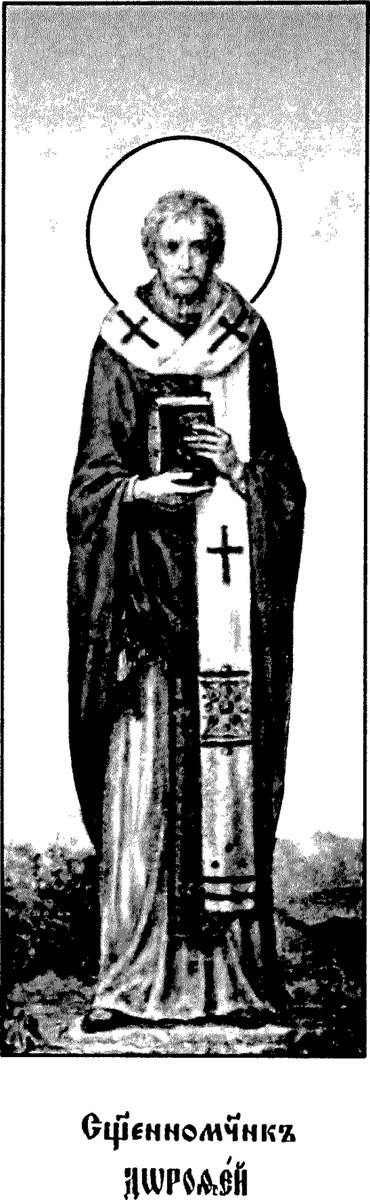
_-_%D0%B8%D0%BA%D0%BE%D0%BD%D0%B0_10051_%D0%94%D0%BE%D1%80%D0%BE%D1%84%D0%B5%D0%B9.png)
Origins and the see of Tyre
Dorotheus belonged to the church of Phoenicia, in the metropolitan province of Tyre — a great commercial city on the Syrian coast whose Christian community was ancient and, in the fourth century, one of the more consequential in the Antiochene sphere. The tradition makes him a man of unusual education: skilled in Greek and Latin letters as well as in Hebrew, and thoroughly versed in the Scriptures, which he is said to have been able to expound in several tongues. He is described as having been ordained presbyter and then raised to the episcopate of Tyre.
Some ancient and modern writers identify him with the Dorotheus, presbyter of Antioch whom Eusebius of Caesarea knew personally and praised in his Church History (VII.32) — a learned man, eunuch from birth, a diligent student of the Hebrew Scriptures and of liberal learning, whom Eusebius heard expounding the Scriptures in the church at Antioch under Bishop Cyril, and whom the emperor (Diocletian) honoured with the superintendence of the imperial purple-dye works at Tyre. The identification is attractive — the learning, the languages, the association with Tyre all agree — but it is not certain, and it is discussed under Disputed questions below.
The Great Persecution and the peace of the Church
When the persecution of Diocletian broke over the eastern provinces (from 303), Dorotheus, on the counsel of his own flock and following the Lord's word that when they persecute you in one city you should flee to another, withdrew from Tyre and hid himself through the years of the terror, keeping his life for the service of the Church rather than courting a martyrdom he was not yet called to. With the victory of Constantine and the peace granted to the Church, he returned to his city and resumed the government of his see, and he lived through the long middle decades of the century — the Arian troubles, the councils, the reigns of Constantius and Gallus — teaching, ordaining, and confirming his people in the faith of Nicaea, until he was very old.
Martyrdom under Julian the Apostate
In 361 the emperor Julian, nephew of Constantine and reared a Christian, publicly renounced Christ, restored the temples and the sacrifices, and set the whole machinery of the state to the humiliation of the Church. Julian's policy was less often bloody than mocking, but in Phoenicia and Palestine it produced real martyrs. Dorotheus, by now a very old man, would not be silent: he confessed Christ openly and refused the sacrifices. He was arrested and brought before the governor, and, when neither flattery nor threat could bend him, he was subjected to tortures — beatings and the tearing of his aged flesh — under which he gave up his soul, about the year 362, in the one hundred and seventh year of his life.
A strand of the tradition places this not at Tyre but at Odyssopolis in Thrace (the modern Varna, ancient Odessos), whither Dorotheus is said to have travelled or been taken; the synaxaria are divided, and both places are recorded below rather than harmonised.
The writings ascribed to him
Dorotheus's ancient reputation as a scholar of the Scriptures attached his name to a body of learned material. In particular, the Byzantine tradition transmits a Synopsis on the lives and deaths of the prophets, the apostles and the disciples of the Lord under the name of "Dorotheus, Bishop of Tyre" — a catalogue that, with the parallel lists ascribed to Hippolytus and to the Chronicon Paschale tradition, lies behind the standard Byzantine enumerations of the Seventy Apostles and behind many of the individual synaxarion notices of them. Modern scholarship regards the text as a later compilation falsely ascribed to him (a "pseudo-Dorotheus"), assembled well after the fourth century; but the ascription is itself old evidence of how thoroughly the Church remembered this bishop as a man of books. He is on that account sometimes styled "Dorotheus the Historian."
Feast and commemoration
June 5 (church date; Old Calendar civil June 18). Dorotheus is the principal commemoration of the day in the Greek, Antiochian, Slavonic and Romanian usage alike, and the Menaion service of June 5 is his, with the martyrs of Egypt and the ascetics of the day commemorated at the sixth ode of the canon. As a bishop of Tyre he has a particular claim on the Patriarchate of Antioch, in whose territory Phoenicia Prima lay, and he is counted among the hierarch-martyrs of the Syrian coast.
Hymns
Troparion — Tone 4 (common of a hieromartyr-bishop)
Sharer in the ways of the Apostles and successor to their thrones, thou didst find in action the ladder to divine contemplation, O God-inspired Dorotheus; therefore, rightly dividing the word of truth, thou didst contend for the faith even unto blood. Intercede with Christ our God that our souls be saved.
Original translation from the Greek
Kontakion — Tone 2 (common of a hieromartyr)
Having lived out a hundred years and more in the priesthood of Christ, thou wast found in extreme old age a young athlete; for when the apostate raised again the altars of the demons, thou didst rebuke him, O wise Dorotheus, and wast crowned with a martyr's crown.
Original translation from the Greek
Iconography
Dorotheus is written as a hierarch: an old man with a short rounded beard, in phelonion and the cross-marked omophorion, blessing with the right hand and holding the Gospel book in the left, sometimes with the epigonation and a richly-worked epitrachelion. His great age is the chief distinguishing note, and in Russian plates — such as the one above, from the June volume of the Lives of the Saints after Dimitry of Rostov, where the Slavonic caption reads Сщенномчнкъ Дороѳей — he is given the whitened hair of extreme old age. Because his martyrdom was by scourging rather than by the sword, no instrument is normally shown; where the passion is depicted at all, it is as the beating of an old bishop before a seated governor. As a June saint he does not appear in the Menologion of Basil II, which covers only September to February; a Commons file bearing that name and his is therefore mis-titled and was not used here.
Disputed questions
- Identity with Eusebius's Dorotheus of Antioch. Eusebius (H.E. VII.32) describes a Dorotheus, presbyter at Antioch under Bishop Cyril (c. 280–300), learned, a eunuch from birth, whom Diocletian set over the purple works at Tyre. Many hagiographers and some historians identify him with the martyr-bishop of this day; others hold that the synaxarion has conflated two men, since Eusebius says nothing of an episcopate and nothing of a martyrdom, and Eusebius (who died c. 339) could not in any case have reported a death under Julian. The identification is recorded here as probable but unproven.
- Place of martyrdom. Tyre in Phoenicia, or Odyssopolis (Odessos, modern Varna) in Thrace: the synaxaria transmit both, and the second may have arisen from confusion with another Dorotheus.
- Age at death. The figure of 107 years is given consistently in the Greek and Slavonic synaxaria; it requires a birth about 255, which is compatible with an active presbyterate at Antioch before 300 but is at the outer limit of credibility and is best read as the tradition's way of saying that he was extraordinarily old.
- Not to be confused with the other Dorothei of the calendar, several of whom
are distinct men of the same very common Greek name:
- Dorotheus of Gaza, the sixth-century abba and author of the Spiritual Instructions, commemorated on this same day, June 5 — the confusion most likely to occur, since the two share both name and feast. That Dorotheus was a Palestinian monk and spiritual writer who died in his bed; this one was a Phoenician bishop and martyr.
- Dorotheus the Hermit of Egypt (the Theban, September 16), the ascetic of the Lausiac History.
- Dorothea of Caesarea (February 6), the virgin martyr of Cappadocia, whose name is the feminine of his.