
Domnica of Constantinople
Our Venerable Mother Domnica of Constantinople
Venerable · b. 4th century, Carthage — d. c. 474, at Constantinople
Commemorated 8 January — Repose; kept within the afterfeast of the Theophany
Domnica of Constantinople (fourth century – c. 474) was a venerable amma of the imperial city, remembered as a foundress of monastic life for women and a saint of extraordinary spiritual gifts. According to the tradition she came from Carthage in Roman Africa to Constantinople in the reign of Theodosius the Great, was baptised by the Patriarch Nectarius, and gave herself wholly to the ascetic life, gathering a community of women and reaching a rare height of prayer. The synaxaria credit her with healings, with power over the elements — stilling fires and storms that threatened the capital — and with foreknowledge of things to come, gifts by which she turned the citizens of Constantinople toward the care of their souls. She lived to a very great age and reposed a virgin about the year 474. She is commemorated on January 8, within the afterfeast of the Theophany.
.jpg)
From Carthage to Constantinople
The tradition preserved in the synaxaria makes Domnica a native of Carthage, the great city of Roman Africa, who came to Constantinople in the days of the emperor Theodosius the Great (379–395). Some accounts bring her in the company of four pagan maidens; on their arrival in the capital they sought out the Patriarch Nectarius (381–397), the successor of Gregory the Theologian in the see of Constantinople, who instructed and baptised them. Domnica alone, or she together with her companions, then renounced the world entirely and entered upon the monastic life, and it is as a foundress and guide of ascetic women in the imperial city that the Church remembers her.
Ascetic struggle and gifts
Domnica pursued the monastic life with such severity and constancy — the notices speak of prolonged fasting, unbroken prayer, and vigil — that she attained, in the words of the synaxarion, a high perfection of soul, and with it the charisms that crown the desert tradition: the healing of the sick, the gift of prophecy, and a God-given authority over the natural elements. The hagiographers relate that her prayers stilled fires and calmed storms that threatened Constantinople, a city forever vulnerable to conflagration and to the tempests of the Bosporus; and that by these wonders, and by the plain evidence of her holiness, she moved many of the citizens of the capital to turn from the cares of the present life to concern for the life eternal and the soul. She is honoured as an amma and a mother of monastics, gathering and guiding a community of women in the ascetic way.
Repose
Adorned with virtues and full of years, Domnica reposed in peace, a spotless virgin, in extreme old age — the tradition places her death about the year 474, in the reign of Leo I or at the accession of Zeno, so that her life is made to span the whole of the fifth century's first three-quarters, from Theodosius to the age of the Henotikon. The great length ascribed to her life is itself part of her memory: a saint who, baptised in the last years of the fourth century, was still a living pillar of prayer in the capital more than seventy years later.
Feast and commemoration
Domnica is commemorated on January 8 (church date; Old Calendar civil January 21), within the afterfeast of the Theophany, and is kept together with the venerable George the Chozebite and the confessor Emilian of Cyzicus. The Greek, Slavic, and Antiochian calendars agree on the day; the Slavic books style her igoumeni (abbess), the Greek ὁσία (venerable). Her office is sung under the hymns of the afterfeast of the Baptism of Christ.
Hymns
Troparion — Tone 8
In thee, O Mother, was the image preserved with exactness; for taking up the Cross thou didst follow Christ, and by thy deeds thou didst teach us to despise the flesh, for it passeth away, but to care for the soul, a thing immortal. Therefore doth thy spirit, O venerable Domnica, rejoice together with the Angels.
Original translation from the Greek
Iconography
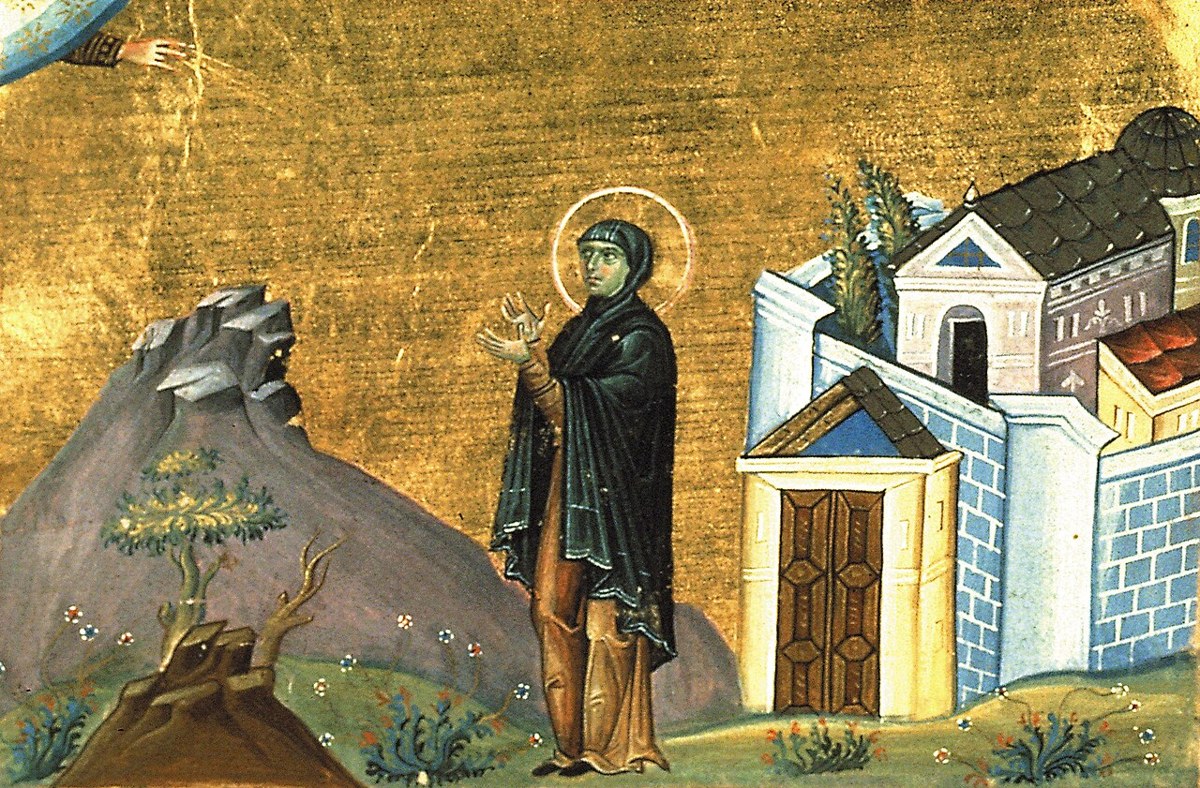
Domnica is depicted as an aged nun in the dark monastic habit and koukoulion, her hand raised in prayer or holding a cross — the type of the venerable amma. The stored image is the miniature for January 8 from the Menologion of Basil II (Constantinople, c. 985; Vatican, Vat. gr. 1613): Domnica robed as a nun, named in the Greek inscription, in the emperor's great illustrated synaxarion — one of the earliest surviving images of the saint (source, public domain, pd-old-work).
Disputed questions
The chronology is the entry's one real difficulty and is best stated plainly. If Domnica was baptised by Nectarius (who died in 397) as an adult come from Carthage, and reposed about 474, she must have lived well past a hundred years and sustained some eighty years of monastic labour. The synaxaria present exactly this — an exceptionally long-lived ascetic — and the two fixed points (baptism under Nectarius; repose c. 474) are transmitted together; the entry records the tension rather than resolving it by adjusting either date. Her name appears in the manuscripts as Δομνίκη (Domnikē / Domnica) and, by variation, Domnina; she is not to be confused with the martyr Domnina of Anazarbus in Cilicia (also transmitted as "Domnica," kept October 12) or with Domnina of Syria and her daughters, nor with the ascetic Domnina the Younger of Syria (†c. 460, kept March 1) — each a different saint of a different age and category.