
Domnina of Anazarbus
The Holy Martyr Domnina of Anazarbus in Cilicia
Martyr · d. 286
Commemorated 12 October — Death in prison at Anazarbus after torture
Domnina of Anazarbus (†286) was a Christian woman of Cilicia who confessed Christ before the governor in the early years of Diocletian's reign, was beaten at length and burned with fire, and died of her torments in prison. The Greek synaxarion of October 12 remembers her with the epithet "victorious" (καλλίνικος) and a distich in her honour: though her limbs were wrenched from their joints, she did not deny the true faith. She shares her day with the greater company of Probus, Tarachus and Andronicus, who suffered in the same city eighteen years later.
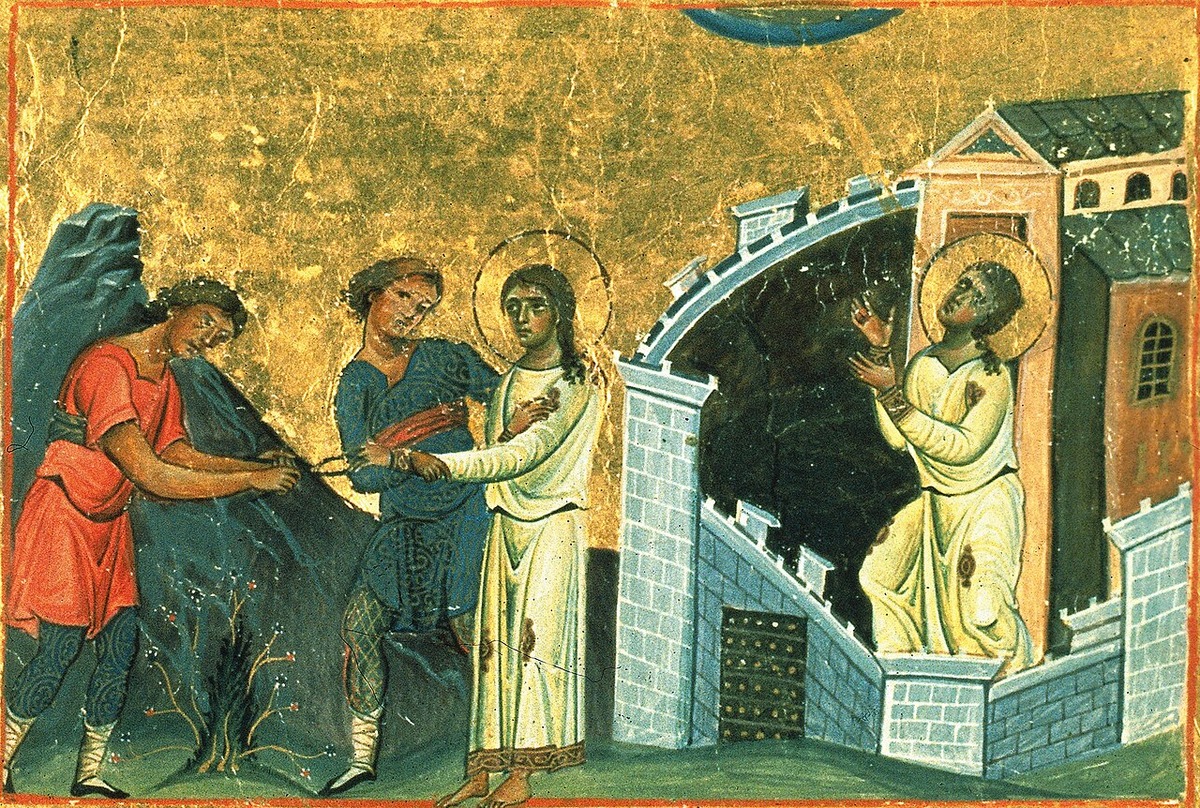

The record of Domnina is a synaxarion notice, and this entry keeps to it. She lived in Cilicia, in or near Anazarbus, and was seized as a Christian under the governor whom the Slavic tradition names Lysias (the OCA's notice spells it "Licius"). Refusing to sacrifice, she was subjected to a prolonged beating with rods and burned with fire; the Greek distich adds the wrenching of her limbs from their sockets. Broken by the tortures but not in her confession, she was cast into prison, where she gave up her soul to God in the year 286. Her death in prison, rather than under the executioner's hand, changed nothing in the Church's account of her: she is counted a martyr, "made perfect" by the torments of which she died.
Feast and commemoration
October 12 (church date; Old Calendar civil October 25), in the shadow of the day's principal martyrs Probus, Tarachus and Andronicus, with whose city her own is one: the synaxarion of the day lists her second, with her distich. No proper service is appointed; the common of a woman martyr is used where her memory is kept liturgically.
Hymns
Troparion — Tone 4 (from the common of a woman martyr)
Thy lamb Domnina crieth to thee with a great voice, O Jesus: Thee, my Bridegroom, do I love, and seeking thee I contend, and am crucified and buried with thee in thy baptism; I suffer for thy sake, that I may reign with thee, and I die for thee, that I may live in thee. Receive me then as a spotless sacrifice, slain with love for thee. By her intercessions, O merciful one, save our souls.
Original translation from the Greek
Iconography
The stored image is the miniature of the Menologion of Basil II (c. 985; Vat. gr. 1613, p. 111) transmitted for the martyr Domnica/Domnina of this day: a double scene showing the young martyr in a white chiton seized and beaten by two executioners, and again within the prison walls, hands raised in prayer as she dies — the two moments of her synaxarion notice. The manuscript's own placement at October 12 secures the identification against the other Domninas of the calendar (the Domnina of October 4 is transmitted in the same manuscript under a separate miniature, used at this collection's entry for her).
Disputed questions
- Name-form. The Greek synaxaria and the calendars transmit both Domnina (Δομνίνα) and Domnica/Domnika; azbyka's calendar prints "Domnika (Domnina)." The forms designate the same martyr of October 12.
- The year. The calendars give 286 — early in the reign of Diocletian, well before the general persecution of 303; local proceedings against Christians in the provinces are attested throughout the period, and the synaxarion tradition is retained here as transmitted.
- Not to be confused with Domnina of Syria and her daughters Berenice and Prosdoce, the Antiochene martyrs of October 4 (whose entry carries the reciprocal note), nor with Domnina the Younger of Syria (†c. 460), the ascetic of Cyrrhus (associated with the school of Maron) commemorated March 1; nor with the venerable Domnica of Constantinople (†c. 474, kept January 8), the amma of the imperial city, whose name is likewise transmitted as "Domnica" — this saint of Anazarbus is a martyr of Cilicia, that one a venerable of Constantinople.