
Dorothea of Caesarea
The Holy Virgin-Martyr Dorothea of Caesarea, and her companions Theophilus, Christina, and Callista
Martyr · Virgin · d. c. 304 (Diocletianic persecution), at Caesarea in Cappadocia
Commemorated 6 February — Martyrdom, with Theophilus, Christina, and Callista, within the afterfeast of the Meeting
Dorothea (†c. 304) was a Christian maiden of Caesarea in Cappadocia, martyred in the persecution of Diocletian and celebrated for her beauty, her wisdom, and her steadfast confession. Brought before the governor and refusing to sacrifice, she was given over to two lapsed Christian sisters, Christina and Callista, to be turned from the faith; instead she won them back to Christ, and they were martyred with her. Led out to death, she was mocked by a scholar named Theophilus, who asked her in jest to send him fruits from the garden of her heavenly Bridegroom; after her beheading, in the frost of February, a child brought Theophilus a basket of roses and apples from paradise, and at that miracle he confessed Christ and was himself martyred. The story of the roses of Saint Dorothy has made her one of the best-loved of the virgin-martyrs, East and West. She is commemorated on February 6.

The maiden of Caesarea
Dorothea was a young Christian woman of Caesarea, the chief city of Cappadocia, in the reign of Diocletian, when the last and fiercest of the persecutions was emptying the cities of their confessors. The tradition paints her as a maiden of noble bearing — "distinguished by her great beauty, humility, and prudence" — vowed to Christ in her virginity, and unshaken when she was denounced as a Christian and haled before the governor (the acts name him Sapricius, or Fabricius). Commanded to sacrifice to the idols, she refused with a serene boldness, confessing that she served the living God and was the bride of Christ alone; and she bore with joy the tortures laid on her to break her.
Christina and Callista won back
Unable to move her by pain, the governor tried subtlety. He handed Dorothea over to two sisters, Christina and Callista, who had once been Christians but had fallen away in fear of the persecution and now lived as apostates, charging them to argue the young confessor out of her faith. The stratagem was turned inside out: instead of shaking Dorothea, the two sisters were shaken by her — her words of repentance and of the mercy of Christ pierced them, they wept for their denial, and they returned to the faith they had abandoned, ready now to die for it. For this the governor had the sisters put to death — the tradition says they were bound back to back and burned, or otherwise slain — so that Dorothea, before her own end, had already gathered two fellow-martyrs won back from the edge of ruin.
The roses of paradise, and Theophilus
Condemned at last to be beheaded, Dorothea was led out to the place of execution rejoicing, as a bride going to her Bridegroom. Along the way a scholar of the city, a lawyer named Theophilus, called out to her in mockery: since she was going, she said, to the garden of her heavenly Spouse, let her send him back some of its fruits and roses. Dorothea answered that she would; and kneeling for the sword she prayed. Then — the tradition tells — as she bowed her head there appeared beside Theophilus a child (an angel in a child's form) bearing a small basket with three roses and three apples, fresh and fragrant, though it was the dead of February and the frost lay on the ground; and the child said they were sent from the garden of Dorothea's Bridegroom, as she had promised. At the sight and scent of the roses of paradise in midwinter, Theophilus — who had asked in scorn — was pierced to the heart and confessed Christ aloud. For his confession he too was seized, tortured, and put to death, and so the mocker became a martyr, the last and strangest of the fruits of Dorothea's witness.
Veneration
Dorothea's memory spread early and far. In the East she is kept on February 6; in the West she became one of the most popular of the virgin-martyrs, honoured with Barbara, Catherine, and Margaret, invoked by gardeners, florists, and brewers, and depicted through the whole medieval and Renaissance West with her basket of roses and fruit — the emblem of the miracle that converted Theophilus. The Martyrologium Hieronymianum, the oldest Western martyrology, already records her martyrdom at Caesarea and names Theophilus with her.
Feast and commemoration
Dorothea and her companions are commemorated on February 6 (church date; Old Calendar civil February 19), within the afterfeast of the Meeting of the Lord, their office sung with the hymns of the Meeting. The Greek and Slavic calendars keep her on this day, together with Theophilus, Christina, and Callista; the Western calendars observe her on the same date. She is honoured with the common hymns of a woman-martyr.
Hymns
Troparion — Tone 4
Thy ewe-lamb Dorothea crieth out to thee, O Jesus, with a great voice: O my Bridegroom, thee I love, and seeking thee I contend, and I am crucified and buried together with thee in thy baptism; I suffer for thy sake, that I may reign with thee; I die for thee, that I may live in thee. Receive me, then, as a spotless sacrifice offered in love to thee. By her intercessions, save our souls, O thou who art merciful.
Original translation from the Greek
Iconography
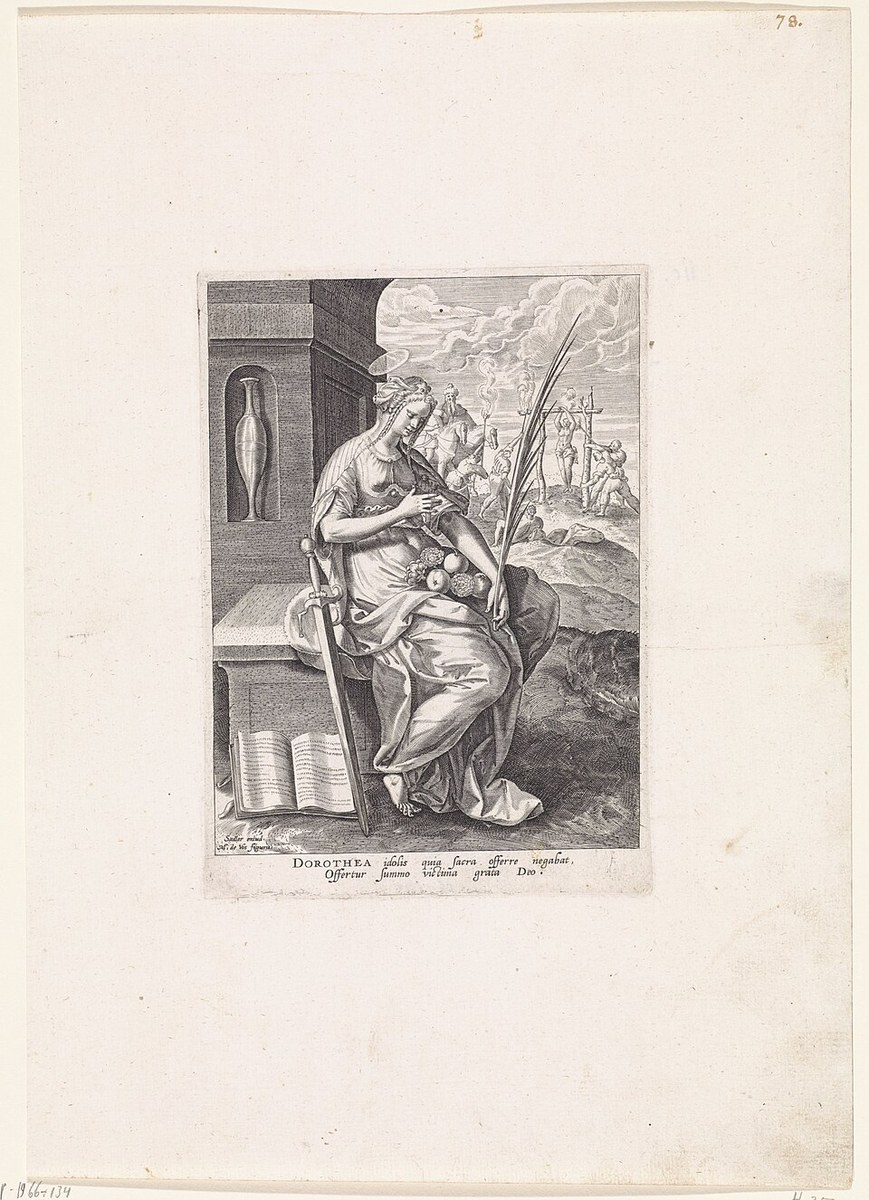
Dorothea is shown in the type of the virgin-martyr: a young woman crowned or veiled, in the maiden's robe, holding the cross of martyrdom and, as her constant emblem, a basket of roses and fruit — the roses of paradise sent to Theophilus; a small child bearing the basket may attend her, and the sword of her beheading lies near. The scene of the miracle of the roses and her martyrdom is her narrative image.
The stored image is a Western engraving by Johann Sadeler I after Maerten de Vos (1583–1587; Rijksmuseum), inscribed DOROTHEA, in which the saint is seated with the palm of martyrdom, the sword, and the basket of roses and apples of her miracle, her martyrdom shown in the background — an identity-verified depiction of this Dorothea, chosen for want of a licence-clean pre-modern Byzantine image (source, public domain, pd-old-work). An Eastern icon remains wanted.
Disputed questions
- The historical record. As with many of the great virgin-martyrs, the surviving acta of Dorothea are late and legendary in form, and the earliest notice — in the Martyrologium Hieronymianum — gives little beyond her name, her city, the date, and the name of Theophilus. The Church keeps her venerable history as it has received it, while acknowledging that the biographical detail cannot be verified against contemporary record. The date is placed variously in the range c. 288–304 (and by some c. 311); it belongs to the Diocletianic persecution.
- Not to be confused with the masculine saints of the like name — the venerable Dorotheus of Gaza, disciple of the elders of the previous entry, or Dorotheus the Hermit of Egypt (September 16). Dorothea is the virgin-martyr of Caesarea in Cappadocia, kept February 6.