
Dositheus of Gaza
Our Venerable Father Dositheus, Disciple of Abba Dorotheus of Gaza
Venerable · d. c. 530
Commemorated 19 February
Dositheus (sixth century) was the young disciple of Abba Dorotheus of Gaza, and the living illustration of his master's teaching on obedience. A pampered youth of a rich house, ignorant of the faith, he was converted by a vision at the holy places of Jerusalem and entered the coenobium of Abba Seridos near Gaza, where he was given wholly into the care of Dorotheus. In some five years he was so refined by a perfect, unquestioning obedience — cutting off his own will in the smallest things, even his fondness for fine food and his craft as an infirmarian — that when he died young of consumption, the great elders Barsanuphius and John declared his measure equal to that of the aged ascetics. His Life, written by Dorotheus, and the sayings that frame it, are a classic of the literature of monastic obedience.
_-_%D0%B8%D0%BA%D0%BE%D0%BD%D0%B0_06191_%D0%94%D0%BE%D1%81%D0%B8%D1%84%D0%B5%D0%B9.png)
The pampered youth and his conversion
Dositheus was, by Dorotheus's account, a youth of a wealthy and worldly household, reared in soft living and knowing almost nothing of God — he had not so much as heard the name of God spoken with understanding. Attached to the service of a military officer, a kinsman, he was one day moved by talk of Jerusalem and the holy places to make the pilgrimage. At Gethsemane he came upon a painted image of the Last Judgment, and stood gazing at the torments of the damned; a grave and majestic woman — the tradition understands her to be the Most Holy Theotokos — appeared beside him and taught him how to escape that fire: by fasting, by abstaining from meat, and by praying continually. From that hour he was changed, and sought out the monastic life.
Obedience under Dorotheus at the coenobium of Seridos
He came to the great coenobium of Abba Seridos near Gaza — the same community that sheltered the recluses Barsanuphius and John — and was received and given into the charge of Dorotheus, then guest-master and infirmarian, who became his elder. Dorotheus set himself to train the untried and self-willed boy by a total cutting off of his own will. Dositheus was gluttonous, and was weaned by degrees from the abundance and daintiness of food he had known, until he ate little and plainly, and would take nothing without his elder's word. He was set to serve in the infirmary, where he tended the sick with such love and skill that he was greatly esteemed — and even here Dorotheus watched that he should keep no attachment of his own: bidden to give up a fine knife or a garment he had come to like, he surrendered it at once and without a murmur. Above all he was schooled never to answer back, never to keep anger, never to act on his own judgment — so that his whole short life became a single exercise of the surrender of the self, done not in insensibility but in love.
Repose, and the witness of the elders
After some five years Dositheus fell mortally ill of a wasting disease (consumption), his strength broken as much by the ardour of his life as by the sickness. As he lay dying he asked his elder's leave to depart, and Dorotheus, with the counsel of the great old men, at last blessed him: "Go in peace, and stand before the Holy Trinity, and intercede for us." He reposed young, having been in the monastery only those few years. When some of the brethren, who had not understood the hidden greatness of so young and unremarkable a monk, murmured that he had been reckoned among the perfect, it was revealed to a holy elder — and confirmed by Barsanuphius and John — that Dositheus, by his obedience, had attained the measure of the greatest ascetics of the desert, and stood among them in glory. His memory was kept in the community, and his Life set down by his own elder.
Feast and commemoration
February 19 (church date; New Calendar civil February 19; Old Calendar civil March 4), a synaxarion commemoration of the venerable Dositheus, kept in the Greek and Slavic calendars and by the OCA (which places him in the "sixth–seventh century"). No proper service is appointed; where his memory is kept liturgically the common of a venerable monk is used. His feast falls on the day led by the apostle Archippus and honoured for the martyr Philothei of Athens.
Hymns
Troparion — Tone 8 (from the common of a venerable one)
By a flood of tears thou didst make the barren desert bloom, and by thy deep sighing thou didst bring forth fruit a hundredfold in labours, and wast made a beacon shining upon the world by thy miracles, O Dositheus our father. Intercede with Christ God that our souls may be saved.
Original translation from the Greek
Iconography
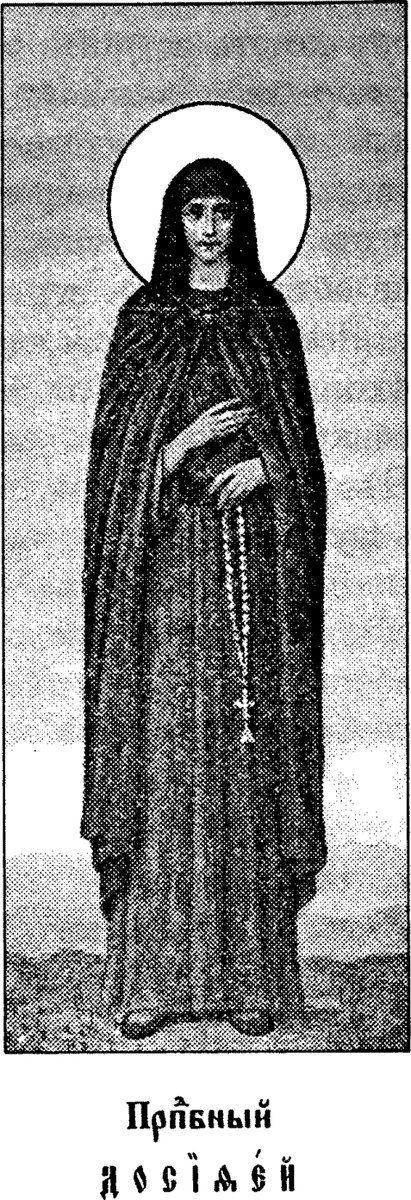
Dositheus is depicted as a young monk — beardless or with the first down of a beard, in the dark monastic rasson and often the analavos — set apart among the elders by his youth; he may hold a scroll, or be shown as an infirmarian serving the sick, or receiving the blessing of his elder Dorotheus. The stored image is a lithograph from Dimitry of Rostov's Lives of the Saints (the February volume, 1903–1911), depicting the venerable Dositheus as a young monk — a public-domain reproduction; a pre-modern icon or menologion miniature would be an upgrade.
Disputed questions
- Not to be confused with Dositheus of the Kiev Caves (the Russian recluse of the eighteenth century associated with the young Prochor Moshnin — the future Seraphim of Sarov — whom "Dositheus" is said to have blessed to go to Sarov, a figure whom later research identified with the concealed woman-ascetic Dosithea of Kitaev); nor with the several other Dosithei of the Russian calendar. The Dositheus of this entry is the sixth-century Gaza disciple of Dorotheus, known from Dorotheus's own writings.
- Date. Dorotheus of Gaza flourished in the first half of the sixth century; Dositheus, his disciple, reposed young, about the year 530. The OCA styles him "of the sixth–seventh century"; the earlier dating is followed here on the chronology of Dorotheus and of the elders Barsanuphius and John.