
Elizabeth the New Martyr
The Holy New Venerable-Martyr Elizabeth, Grand Duchess of Russia, Foundress of the Convent of Saints Martha and Mary
Venerable Martyr · New Martyr · Princess · b. 1 November 1864, at Bessungen near Darmstadt (Hesse) — d. 18 July 1918 (5 July Old Style), at the Nizhnyaya Selimskaya mine near Alapaevsk
Commemorated 5 July — Martyrdom in the mine-shaft at Alapaevsk, 1918
Elizabeth Feodorovna (1864–1918), born a princess of Hesse and by Rhine and a grand-daughter of Queen Victoria, married the Grand Duke Sergei Alexandrovich of Russia, received Orthodoxy freely in 1891, and after her husband's assassination by a terrorist bomb in 1905 — she gathered his remains from the Kremlin snow with her own hands, and went to the prison to forgive his murderer — sold everything she had and founded in Moscow the Convent of Saints Martha and Mary, a community of nursing sisters serving the poorest quarters of the city. Arrested by the Bolsheviks in 1918 and deported to the Urals, she was thrown alive with seven others down a disused mine-shaft near Alapaevsk on the night of 18 July 1918, and lived some hours at the bottom, binding the wounds of a fellow victim and singing. Her relics rest at Gethsemane in Jerusalem. She was glorified by the Church Abroad in 1981 and by the Moscow Patriarchate in 1992.

Origins and early life
Elisabeth Alexandra Luise Alice was born on 1 November 1864 at Bessungen, near Darmstadt, the second daughter of Ludwig IV, Grand Duke of Hesse and by Rhine, and of Princess Alice of the United Kingdom, the second daughter of Queen Victoria. In the family she was always "Ella." Her younger sister Alix would become the Empress Alexandra Feodorovna of Russia, and would die at Ekaterinburg the day before Elizabeth died at Alapaevsk.
The household was Lutheran, English in its habits and unusually serious. Princess Alice took her daughters with her to visit hospitals and the wards of the poor, and it was a settled rule of the house that the children should make their own beds and clean their own rooms. In November 1878 diphtheria swept the family; Elizabeth's youngest sister Marie died, and then her mother, who had nursed them all. Elizabeth was fourteen. She and her sisters were much at the English court thereafter, and Queen Victoria — who thought her the most beautiful young woman in Europe — took a close hand in her upbringing and would have preferred a German marriage for her.
Marriage and reception into Orthodoxy
She refused, among others, her cousin the future Kaiser Wilhelm II, and in June 1884 married the Grand Duke Sergei Alexandrovich, fifth son of the Emperor Alexander II, in the chapel of the Winter Palace at St Petersburg. Russian law did not require the bride of a grand duke who was not heir to the throne to change her religion, and Elizabeth did not change it for seven years. She learned Russian, she went with her husband to the services, and she read; and in 1891, on Lazarus Saturday, she was received into the Orthodox Church by chrismation, keeping her own name. She wrote to her father — who was distressed, and did not send the blessing she asked for — that she was acting from conviction and not from any wish to please, and that she could no longer stand in the church of her husband's people as a stranger to their communion. Her often-quoted account of what moved her is simply the service itself.
The marriage was childless. When Elizabeth's brother-in-law Grand Duke Paul was widowed, the couple brought up his children, Maria and Dmitri Pavlovich, as their own. In 1891 Sergei was appointed Governor-General of Moscow, a post he held through years of rising revolutionary violence and in which he was thoroughly hated by the revolutionary parties.
The murder of Grand Duke Sergei, and the visit to Kaliayev
On 17 February 1905 (4 February Old Style), as Sergei drove out of the Nikolsky Gate of the Kremlin, the Socialist-Revolutionary Ivan Kaliayev threw a bomb into his carriage at close range. Elizabeth, hearing the explosion from the Nicholas Palace, ran out into the square and, kneeling in the snow among the wreckage, gathered her husband's remains with her own hands.
Some days later she went, alone, to the prison where Kaliayev was held. She told him she brought him forgiveness from her husband, asked him to repent, left him a Gospel and a small icon, and afterwards petitioned the Emperor for his pardon. Kaliayev refused to ask for it and was hanged. The visit was widely reported and as widely misunderstood — as sentimentality, as a political manoeuvre — but it is the hinge of her life: from that moment she withdrew entirely from the court, gave up meat, wore mourning and then a habit, and turned to the work that occupied her remaining thirteen years.
The Convent of Saints Martha and Mary
Elizabeth sold her jewels — returning to the imperial family what belonged to it, and keeping nothing, not even her wedding ring — and with the proceeds bought a property on Bolshaya Ordynka in Moscow. There in 1909 she opened the Convent of Saints Martha and Mary of Mercy (the Marfo-Mariinsky Obitel), and was dedicated with seventeen sisters as the first Sisters of Love and Mercy.
The community was deliberately not a monastery of the usual Russian kind. Its rule, drawn up with the counsel of her confessor Father Mitrophan Serebriansky, held the two sisters of Bethany together: prayer and active mercy, contemplation and the ward. The sisters took no irrevocable vows and might leave and marry; and the house maintained a hospital of some twenty-two beds, an out-patient clinic, a free dispensary which supplied the poor with medicines at no charge or at cost, an orphanage for girls, a school, a canteen and a library. Elizabeth herself worked in the wards, assisted at operations, and went by night into the Khitrov market — the worst slum in Moscow, a district the police entered only in numbers — to take children out of the cellars and lodging-houses and bring them to the convent. The beautiful church of the Protection of the Theotokos which she built there, by the architect Shchusev and painted by Nesterov, still stands.
She refused every suggestion that she leave Russia when the war came, and refused again in 1917 when the Kaiser and, later, the Swedish ministry offered to bring her out. She said that she would share whatever God sent to the people among whom she had chosen to live.
Arrest, Alapaevsk and martyrdom
She was arrested at the convent on Bright Tuesday, 7 May 1918, by a detachment of Latvian Cheka troops, given half an hour, and allowed to take with her two of her sisters. She was carried to Perm, then to Ekaterinburg, and in May to the small Urals factory town of Alapaevsk, where she was lodged with the other imperial prisoners in the Napolnaya school at the edge of the town. One of her two sisters, the nun Barbara (Yakovleva), was offered her freedom, refused it, and stayed; the other was sent away.
On the night of 17–18 July 1918 — the night after the shooting of the imperial family at Ekaterinburg — the prisoners were roused, told they were being moved, driven some twelve miles into the forest to the abandoned iron-mine of Nizhnyaya Selimskaya, beaten, and thrown alive down the shaft. Elizabeth was thrown first. Grenades were flung down after them, and brushwood was set alight at the mouth of the shaft. The peasants of the nearest village afterwards testified that for a long time they heard singing rising out of the ground — the Cherubic Hymn, they said, and the prayer to the Theotokos — and that the singing did not stop at once.
When the mine was opened in October 1918, after the town changed hands, the bodies were brought up. Elizabeth had fallen onto a ledge some seventy feet down rather than into the water at the bottom; beside her lay Prince John Konstantinovich, whose head she had bandaged with her own wimple in the darkness, though her own injuries were mortal. Her right hand was found folded in the sign of the cross. Beside her was an icon of Christ Not-made-by-hands that she had worn since her chrismation.
Relics and translations
The eight coffins were carried east ahead of the retreating armies, through Chita, and in 1920 to Peking, where they were laid in the cemetery of the Russian Ecclesiastical Mission. Elizabeth had said, after her pilgrimage to the Holy Land in 1888 for the consecration of the church her family had built at Gethsemane, that she would be glad to be buried there. In 1921 her sister the Marchioness of Milford Haven arranged for her coffin and that of the nun Barbara to be taken from Peking to Jerusalem, where they were received by the Patriarch and laid in the church of Saint Mary Magdalene in Gethsemane, beneath the Mount of Olives, and where they remain.
The relics were found incorrupt when the coffins were opened in 1981. Portions were taken in 2004–2005 on a long journey through the dioceses of Russia and the former Soviet territories, where several million people venerated them, before returning to Jerusalem; other portions rest at the restored Convent of Saints Martha and Mary in Moscow.
Veneration
Elizabeth and the nun Barbara were glorified by the Russian Orthodox Church Outside Russia in 1981, among the New Martyrs and Confessors of Russia, and by the Moscow Patriarchate in 1992. In 1998 her figure was set among the ten twentieth-century martyrs carved above the west door of Westminster Abbey — the only Orthodox saint among them. Her convent on the Ordynka, closed by the Soviet authorities in 1926 and used for many years as a cinema and a laboratory, has been restored and again keeps her rule.
Feast and commemoration
July 5 (church date; Old Calendar civil July 18 — the anniversary of the murder). She is commemorated with the nun Barbara, and in the usage of the Church Abroad with the other martyrs of Alapaevsk. She is also named among the New Martyrs and Confessors of Russia, whose synaxis is movable (the Sunday nearest 25 January). Her feast falls on the same day as Athanasius of Athos and the uncovering of the relics of Sergius of Radonezh, so that in Russian usage July 5 carries both the greatest of the Athonite founders and the Grand Duchess who died in the Urals.
Hymns
Troparion — Tone 1
Having taken up the humility of Christ, thou didst put off the purple of an earthly princess and clothe thyself in the habit of mercy; and having served the poor and the suffering with thine own hands, thou didst descend as into a tomb into the pit of the ungodly, singing there the hymn of the Cherubim. O holy Martyr Elizabeth, with Barbara thy companion, entreat Christ God that our souls may be saved.
Original translation from the Slavonic
Kontakion — Tone 2
Forgiveness thou didst carry to thy husband's murderer, and thy jewels thou didst give to the poor; and when the hour of thy passion came thou didst bind up thy neighbour's wounds in the darkness of the shaft. Wherefore, O Elizabeth, the Church that is in Russia honoureth thee as a lamp of mercy shining in a night of blood.
Original translation from the Slavonic
Iconography
Elizabeth is written as a nun-martyr in the grey-white habit and veil of her own community — not the black of a Russian monastic, since she and her sisters wore a dove-grey habit with a white wimple — holding the martyr's cross in her right hand, and in her left either a scroll, a model of the church of the Protection on the Ordynka, or a small vessel of myrrh, which links her to the Myrrhbearers and to the Martha and Mary of her convent's name. She is very often paired with the nun Barbara, smaller and slightly behind her, and in Church Abroad icons stands at the head of the whole company of Alapaevsk before the black mouth of the mine-shaft. In the composite icons of the New Martyrs of Russia she is placed among the foremost figures.
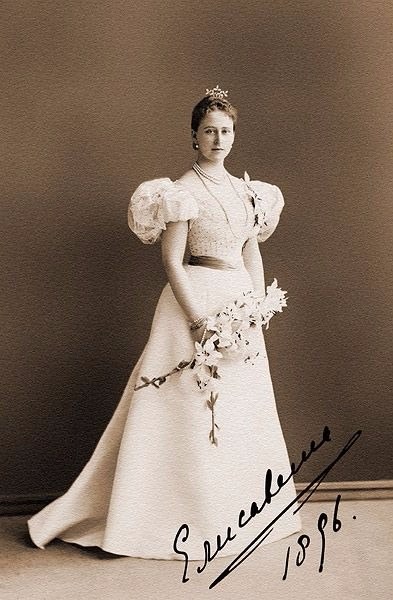
No pre-1900 or otherwise licence-clean image can exist of a saint who died in 1918: every icon of her is a modern work in copyright, and photographs of her, though many survive, are not icons. The stored image is her signed photograph of 1896 — "Елисавета 1896" in her own hand — stored per the §50 ruling, which resolved this entry's earlier refusal. A free-licensed painted icon remains the eventual want and is listed among the upgrade-wanted icons.
Disputed questions
- Which day is her feast? Her repose fell on 18 July 1918 by the civil (Gregorian) calendar, which is 5 July by the Julian reckoning of the Church. The Russian Church therefore keeps her on the church date July 5, which for the Old Calendar falls on civil July 18 — the true anniversary. New Calendar jurisdictions that keep her, including the OCA, commemorate her on civil July 5; the discrepancy is inherent in the calendars and is not a disagreement about the date of her death.
- Not to be confused with Elizabeth the Wonderworker of Constantinople (April 24), nor with the Righteous Elizabeth, mother of the Forerunner.
- Her companions. The Church Abroad glorified all the Alapaevsk victims in 1981; the Moscow Patriarchate has canonised only Elizabeth and Barbara. See the Martyrs of Alapaevsk.