
Ephraim of Pereyaslavl
Our Father among the Saints Ephraim, Bishop of Pereyaslavl, of the Kiev Caves
Bishop · Venerable · d. c. 1098, buried in the Far Caves of Kiev
Commemorated 28 January — Principal commemoration, 28 September — Synaxis of the Fathers of the Kiev Caves Far Caves
Ephraim of the Kiev Caves (†c. 1098) was a courtier of the Great Prince Izyaslav of Kiev who left the prince's service to become a monk under Saints Anthony and Theodosius at the Caves monastery. Sent to Constantinople, he brought back a copy of the Studite Rule, which Theodosius adopted as the constitution of the Caves and, through it, of Russian monasticism. Later consecrated bishop (and metropolitan) of Pereyaslavl, he adorned his city with churches and stone walls "in the Greek manner" and, in a work of rare Christian philanthropy, built free hospitals and public bath-houses for the poor and for travellers. He reposed about 1098 and was buried in the Far (Anthony) Caves, where his relics rest. He is commemorated on January 28 and among the Fathers of the Far Caves.

Courtier and monk
Ephraim served at the court of the Great Prince Izyaslav Yaroslavich of Kiev (reigned, with interruptions, 1054–1078) as treasurer and steward of the household — a man of trust in the prince's inner circle. (The tradition adds that he was a eunuch, whence one of his by-names.) Drawn to the monastic life, he came to the newly founded Caves monastery and sought tonsure under its founder Anthony of the Caves, receiving the habit from the hand of Nikon. The prince, angered at losing so valued a servant, threatened to imprison the monks and raze their caves; but — the chronicle of the monastery relates — his wife dissuaded him, warning of the divine punishment such violence against God's servants would bring, and Izyaslav relented. Thus early did the Caves monastery learn to stand against the powers of the world for the freedom of the monastic calling.
The Studite Rule from Constantinople
With the blessing of Saint Anthony, Ephraim travelled to Constantinople, where he lived in a monastery and copied out the Rule of the Studion — the great Constantinopolitan monastic typikon of Theodore the Studite. At the request of Theodosius of the Caves, then abbot, he brought this Rule back to Kiev, and Theodosius adopted it as the governing order of the Caves community. Through this act Ephraim stands at the fountainhead of organised Russian cenobitic monasticism: the Studite discipline he carried home became, by way of the Caves, the pattern for monasteries throughout the Rus' lands.
Bishop of Pereyaslavl
Some time after 1072 Ephraim was consecrated bishop of Pereyaslavl (Pereyaslav, south-east of Kiev), a see that in this period bore for a time the dignity of a metropolitanate. As hierarch he proved a great builder and benefactor. He "adorned Pereyaslavl with many beautiful churches and public buildings," raised stone walls around the city in the Greek manner, and — in the act for which he is most remembered — established free hospices and hospitals for the poor and for travellers, and built public bath-houses, the first such works of organised charity recorded in the land of Rus'. In 1091 he took part in the solemn translation of the relics of Saint Theodosius of the Caves, the abbot whose Rule he had once carried from Constantinople.
Repose
Ephraim reposed about the year 1098 and was buried in the Far (Anthony) Caves of the Kiev Caves monastery, where his incorrupt relics are venerated among the fathers of that place.
Feast and commemoration
Ephraim is commemorated on January 28 (church date; Old Calendar civil February 10), his principal feast; on September 28 with the Synaxis of the Fathers of the Far (Anthony) Caves; and on the Second Sunday of Great Lent, with the general synaxis of the Kiev Caves saints. His is a Russian and Ukrainian commemoration; he does not appear on the universal Byzantine calendar. He shares January 28 with the two Syrian fathers Ephrem and Isaac — and with a second Slavic Ephraim, of Novy Torg — a coincidence of names noted below.
Hymns
Troparion — Tone 4
The truth of things did make thee to thy flock a rule of faith, a model of meekness, and a teacher of temperance; thou didst gather wisdom through humility, and riches through poverty. O Father and hierarch Ephraim, intercede with Christ our God that our souls may be saved.
Original translation from the Slavonic
Iconography
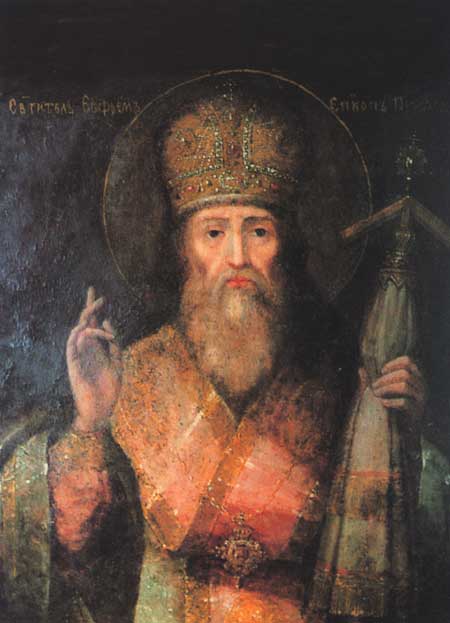
Ephraim is depicted as an Orthodox bishop in the vesture of a hierarch — the phelonion or sakkos, the omophorion, blessing or holding the Gospel — grey- or brown-bearded, in the manner of the Kiev Caves fathers; in the collective icons of the saints of the Far Caves he takes his place among them.
The stored image is an icon of Ephraim, Bishop of Pereyaslavl, of the nineteenth century or earlier, from the Kiev Caves Lavra: the saint vested as a hierarch and inscribed with his name (source, public domain, pd-old-work).
Disputed questions
- Not to be confused with Ephrem the Syrian (†373), the fourth-century Harp of the Holy Spirit, with whom he shares this day; nor with Ephraim of Novy Torg (Novotorzhsk) (†1053), the Hungarian-born abbot and wonderworker of Torzhok, likewise commemorated on January 28. All three Ephraims fall on the one day, and are readily confused; each is a distinct saint of a distinct age and land. Distinct again is Ephraim of Cherson, one of the fourth-century Hieromartyrs of Cherson (March 7), the bishop-martyr who preached among the peoples of the Danube.