
Ephrem the Syrian
Our Venerable Father Ephrem the Syrian, Deacon of Edessa and Teacher of the Church
Venerable · Deacon · b. c. 306, at Nisibis in Mesopotamia — d. 373, at Edessa
Commemorated 28 January — Repose at Edessa
Ephrem the Syrian (c. 306–373) was a deacon of Edessa and the greatest of the Syriac Fathers — poet, theologian, and teacher, whom the tradition names the Harp of the Holy Spirit. Born at Nisibis on the Roman–Persian frontier and formed under its bishop James of Nisibis, he taught in the schools of Nisibis and, after that city passed to Persia in 363, of Edessa, where he spent his last decade as an ascetic. He fought the heresies of his age — Bardaisan, Marcion, Mani, and the Arians — not chiefly in prose but in hymns (madrāšê) and metrical homilies (memrê) of extraordinary beauty, giving the faith of Nicaea to the Syriac Church in verse the people could sing. A deacon who is said to have fled ordination to the priesthood and the episcopate, humble and given to tears of compunction, he organised famine-relief at Edessa in his last days and reposed in 373. The Byzantine Church keeps him on January 28; his Lenten prayer, "O Lord and Master of my life," is prayed with prostrations throughout Great Lent.
.jpg)
Origins and early life at Nisibis
Ephrem was born about the year 306 at Nisibis (modern Nusaybin), the great fortress-city on the frontier between the Roman Empire and Sasanian Persia, in the first years of the Peace of the Church. The Syriac tradition, and Ephrem's own writings, present him as a Christian from childhood; a later Greek life makes his father a pagan priest, but this contradicts Ephrem's own testimony that he was reared in the faith ("I was born in the way of truth," he writes), and is not credited. He grew up under the shadow of the last persecutions and the first of the Persian wars, in a border city that changed the whole shape of his life.
Nisibis in Ephrem's youth was governed by its first bishop, James of Nisibis — one of the 318 Fathers of the First Ecumenical Council at Nicaea (325) and, the tradition holds, Ephrem's own teacher and the man who baptised him. Ephrem attached himself to James and to the school of the city, and it was under James and his successors — Babu, Vologeses, and Abraham — that he was formed as an interpreter of Scripture and a servant of the Church. He entered the ranks of the "sons of the covenant" (bnay qyāmā), the consecrated ascetics of the early Syriac Church who lived a celibate and prayerful life in the midst of the community rather than in the desert, and among them he began to teach and to compose. The tradition remembers him assisting James during the Persian sieges of Nisibis under Shapur II — three great sieges in Ephrem's lifetime (338, 346, 350) — and ascribes the city's deliverance to the bishop's prayers; Ephrem's own Hymns on Nisibis (the Carmina Nisibena) sing the city as a bride guarded by God, and are among the earliest witnesses to its history.
Deacon and teacher
Ephrem was ordained deacon, and deacon he remained to the end — the office in which the Church commemorates him. A firm tradition, told in several forms, holds that he fled higher ordination: that when he was to be made priest, or (in the fuller version) when the people would have consecrated him bishop, he feigned madness in the streets to escape the honour, judging himself unworthy of the altar's higher service. Whether or not the detail is literal, it fixes the memory of Ephrem the Church has always kept — a man of profound humility and self-accusing compunction, who wept for his sins as though he were the chief of sinners, and who made of that penitential tenderness the very key of his teaching.
As a teacher (malpānā) he stood at the head of the catechetical school — the "School of the Persians," which travelled with the exiles from Nisibis to Edessa — expounding the Scriptures and training the faithful. His method was not the syllogism of the Greek schools but the symbol and the type: for Ephrem the whole created order and the whole of Scripture are woven of symbols (rāzê) that point to Christ, and theology is less a matter of definition than of wonder before the God who cannot be contained. "If someone concentrates his attention solely on the metaphors used of God's majesty," he warned, "he abuses and misrepresents that majesty… and thus errs" — yet the metaphors are God's own gift, "put on" by the Most High as a man puts on clothing, that we might draw near. This refusal to pry into the divine essence, joined to an unbounded reverence, makes Ephrem at once the poet of the Syriac Church and one of the surest guides of its faith.
From Nisibis to Edessa
In 363 the emperor Julian the Apostate fell in his Persian campaign, and his successor Jovian, to extricate the Roman army, ceded Nisibis to Persia. The Christian population was given leave to depart, and Ephrem departed with them, going west to Edessa (modern Urfa), the Christian city of Osrhoene that treasured the memory of King Abgar and the Apostle Thaddaeus. There Ephrem passed the last decade of his life. He lived as an ascetic in a cave in the hills above the city, coming down to teach, to preach, and to write; he laboured in the famous School of Edessa, which under his influence became the fountainhead of Syriac Christian learning; and he threw himself into the controversies that troubled the Edessene church, where Arians, the followers of Bardaisan, the Marcionites, and the Manichaeans all contended for the people.
It is to this Edessene period that the tradition assigns his celebrated meeting with Basil the Great at Caesarea in Cappadocia — the two great fathers of East and West Syria and of Cappadocia recognising one another's holiness, Basil marvelling that so unlettered-seeming a Syrian should be a vessel of such grace, and (some accounts add) ordaining Ephrem deacon with his own hand. The meeting is late and legendary in its details and cannot be pressed as biography; but it enshrines a true perception — that Ephrem belonged, for all his Syriac tongue, to the one company of the Nicene Fathers, and that the Greek Church knew it.
The hymns: the Harp of the Holy Spirit
Ephrem's enduring monument is his poetry. He wrote in two great verse forms. The memrā is a metrical homily in couplets of a single metre, a sermon in verse. The madrāšā — the form that made him — is a strophic teaching-hymn, built on a repeating metrical pattern with a sung refrain (ʿūnitā), composed to be chanted by a choir. The tradition credits Ephrem with organising choirs of consecrated women at Edessa (and earlier at Nisibis) to sing these hymns in the services, setting sound doctrine to melody so that the faithful carried the true faith home on their lips — a deliberate answer to the heretic Bardaisan, whose own attractive hymns had spread his errors. For this gift the Syriac Church named Ephrem kennārā d-Rūḥā, the Harp (or Lyre) of the Holy Spirit, and the Byzantine hymnographers took up the title after her.
The surviving corpus is vast: the Hymns on Faith (with the sub-cycle On the Pearl, meditating on the pearl as an image of Christ and of faith); the Hymns on the Nativity, on the Epiphany, on Virginity, on the Church, on Paradise (a luminous vision of the restored garden and the ascent of the soul), on the Unleavened Bread and the Crucifixion and the Resurrection; the Hymns against Heresies and against Julian; the Carmina Nisibena; and the verse and prose Commentaries on Genesis, Exodus, the Diatessaron (Tatian's gospel-harmony, which Ephrem read and expounded), and other books. Through all of it run the same notes: the types and symbols binding the two Testaments and all creation to Christ; the wonder of the Incarnation, the "Most High who bent down" and put on a body; a tender Marian devotion; the paradise of the penitent; and above all compunction and tears as the soul's return to God.
Repose
Ephrem's last recorded act was one of mercy. A famine struck Edessa toward the end of his life; the tradition tells how the old deacon left his cell, rebuked the rich who were hoarding grain, and himself took charge of the relief of the starving, organising the distribution of food and the care of the sick and dying in improvised shelters. His labours spent, he returned to his cell and reposed soon after, in the year 373. He had asked in his Testament — a moving poem of self-accusation and humility — to be buried without pomp, in a pauper's grave, wrapped in the clothes of the poor: "Lay me not with sweet spices, for this honour avails me nothing; nor incense, for the honour is not mine." The Syriac Church kept his memory from the first; within a generation his hymns were being translated, and his fame spread East and West until, as Jerome noted before the century was out, his writings were read publicly in some churches after the Scriptures.
Feast and commemoration
Ephrem is kept universally on January 28 (church date; Old Calendar civil February 10). The Syriac and Western reckonings that attach to the day of his actual repose vary (the Syriac tradition and the later Roman calendar have kept June 9), but the Byzantine calendar — Antiochian, Greek, and Slavic alike — commemorates the Harp of the Holy Spirit on January 28, and it is on this day that his office stands in the Menaion. The date is fitting: his feast falls in the weeks before Great Lent, whose spirit — compunction, tears, the watch upon the self — is Ephrem's own, and whose most famous prayer is his. He is honoured throughout the Church as a Teacher (the West, since 1920, styles him a Doctor of the Church); the Byzantine tradition ranks him among the great ascetic teachers and reads his works widely in the monasteries and in the Philokalia's ascetic stream.
He shares his day with a second and later Syrian father of the first rank, Isaac the Syrian of Nineveh, so that January 28 is, in effect, the feast of the two greatest ascetic doctors of the Syriac East.
He is not to be confused with the other saints named Ephraim of the calendar — among them Ephraim of Cherson, one of the fourth-century Hieromartyrs of Cherson (March 7), the bishop-martyr beheaded among the peoples of the Danube; Ephraim of Antioch (†545, June 8), the Syrian of Amida who was Count of the East before he was raised to the throne of Antioch — likeliest of all to be confused with him, since both were Syrians of upper Mesopotamia bearing the same name; and Ephraim of Pereyaslavl, the eleventh-century Russian hierarch who shares Ephrem's own day of January 28. "The Syrian," the Harp of the Holy Spirit, is this Ephrem of Nisibis and Edessa alone.
Hymns
Troparion — Tone 8
By the streams of thy tears thou didst till the barrenness of the desert, and by thy sighing from the depths thou didst bring forth fruit a hundredfold in thy labours; and thou becamest a luminary for the whole world, shining with wonders. O Ephrem our holy Father, intercede with Christ our God that our souls may be saved.
Original translation from the Greek
Kontakion — Tone 2
Ever foreseeing the hour of the reckoning, thou didst mourn bitterly, O Ephrem, as a lover of stillness; and thou wast made a teacher fervent in deeds, O venerable one. Therefore, O Father of all the world, thou dost rouse the slothful to repentance.
Original translation from the Greek
The
O Lord and Master of my life, give me not a spirit of idleness, of meddling, of love of power, and of vain talking. But bestow upon me thy servant a spirit of soberness, of humility, of patience, and of love. Yea, O Lord and King, grant me to see mine own transgressions, and not to condemn my brother; for blessed art thou unto the ages of ages. Amen.
Appointed readings
Epistle — Galatians 5:22–26; 6:1–2
22But the fruit of the Spirit is love, joy, peace, longsuffering, gentleness, goodness, faith, 23Meekness, temperance: against such there is no law. 24And they that are Christ’s have crucified the flesh with the affections and lusts. 25If we live in the Spirit, let us also walk in the Spirit. 26Let us not be desirous of vain glory, provoking one another, envying one another. 1Brethren, if a man be overtaken in a fault, ye which are spiritual, restore such an one in the spirit of meekness; considering thyself, lest thou also be tempted. 2Bear ye one another’s burdens, and so fulfil the law of Christ.
Gospel — Luke 6:17–23
17And he came down with them, and stood in the plain, and the company of his disciples, and a great multitude of people out of all Judæa and Jerusalem, and from the sea coast of Tyre and Sidon, which came to hear him, and to be healed of their diseases; 18And they that were vexed with unclean spirits: and they were healed. 19And the whole multitude sought to touch him: for there went virtue out of him, and healed them all. 20And he lifted up his eyes on his disciples, and said, Blessed be ye poor: for yours is the kingdom of God. 21Blessed are ye that hunger now: for ye shall be filled. Blessed are ye that weep now: for ye shall laugh. 22Blessed are ye, when men shall hate you, and when they shall separate you from their company, and shall reproach you, and cast out your name as evil, for the Son of man’s sake. 23Rejoice ye in that day, and leap for joy: for, behold, your reward is great in heaven: for in the like manner did their fathers unto the prophets.
Iconography
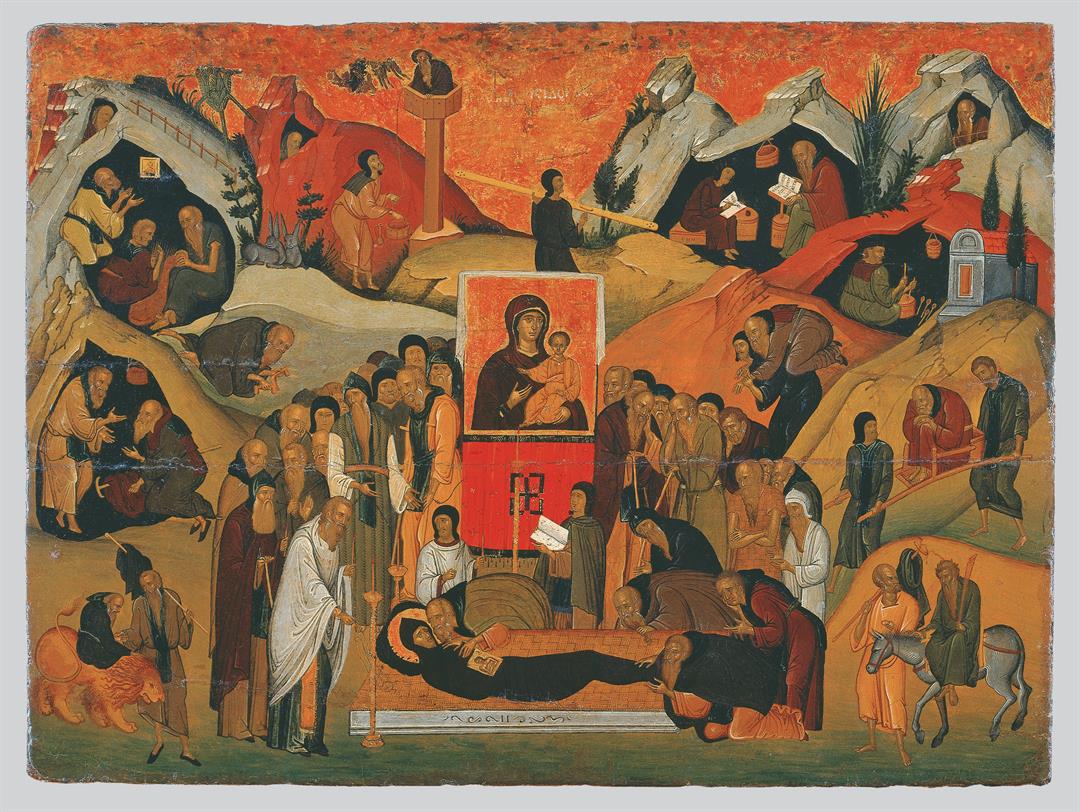
Ephrem is depicted as an aged monk — bald or grey, with a long white beard, stooped and thin from asceticism — in the dark habit of a deacon-monk, often holding a scroll of his teaching or a book. His most distinctive image, however, is the great narrative composition of the Dormition (Koimesis) of Ephrem: the dead saint laid out on his bier in the centre, surrounded by the whole world of Syrian and Egyptian monasticism gathered to mourn him — hermits emerging from mountain caves, stylites on their pillars, monks reading, digging, weaving baskets, plaiting mats, burying the dead, drawing water — a panorama of the ascetic life of which Ephrem was reckoned a father. The type is among the most crowded and beloved in the Byzantine repertoire.
The stored image is a portable icon of the Dormition of Ephrem, painted by a mid-fifteenth-century Cretan master and now in the Byzantine and Christian Museum at Athens: Ephrem laid upon his bier amid the labours and prayers of the monastic world (source, public domain, pd-old-work).
Disputed questions
- The date of repose and the January 28 feast. Ephrem died in 373; the Syriac Churches and the later Roman calendar keep his memory on June 9, while the Byzantine calendar fixes the feast on January 28. The entry follows the Byzantine usage the Antiochian and Greek calendars keep, noting the June date.
- The Ephraem Graecus. A large body of Greek ascetic works circulated under Ephrem's name and did much to spread his fame, but a great part of it is not his — Greek compositions in his spirit and manner, some translated from lost Syriac originals, many independent. The Lenten Prayer belongs to this Greek tradition; it is received by the whole Church as Ephrem's and prayed as such, and its attribution, while not verifiable from the Syriac corpus, is honoured here as the Church honours it.
- Not to be confused with the several later Slavic saints named Ephraim who share this very day: Ephraim, Bishop of Pereyaslavl of the Kiev Caves (†c. 1098), also kept January 28; and Ephraim of Novy Torg (Novotorzhsk) (†1053), the Hungarian-born abbot and wonderworker likewise commemorated on January 28. "The Syrian" belongs to this Ephrem alone — the fourth-century Harp of the Holy Spirit. Nor should he be confused with Ephraim of Nea Makri (†1426, feasts May 5 and January 3), the venerable-martyr of Mount Amomon in Attica whose relics were found in 1950: in modern Greek devotional material the bare name Ἅγιος Ἐφραίμ most often means that saint, whereas in patristic and liturgical contexts it means this one.