
Eulalia of Barcelona
The Holy Virgin-Martyr Eulalia of Barcelona
Martyr · Virgin · b. c. 290, near Barcinona (Barcelona) — d. c. 303–304, at Barcinona
Commemorated 22 August — Byzantine commemoration of her martyrdom under Dacian
Eulalia was a girl of about thirteen or fourteen from a Christian family of the country outside Barcinona — Roman Barcelona — who, when the governor Dacian came to the city in the persecution of Diocletian and Maximian to compel sacrifice, slipped out of her parents' house by night and denounced him to his face. She was scourged, torn with iron hooks, burnt with torches and set upon a cross, and died about the year 303; the tradition adds that the flames turned back upon her executioners, that a white dove was seen to leave her mouth as she gave up her spirit, and that snow fell and covered her body until the Christians came for it. With her the Byzantine calendar names the martyr Felix, who buried her and followed her in death. She is the patroness of Barcelona, and the Eastern Church keeps her on August 22.

A girl outside Barcinona
Her passion sets her in a house in the country near Barcinona, a coastal colony of Tarraconensis, and makes her the child of Christian parents who raised her in the faith. What the account says of her before the persecution is entirely ordinary and, for that reason, worth keeping: she was about fourteen, and her days were spent in prayer, the reading of the Scriptures, and handiwork — the wool and the needle that were the whole horizon of a well-brought-up girl of the Roman provinces. Her parents, seeing the storm coming, had taken her out of the city precisely to keep her from it.
Denouncing the governor
The persecution of Diocletian (284–305) and Maximian reached Spain through the governor Dacian, whose name stands over the passions of a whole cluster of Spanish martyrs — Vincent of Saragossa, Felix of Girona, the martyrs of Complutum. When Eulalia learned that he had come to Barcinona and was compelling the Christians to sacrifice, she left her parents' house at night, went into the city, and confronted him publicly at his tribunal, charging him with forcing men to abandon the true God for demons.
Dacian's reply was the ordinary machinery: rods, then the iron claws that stripped the flesh from the ribs, then torches applied to the wounds. The passion preserves a single exchange from the torture. Mocked and asked where her God was now, Eulalia answered that the Lord was standing beside her, and that Dacian, for the impurity of his life, could not see him. The torches, the account continues, blew back upon those who held them. She prayed to be released, and died — on a cross, in the received tradition, set upon a diagonal cross of the kind that has been her emblem in Catalan art ever since.
Two wonders close the narrative, and both are old: as she died a white dove came out of her mouth and flew upward, seen by the bystanders; and snow fell over the exposed body, covering its nakedness until the Christians dared to take it down — a detail that gave the Catalans their name for her, Santa Eulàlia de les Neus, "of the snows."
The martyr Felix
The Byzantine notice of the day couples her with a Felix, who came with the Christians on the third day to take up her body and, seeing her, wept for joy, saying that she had been the first among them to win the martyr's crown; and who was himself martyred soon afterwards. The Latin tradition knows him as Felix of Girona, an African-born deacon or missionary put to death under the same governor Dacian, whose own feast in the West falls on August 1. Whether the two are the same man is discussed below; the Eastern books commemorate him on this day, and no separate entry is made for him here.
Relics and cultus
Barcelona has kept her without interruption. Her tomb was venerated in the church of Santa Maria del Mar; in 878 the bishop Frodoin is said to have recovered the relics and translated them, and in 1339 they were moved into the alabaster sarcophagus in the crypt of the cathedral of Barcelona, which is dedicated to the Holy Cross and to St Eulalia and where they remain. She is co-patroness of the city, and her February feast is one of the great civic celebrations of Catalonia. The bishop Quiricus of Barcelona in the seventh century already writes of her, which is the earliest firm evidence of the local cult.
The Greek Church received her, as it received a small number of Western martyrs, through a translation of the Latin passion into Greek, and entered her in the Synaxarion of Constantinople under 22 August — a date unconnected with the Western observance and not now explicable. From the Greek books she passed into the Slavonic ones, and she is listed today by the Greek, Russian and OCA calendars alike on this day, which is how a fourth-century Catalan girl comes to be commemorated in the afterfeast of the Dormition alongside the martyrs of Nicomedia.
Feast and commemoration
August 22 (church date; Old Calendar civil September 4), within the afterfeast of the Dormition of the Theotokos — the Eastern commemoration, shared with Agathonicus of Nicomedia, who is the principal saint of the day. In the West she is kept on 12 February (with the translation of 1339 marked on 23 October in Barcelona), and it is the February feast that Catalonia observes with the Festes de Santa Eulàlia. The Byzantine books appoint her no proper office. This entry is keyed to the Eastern date, as the calendar of this collection requires; the Western date is recorded here and not in the entry's record, since it belongs to a different calendar and not to a second Byzantine feast.
Hymns
Apolytikion — Tone 4 (common of a woman martyr)
Thy ewe-lamb Eulalia crieth to thee with a great voice, O Jesus: Thee, my Bridegroom, do I love, and seeking thee I endure the contest; I am crucified and buried with thee in thy baptism, and I suffer for thy sake, that I may reign with thee; I die for thee, that I may live in thee. Receive me as a spotless sacrifice, slain for thee with love. By her prayers, since thou art merciful, save our souls.
Iconography
In the Greek and Slavonic menologia Eulalia is a young virgin-martyr: a girl in a long tunic and maphorion, hair bound or veiled, holding the cross of martyrdom, indistinguishable in type from the other virgin-martyrs of the calendar — the Byzantine painters had no local knowledge of her and gave her the standard form.
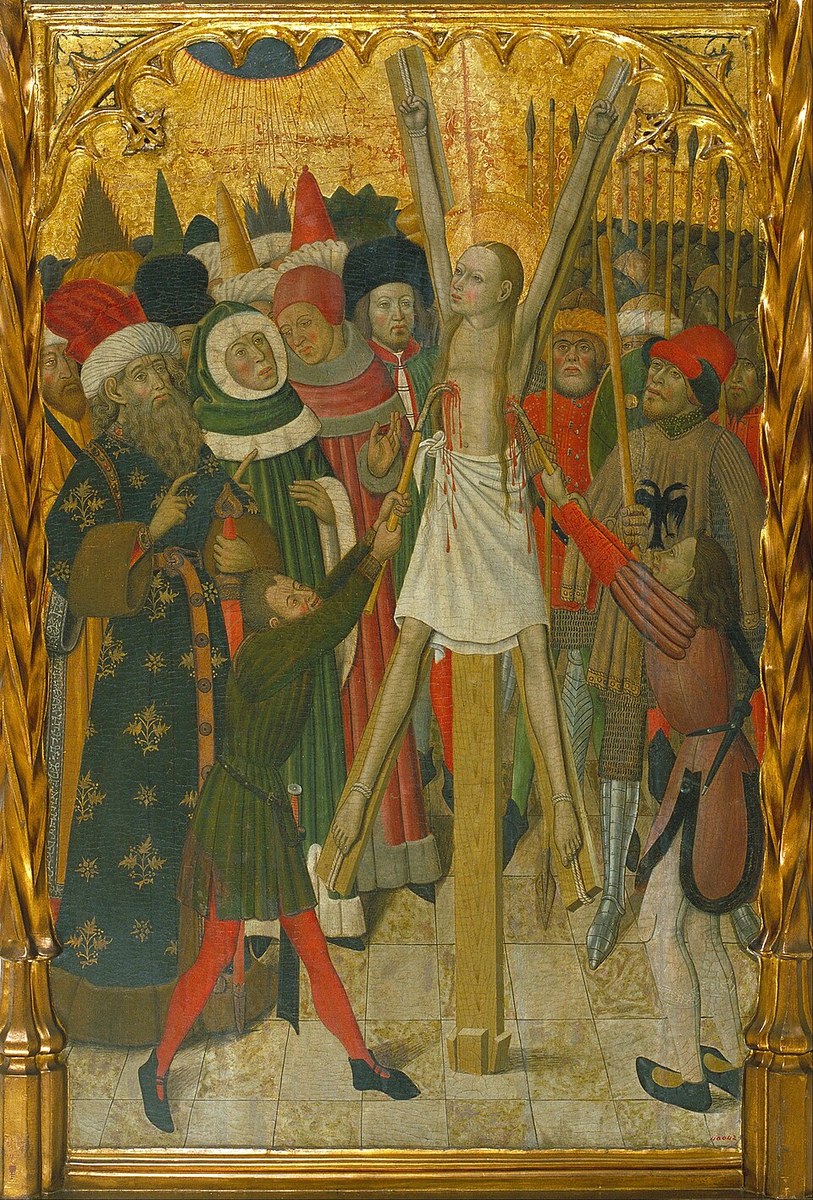
The developed iconography is Western, and it is very rich. Catalan Gothic painters made her passion a cycle: the girl before Dacian; the scourging; the equuleus and the iron combs; the cross, which in Catalan art is regularly the diagonal or X-shaped cross on which she is bound with her hair falling loose; the dove issuing from her mouth; the snow. Her attributes are the cross, the palm, the dove, and — for the snow — a white ground. The stored image is the Martyrdom of Saint Eulalia by Bernat Martorell (c. 1442–45), tempera and gold on wood, from an altarpiece of the saint and now in the Museu Nacional d'Art de Catalunya: Eulalia bound to the upright cross in a white cloth, blood running from the wounds of the combs, executioners at her feet with torches and iron claws, and the turbaned and hatted crowd of judges behind — the medieval Catalan reading of a Roman tribunal. It is included here as the finest pre-modern depiction of her passion and is explicitly a Latin-Western panel painting, not an Orthodox icon; no Byzantine or Slavonic image of her has been located.
Disputed questions
- Eulalia of Barcelona and Eulalia of Mérida. The most serious question in her dossier. Eulalia of Mérida (Emerita Augusta), a virgin martyr of the same age, the same persecution, the same governor and very nearly the same passion, was celebrated by Prudentius in the Peristephanon (Hymn 3) at the beginning of the fifth century — the dove from the mouth and the covering snow are both in Prudentius — and her cult is documented far earlier than the Barcelonese one. A long line of scholars has therefore held that Barcelona's Eulalia is a doublet: a local appropriation of the Emeritan martyr, whose passion was transferred with her name to a Barcelonese tomb. Against this stands an unbroken local tradition and the seventh-century testimony of Quiricus. The question is not settled, and it is recorded here rather than resolved: the Church commemorates both — Mérida on December 10, Barcelona on February 12 in the West and August 22 in the East.
- The dates. Her martyrdom is placed c. 303–304 by most authorities; the Russian menologion gives c. 303, and the OCA notice, following an older reckoning, dates Maximian's reign 305–311 and places the persecution accordingly. Her age is given as twelve, thirteen or fourteen in different recensions.
- Which Felix. If the Felix of this day is Felix of Girona, then his commemoration on August 22 in the East and August 1 in the West are two feasts of one man; if he is a Barcelonese Christian otherwise unknown, the coincidence of name and persecutor is striking. The Eastern notice is too brief to decide it. He has no entry of his own in this repository, and the question is flagged for a later pass.
- February 12 and August 22. No source explains the Byzantine date. It is not the day of a translation of her relics known to the West, and it appears already in the earliest Constantinopolitan synaxaria.