
Agathonicus of Nicomedia
The Holy Martyr Agathonicus of Nicomedia, and those who suffered with him
Martyr · d. c. 305
Commemorated 22 August — Beheading at Selymbria in Thrace
Agathonicus was a well-born and learned Christian of Nicomedia, the eastern capital of the Roman world, who used his standing and his knowledge of the Scriptures to argue the Greeks of that city out of their idolatry — winning among others a leading man of the senate. Arrested with a company of fellow confessors when the comes Eutolmius swept Bithynia and the Pontic shore for Christians, he was tortured, marched westward toward the imperial tribunal in Thrace, and at last beheaded at Selymbria on the Sea of Marmara, about the year 305. Of those taken with him — Zoticus, Theoprepius, Acindynus, Severian, Zeno and others — several died of their wounds on the road. His memory was kept with honour in Constantinople, where a church bore his name and pilgrims venerated his relics into the thirteenth century.

Origins and early life
The passion places Agathonicus in Nicomedia in Bithynia — the city Diocletian made his capital, and therefore the place where the last and greatest persecution fell hardest and first. He is said to have belonged to the family or clan of the Hypasii, a house of some consequence; he was educated, and above all he was well read in the Holy Scriptures, which he used as a controversialist uses a brief. The notice preserved of him is not that of a quiet believer but of a persuader: he "converted many of the Greeks," meaning the cultivated pagans of a Greek-speaking imperial city, and among his converts the tradition names a principal man of the senate — in the Latin transmission simply Princeps, which some later lists have read as a proper name rather than the title it almost certainly is.
The sweep of Eutolmius
The persecution reached him indirectly. An imperial officer, the comes Eutolmius, was sent into the region of Pontus, on the southern shore of the Black Sea, with a commission against the Christians there. At a place the sources call Carpe he found a small ascetic community gathered around one Zoticus; the disciples refused to sacrifice and were crucified, and Zoticus himself was taken along in the officer's train.
Returning through Nicomedia, Eutolmius learned of Agathonicus and of the senator he had converted. He arrested them both, and with them Theoprepius (a name the Slavonic books render Bogolep, "comely to God"), Acindynus and Severian. They were questioned, refused to offer sacrifice, and were tortured. Because a case involving a man of senatorial rank could not be settled by a provincial officer, Eutolmius was ordered to bring the whole company westward across the straits into Thrace, where the emperor then was, for judgment at the imperial tribunal.
Martyrdom on the road and at Selymbria
The journey killed most of them. Near a place named in the acts as Potamoi — "the rivers" — Zoticus, Theoprepius and Acindynus, already broken by torture, could go no further, and were dispatched or died of their wounds where they fell. Severian was put to death at Chalcedon, on the Asian shore opposite Byzantium. The remainder were brought on into Thrace, and there, by the emperor's own order, Agathonicus and those left with him were beheaded with the sword at Selymbria (modern Silivri), a walled town on the Marmara road some forty miles west of Byzantium. The year is given as within the reign of Maximian (286–305), and the Slavonic calendars stretch the possible span to 305–311.
Veneration and later cultus
Selymbria kept his tomb, but his fame belonged to the capital. A church of St Agathonicus stood in Constantinople and was reckoned among the notable sanctuaries of the city; the Russian pilgrim Anthony of Novgorod, who catalogued the relics of Constantinople about the year 1200, records venerating the martyr's remains there. Their survival in the capital is why Agathonicus, a martyr with no great acts and no literary passion of his own, is nevertheless a fixed and universal commemoration: the Byzantine calendar was in large part the calendar of the shrines of Constantinople, and the martyr of Selymbria was one of the city's own.
He is kept everywhere on 22 August, the eighth day of the afterfeast of the Dormition, which is why the Menaion gives him a modest office rather than a full festal one. The Roman martyrology commemorates the same company — Agathonicus, Zoticus, Zeno, Theoprepius, Acindynus and Severian — in the same days of late August.
Feast and commemoration
August 22 (church date; Old Calendar civil September 4), within the afterfeast of the Dormition of the Theotokos. Agathonicus is the principal commemoration of the day in every jurisdiction — Antiochian, Greek, Russian and OCA alike — though the office yields precedence to the afterfeast. The Greek books head the day Ὁ Ἅγιος Ἀγαθόνικος καὶ οἱ σὺν αὐτῷ, "and those with him," and print the companions' names in the synaxarion notice rather than in the title.
Hymns
Apolytikion — Tone 4 (common of several martyrs)
Thy martyrs, O Lord, in their contest received incorruptible crowns from Thee, our God; for possessing Thy strength, they cast down the tyrants and shattered the feeble insolence of the demons. By their intercessions, O Christ God, save our souls.
Kontakion — Tone 4
Thou didst draw the wise of this world out of the darkness of the idols by the word of truth, O Agathonicus, and having finished thy course with them in blood, thou wast crowned as the bearer of a good name indeed: entreat Christ God for us who honour thy memory.
Original translation from the Greek
Iconography
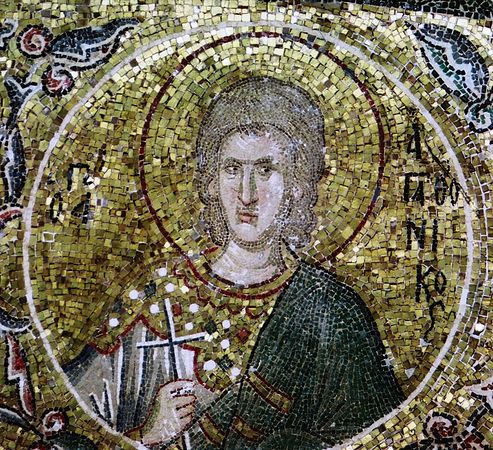
Agathonicus is painted as a young martyr, beardless or barely bearded, with dark curling hair, in the tunic and the mantle of a well-born layman rather than in armour — he was no soldier — and holding the martyr's cross in his right hand. The mosaic medallion stored here, from the Church of the Chora in Constantinople (c. 1315–21), is the finest surviving portrait of him and is inscribed with his name at either side of the halo, Ο ΑΓ[ΙΟϹ] ΑΓΑΘΟΝΙΚΟϹ; the cross is visible at his shoulder in gold and dark tesserae, and the whole medallion is set in a gold ground with a foliate border. Serbian fresco cycles of the fourteenth century give him prominently — a standing figure at Dečani, and at Gračanica the scene of his martyrdom — and the Athonite painters place his beheading in the August section of the calendar cycles (Dionysiou, Stavronikita). Where the company is shown together, the beheading of Agathonicus stands in the foreground and the deaths on the road are compressed behind it.
Disputed questions
- The date. The Greek and English synaxaria place the martyrdom under Maximian (286–305) and most reference works give c. 305; the Russian menologion prints 305–311, and some older lists — including the Prologue tradition — give c. 298, which would put the contest in the third century rather than the fourth. This entry follows the c. 305 dating and indexes the martyrs in the fourth century; the earlier dating is recorded here and not suppressed.
- "Princeps". The senator converted by Agathonicus appears in some Western lists as a martyr named Princeps. The Greek account speaks of a πρίγκιψ, the chief man of the senate, arrested with Agathonicus; the probability is strong that a title has hardened into a name.
- Which companions died where. The transmitted accounts do not agree on the roll or on the order of deaths. Zeno is named in the calendars among those who suffered but does not appear in the road narrative; the group is variously given as five, six, or "and others," and the safest statement is that of the day's own heading — Agathonicus and those with him.
- Not to be confused with Severian of Sebaste (September 9), a different martyr of the same name; with Zoticus the Orphanotrophos (December 30); with Acindynus and his companions (November 2), the Persian martyrs; or with Agathonike of Carthage. "Agathonicus of Tarsus," a fifth-century pseudonymous theological author, is not a saint and is not this man.