
Dormition of the Theotokos
The Dormition of our Most Holy Lady the Theotokos and Ever-Virgin Mary
The Dormition of our Most Holy Lady the Theotokos and Ever-Virgin Mary (August 15) is the last of the Twelve Great Feasts in the order of the church year and the crown of the fixed calendar, which closes sixteen days later on August 31. The Church confesses that the Mother of God, having finished the course of her life at Jerusalem, fell asleep in the presence of the apostles, whom the divine will gathered from the ends of the earth on clouds; that her Son came in person to receive her soul, which the icon shows in his arms as a child in swaddling bands; that she was buried at Gethsemane; and that on the third day, when the tomb was opened for Thomas, who alone had come late, her body was not there. Of none of this does Scripture say a word. The Church's warrant is not a text but a tradition — the memory of the church of Jerusalem, the witness of the tomb, and above all the great festal homilies of John of Damascus, Andrew of Crete and Germanus of Constantinople, which turned what the apocryphal Transitus narratives told as story into theology. What the feast proclaims is not that the Mother of God escaped death but that she passed through it: she died as her Son died, and as he was raised so she was raised, the first of the redeemed to receive in the body what all the redeemed are promised. "Neither tomb nor death held fast the Theotokos," sings the kontakion; and the ninth-ode heirmos states the paradox exactly — "the bounds of nature are overcome in thee, O pure Virgin, for childbirth remains virginal and death is betrothed to life." The feast is preceded by the fourteen-day Dormition Fast, kept with a Burial Service of the Theotokos in many places, and closed by a leavetaking on August 23.

The silence of Scripture
The New Testament says nothing whatever about the end of the Mother of God's life. The last that Scripture reports of her by name is that she was in the upper room at Jerusalem with the Eleven, with the women, and with the brethren of the Lord, "continuing with one accord in prayer and supplication" (Acts 1:14), waiting for Pentecost. After that the record simply stops. There is no account of her death, no notice of her burial, no mention of a grave, and no apostolic reference of any kind to her afterwards.
This silence is the first thing to be said honestly about August 15, and the Church has never pretended otherwise. Epiphanius of Salamis, writing at the end of the fourth century, went out of his way to say that he did not know what became of her: he canvassed the possibilities — that she died an ordinary death, that she was martyred, that she did not die at all — and declined to decide among them, remarking that Scripture had kept silence "because of the exceeding greatness of the wonder." That a bishop of his temper and his appetite for information could find nothing settled to report in about 375 is the strongest single piece of evidence that no fixed and universally received account existed in the fourth-century Church.
What existed instead, and what the Church rests upon, is a tradition: a memory carried in the church of Jerusalem, attached to a specific place in the Kidron valley, celebrated liturgically before it was ever written down as narrative, and confessed in worship. The Orthodox position is not that a document proves the Dormition, but that the Church knows what happened to the Mother of God in the way a family knows what happened to its own — and that this knowing was already old when the first surviving account of it was composed. The distinction matters, because the written accounts that do survive are of very uneven quality, and the Church's confession is not identical with any of them.
What the tradition transmits
The account as the Church tells it — in the synaxarion, in the hymns, and in the festal homilies — runs as follows.
After the Ascension the Mother of God remained in the care of John the Theologian, to whom the Lord had committed her from the Cross, and lived at Jerusalem, near Sion, honoured by the infant Church as its mother and going often to the places of her Son's Passion. Traditions of travel attach to these years — a visit to Lazarus in Cyprus, and, in an Athonite tradition of much later date, a landing on the Holy Mountain — but the tradition proper places her end at Jerusalem.
Three days before her repose the Archangel Gabriel, who had brought her the first announcement, came to her a second time to announce her departure, and gave into her hand a palm from paradise. She returned to her house on Sion, made ready her burial garments, disposed of her two tunics to the poor widows who had served her, and prayed. At her prayer the apostles were gathered from the ends of the earth: caught up on clouds from the countries in which each was preaching, they were set down together at her door, John from Ephesus first among them, and only Thomas was absent. With them the tradition places James the Brother of the Lord, the first bishop of Jerusalem, and the hierarchs of the apostolic generation — which is why the icon and the hymns set bishops in mitre and omophorion around a first-century bier.
At the third hour the roof of the house was opened, or the room filled with a light that put out the lamps, and Christ himself came, with the ranks of the angels and the souls of the righteous. The Mother of God greeted him with the words of her own Magnificat, blessed the apostles, prayed for the world, and gave up her spirit without pain, agony or fear — "as though in a sweet sleep," which is the whole force of the word κοίμησις, a lying-down to rest. And her Son received her soul into his own hands. The hymns dwell on the reversal without embarrassment: the arms that had carried him now lie still, and he carries her.
The apostles took up the bier and carried it in procession from Sion down to Gethsemane, singing; a cloud of light went with them and a heavenly chanting was heard above. The account then relates the episode of a Jewish priest — the Greek tradition calls him Jephonias, the Slavonic and the OCA's synaxarion Athonios — who ran at the bier in fury to overturn it, and whose hands were severed at the wrists by the sword of an angel and left hanging on the bier; who thereupon confessed the Mother of God, and was healed when the apostles bade him apply the stumps to his own hands and confess Christ. She was laid in the tomb at Gethsemane and the apostles kept vigil there three days.
On the third day Thomas arrived, having been brought late, and grieved that he had not been able to take leave of her. To comfort him the apostles opened the tomb — and the body was gone. Only the grave-clothes remained, giving out fragrance. That evening, as they sat at table and raised the bread in her honour, she appeared to them in the air with angels and said: Rejoice, for I am with you all the days. From that appearance the monastic rite of the raising of the Panagia is traditionally derived, and from the empty tomb the Church's confession that she was taken up in the body to her Son.
It is worth noticing what the tradition does with Thomas. That the apostle who was late for the Resurrection should also be late for the Dormition, and that in both cases his lateness is the reason the rest of the Church receives proof, is too neat to be accidental and too old to be dismissed; the tradition itself seems aware of the rhyme. What the empty tomb of Gethsemane is to August 15, the wounded side is to Thomas Sunday.
The apocryphal Transitus literature
The narrative just given is not drawn from Scripture, and it did not come into the homilies out of nowhere. Behind it lies a large, sprawling and theologically mixed body of apocryphal writings, known collectively as the Transitus Mariae ("the Passing of Mary") or, in Greek, the Koimesis narratives. Honesty about them is part of keeping the feast well.
The corpus is early and hard to date. Its principal witnesses include a Greek narrative circulating under the name of John the Theologian, which Tischendorf edited and dated no later than the fourth century; a Latin Transitus falsely ascribed to Melito of Sardis, of about the fifth century; Syriac fragments of a "Book of the Obsequies of the Holy Virgin," surviving in fifth-century palimpsest and preserving what is plainly an older text; an Ethiopic Book of Mary's Repose (Liber Requiei) whose substance may be older still; the Syriac "Six Books" apocryphon; and further narratives under the names of Pseudo-Dionysius, Pseudo-Cyril of Jerusalem and Pseudo-Evodius. Modern scholarship groups them into families — broadly, a "palm of the tree of life" family and a "Bethlehem" family — which differ over where she died, how long she lay in the tomb, and what became of her body. Some versions have her soul taken and her body preserved unburied until the resurrection of all; some have her body assumed at once; one strand is frankly heterodox, mixing in gnostic material about the ascent of the soul through the heavens.
Two things follow, and the entry states both.
First, the Church did not adopt these books. The Transitus literature was treated with suspicion from an early date; the Decretum Gelasianum, the sixth-century Latin list of books received and rejected, names a Transitus sanctae Mariae among the apocrypha to be refused, and the Byzantine Church never read such texts liturgically or gave them any canonical standing. They are not scripture, they are not the source of the dogma, and where their details are extravagant — the numbering of the heavens, the speeches of the angels — the tradition simply dropped them.
Second, the Church did not therefore reject everything in them. What happened is subtler and more interesting. A relatively stable core — the announcement by Gabriel, the gathering of the apostles on clouds, the coming of the Lord to receive the soul, the procession to Gethsemane, the assault on the bier, the burial, the late arrival of Thomas, the empty tomb — was received, purified and preached, while the rest fell away. The test applied was not documentary but doctrinal and ecclesial: what agreed with the faith of the Church about her Son and about the resurrection of the body was kept, and what did not was left. By the seventh and eighth centuries this core had passed wholly into the homiletic and hymnographic tradition, where it has been ever since. The episode of Jephonias, to take the most striking case, stands not merely in an apocryphon but in the third ode of the first canon of the feast, sung at Matins every August 15: justice forestalled the insolent hands of the presumptuous man and brought the severing upon them, since God preserved the honour due to the living ark.
The correct account of the relation is therefore this: the apocrypha are the earliest surviving narrative form of a tradition they did not invent, and the Church's confession is neither derived from them nor identical with them. The homilists knew exactly what they were handling. John of Damascus, coming to the story of the empty tomb, is careful to say where his information comes from and what its standing is — he cites the church of Jerusalem, and the Euthymiac History, not a Transitus.
The homilists: Modestus, Andrew, Germanus, John of Damascus
The real theological sources of the feast are four generations of preachers, all but one of them Palestinian or Constantinopolitan, working between the early seventh and the mid-eighth centuries. It is in their hands that the Dormition becomes doctrine rather than story.
Modestus of Jerusalem (†634), who rebuilt the shrines of the Holy City after the Persian sack of 614 and died as its patriarch, left an Encomium on the Dormition which is among the earliest surviving Greek sermons on the feast. He preaches the glorification of her body, and he preaches it at Jerusalem, within sight of the tomb — an important witness, because he is a local bishop speaking to a local congregation about a local holy place.
Andrew of Crete (c. 660–740), a Damascene by birth who was formed in the monastery of the Holy Sepulchre at Jerusalem before becoming archbishop of Gortyna, preached three homilies on the Dormition, and they are among the most rhetorically magnificent things in Byzantine oratory. His characteristic move is to gather the whole Old Testament into the bier: she is the ark, the jar of manna, the rod of Aaron, the tablets, the lampstand, the closed gate of Ezekiel, the ladder of Jacob — every vessel that held what could not be held. Andrew's insistence is that her death is real, and that its reality is precisely what makes the feast Christian rather than mythological.
Germanus of Constantinople (c. 634–c. 740), patriarch of the imperial city and the first great victim of the iconoclast policy, left three homilies on the Dormition, and his voice is the most tender of the four. He works in dialogue: the Lord speaking to his Mother as he comes for her soul, and she answering; the apostles speaking to the empty bier. Something of that manner survives in the service itself, for the third sticheron at the Lite is ascribed to Germanus by name — Come, all ye ends of the earth, and let us call blessed the honoured translation of the Mother of God — so that on August 15 the Church still sings a stanza by the patriarch who defended the icons.
John of Damascus (c. 675–749), a monk of Saint Sabbas and the greatest of the four, preached three homilies on the Dormition at Gethsemane itself, and also wrote the second canon of the feast, so that his theology is sung as well as spoken. His homilies do the decisive work. He argues from the person of Christ: it was fitting that she who bore the Life should taste death, because her Son tasted it; fitting that death should not hold her, because it did not hold him; fitting that the flesh which gave flesh to God should not see corruption. And it is in the third of these homilies that the famous passage occurs which supplies the Church's account of how the tradition reached Constantinople: the citation of the Euthymiac History, according to which the empress Pulcheria and the emperor Marcian, at the time of the Council of Chalcedon, asked the patriarch Juvenal of Jerusalem for the body of the Mother of God for the church they had built at Blachernae, and were told that the tomb at Gethsemane had been opened at Thomas' request and found to contain only the grave-clothes, which Juvenal sent them instead. Whether that passage is a genuine fifth-century fragment or a later interpolation into the homily is disputed among scholars, and the entry for Juvenal in this collection sets out the argument; but it is the hinge on which the Byzantine understanding of the Dormition historically turned, and it is worth noting that it is a negative report — the point of the story is precisely that Constantinople could not have her body, because there was none to have.
To these four should be added John of Thessalonica (early seventh century), who deliberately produced a cleaned-up recension of the Transitus narrative for liturgical reading in his own church and said openly that he was doing so — the clearest documented instance of the Church editing the apocryphal material rather than either swallowing or discarding it — and Theoteknos of Livias, a Palestinian bishop of the sixth or seventh century whose homily is among the first to speak plainly of her being taken up in the body.
What the Church confesses
Strip away the narrative detail and the Orthodox confession of August 15 has four elements, each of which the hymns of the day state directly.
She died. This is not a concession but a doctrine. The Mother of God was a daughter of Adam, mortal by nature, and she underwent a real death — the separation of soul from body — as every child of Adam does. The second canon puts it without softening: brought forth from mortal loins, thou didst accomplish an end befitting nature. The Church has never held that she was exempted from death, and the reason is Christological: if she had not shared our death she would not have shared our nature, and if she had not shared our nature the Word would not have taken ours from her. Her death is the guarantee that the Incarnation was real. The synaxarion verses for the day make the same argument in two lines: It is no wonder that the Maiden who saved the world should die, seeing that the Fashioner of the world died in the flesh.
Her death was not what our death is. She fell asleep. There is no agony, no fear, no struggle, no dread of judgement in any telling of it; and there is no corruption afterwards. Death for her was, in the words of the first canon, a crossing-over — διαβατήριον, a passage — from the perishable to the divine. The Church's word for the day is koimesis, falling asleep, precisely because what happened to her shows death as Christ has left it: no longer an end, but a sleep from which one is woken.
She was raised and taken up in the body. The empty tomb is not a decorative flourish; it is the content of the feast. The Church holds that her body was not left to corruption but was raised and glorified and united again to her soul, and that she is now, in the body, with her Son. Greek uses a second and more precise word for this: μετάστασις, the translation or removal, which the services use interchangeably with koimesis — the synaxarion for the day is headed not "the Dormition" but "the all-venerable Translation of our Lady." The ninth-ode heirmos of the feast is the doctrine in one sentence: Thou who art a Virgin after childbearing and alive after death, do thou ever save thine inheritance, O Theotokos.
Her glorification is our promise. This is the point of the whole feast and the reason it stands where it does in the calendar. What has happened to her is what is to happen to the whole Church at the general resurrection; she has simply arrived first. She is the firstfruits of the redeemed, the one member of the human race in whom the end of the story has already occurred, and the Church looks at her on August 15 in order to see what it is being saved into. Hence the placing of the feast at the very end of the fixed year: the church calendar begins on September 1 with the Indiction and the world's making, moves through the Nativity of the Mother of God on September 8, and closes with her falling-asleep and glorification — the year framed by her birth and her end, and the last word of it a resurrection.
The Orthodox Dormition and the Roman dogma of the Assumption
Both Churches keep August 15; both confess that the Mother of God is now, body and soul, in the glory of her Son. The difference is real, and it is worth stating precisely rather than polemically, because it is frequently misdescribed on both sides.
On 1 November 1950, in the apostolic constitution Munificentissimus Deus, Pope Pius XII defined as a dogma of the Roman Catholic Church "that the Immaculate Mother of God, the ever Virgin Mary, having completed the course of her earthly life, was assumed body and soul into heavenly glory." Three features of that act are relevant here.
The first is the wording. The definition says "having completed the course of her earthly life" and does not say that she died. This was deliberate: a current of Western opinion (the immortalists) held that she never underwent death at all, and the definition was framed so as not to close the question, even though the body of the constitution repeatedly speaks of her passing from this life and of the Fathers' witness to her death. Pope John Paul II later taught explicitly that she did undergo death, but that is a teaching, not part of the defined dogma.
The second is the manner of the act: a dogma of faith, promulgated by the pope, binding on the faithful under anathema, defined in the twentieth century on the ground of the Church's belief rather than of an apostolic text.
The third is the absence of the empty tomb. The definition says nothing of Gethsemane, nothing of the apostles, nothing of the third day.
The Orthodox difficulty is with the second point far more than the first. The Orthodox Church has always held what the definition asserts, and held it for fifteen centuries before 1950 — that she is glorified in the body is sung in every Byzantine service of the feast. What the Orthodox Church does not accept is that any bishop, including the bishop of Rome, has authority to define a new dogma of faith by his own act; and it is unwilling to convert into a juridically binding definition a truth which the Church has always confessed liturgically and doxologically rather than propositionally. On the Orthodox reading the Dormition is not a proposition to be defined but a mystery to be celebrated, and the appropriate mode of confessing it is a vigil, a procession and a canon.
There is also a difference of emphasis which shows in the very names. The West says Assumption — the taking up — and looks at the terminus. The East says Dormition — the falling asleep — and looks at the death, then adds the translation. The Orthodox icon of the feast is not an icon of the Virgin rising into the sky; it is an icon of a funeral, with the glory hidden inside it. That is not a small difference of taste. The Orthodox insistence on the death of the Mother of God is a defence of the reality of her humanity and therefore of the reality of the Incarnation, and it is also a piece of pastoral realism: the feast is good news about death, and it would not be if she had not died.
Gethsemane and the tomb
The tradition is anchored to a place, and the place is still there. At the foot of the Mount of Olives, in the Kidron valley below Gethsemane, a deep flight of stairs descends to a rock-cut chamber which the Church has venerated as the Tomb of the Mother of God since at least the fifth century. Excavation in the twentieth century found first-century burial evidence in the immediate area, consistent with a Jewish cemetery of the period, though the archaeology of the tomb itself is complicated by centuries of building.
The building history is a summary of Jerusalem's own. A church was raised over the tomb in the fifth century, in the time of Juvenal; it was destroyed in the Persian invasion of 614 and restored by Modestus; a round two-storey church stood there when Western pilgrims described it about 670. The Crusaders rebuilt the complex in the twelfth century as the abbey of Saint Mary of the Valley of Jehoshaphat, fortified with towers; Saladin demolished the upper church in 1187 and used its stone for the walls of Jerusalem, sparing the lower church and the tomb itself, which is why what the pilgrim descends into today is a Crusader stair leading to a Byzantine crypt. Under the status quo fixed in the eighteenth century the shrine is held by the Greek Orthodox Patriarchate of Jerusalem and the Armenian Apostolic Church, with lesser rights for the Syriac, Coptic and Ethiopian Churches.
The girdle, or belt, of the Mother of God belongs to the same complex of traditions. In the developed account Thomas, borne on his cloud, sees her carried up and receives from her hands her girdle as a proof to give the other apostles — the same office the grave-clothes perform in the Euthymiac History, and a plain echo of the Elijah and Elisha story, where the mantle falls to the one left below. Constantinople claimed the girdle from the fifth century and kept its own feast of the Deposition of the Sacred Belt on August 31, the last day of the church year; the relic venerated today at the monastery of Vatopedi on Mount Athos is held to be that girdle, and it is the single most travelled relic in the Orthodox world.
The history of the feast
A commemoration of the Mother of God at Jerusalem is older than a commemoration of her Dormition. The earliest Jerusalem calendars, preserved in the Armenian and Georgian lectionaries, appoint for 15 August a "Memory of Mary" kept not at Gethsemane but at the Kathisma, the church of the Seat, at the third milestone on the road to Bethlehem where tradition said she rested on the way to the Nativity. That commemoration is attested from about the beginning of the fifth century, and its content was originally the Theotokos herself rather than her death.
During the fifth and sixth centuries the observance migrated — physically, from the Kathisma to the tomb at Gethsemane, and thematically, from a general memorial of the Virgin to the feast of her falling asleep. The construction of the church over the tomb, the growing circulation of the Transitus narratives, and the enormous rise in the cult of the Theotokos after the Council of Ephesus in 431 all pushed in the same direction. By the sixth century Jerusalem was keeping the Dormition, at Gethsemane, on August 15.
The extension of that Jerusalem usage to the whole Byzantine world is traditionally credited to the emperor Maurice (582–602), who is reported to have fixed the feast for the empire on August 15 — the report comes late, from the fourteenth-century historian Nikephoros Kallistos Xanthopoulos, and is therefore not beyond question, but the sixth-century date for the general Byzantine observance is not in doubt. Other dates had been in use elsewhere: the Egyptian and Coptic tradition kept a January commemoration of her repose (and still distinguishes the repose, on 21 Tobi, from the assumption of the body, on 16 Mesore), and Gaul kept a January feast. Rome received the feast from the East in the seventh century, under Pope Sergius I (687–701), who appointed a procession for it; the octave was added in the ninth century.
In the Byzantine East the feast rose steadily in solemnity. Its two canons were written in the eighth century by Kosmas the Monk — Cosmas of Maiuma — and John of Damascus, the same pair who wrote the canons of the Transfiguration nine days earlier, and the same Palestinian milieu that produced the homilies. The preparatory fast grew up beside it and was regularised in the middle Byzantine period. By the end of the first millennium August 15 was, with the Nativity, the Theophany and Pascha, one of the fixed points of the Christian year in every part of the Orthodox world; and in the Slavic lands Uspenie became the commonest of all cathedral dedications — the Dormition cathedrals of Kiev, of Vladimir, and the Uspensky Sobor of the Moscow Kremlin, in which the tsars were crowned.
Feast and commemoration
August 15 (church date; New Calendar civil August 15, Old Calendar civil August 28). The Dormition is the last of the Twelve Great Feasts in the order of the church year and the greatest of the feasts of the Mother of God, kept everywhere in the Byzantine rite with an all-night vigil. Where it falls on a Sunday the resurrectional propers are not abolished but combined with the festal ones, as with other Great Feasts of the Theotokos, since the day is not a feast of the Lord. In the Antiochian Patriarchate and its archdioceses it is ʿĪd Ruqād al-Sayyida, the feast of the falling-asleep of the Lady, and it is among the most heavily attended days of the year in the Arabic-speaking parishes of the Levant and the diaspora.
The Dormition Fast
The feast is prepared for by the Dormition Fast, fourteen days from August 1 to August 14 inclusive — the shortest of the four fasting seasons and the strictest. Meat, dairy, eggs, fish, wine and oil are all set aside; wine and oil are permitted at the weekends, and fish only on the Transfiguration (August 6), which stands in the middle of the fortnight. It is the only fast in the year kept in high summer, and the only one whose whole purpose is a single Marian feast. Greek practice fills its evenings with the Paraklesis, the Supplicatory Canon to the Theotokos, sung every evening of the fast except Saturdays and the eves of the Transfiguration and the Dormition, alternating the Small and the Great Paraklesis — for many Orthodox Christians the most familiar service of the year after the Liturgy itself. On August 15 the fast is broken, and it is broken even when the day falls on a Wednesday or a Friday, the rank of the feast abolishing the weekly fast.
Forefeast, afterfeast and leavetaking
There is a forefeast of one day, August 14, kept with the prophet Micah, at which the pre-feast hymns already summon the faithful to Gethsemane; an afterfeast of eight days, August 16 to 22; and the leavetaking (apodosis) on August 23, when the whole service of the feast is sung again. The eight days are the longest afterfeast given to any feast of the Mother of God, and they push the Dormition to within eight days of the end of the church year.
The Burial Service of the Theotokos
In a number of places the feast carries a rite unlike anything else in the Marian calendar: a Burial Service of the Theotokos, modelled directly on the Lamentations of Holy Saturday. An epitaphios — a shroud or embroidered cloth bearing the image of the Mother of God on her bier, exactly answering the epitaphios of Christ — is set out in the middle of the church, and the Encomia, verses of praise interleaved with the verses of Psalm 118 in three stases, are chanted before it, followed by a procession with the shroud. The texts are not in the ordinary Menaion; they are a later composition, transmitted in separate booklets, and their use has spread rather than contracted in the last two centuries.
The rite is kept above all at Jerusalem, where the Greek Patriarchate carries the icon of the Dormition in procession from the Metochion of Gethsemane in the Old City down to the Tomb in the Kidron valley some days before the feast; the icon remains at the tomb through the celebration and is carried back only at the leavetaking. It is kept in many places in Greece and the islands, at Bethlehem, and in Russian usage at the Kiev Caves Lavra and the Gethsemane skete of the Trinity–Sergius Lavra, among others. It is a local custom rather than a universal rubric, and where it is not kept the feast is served from the Menaion alone.
Other customs
Where a liturgical colour is appointed the Dormition is served in blue, the colour of the Theotokos, or in white. In many Slavic and Carpathian parishes flowers and herbs are brought to be blessed on the feast — the day is called Matka Boska Zielna, "Our Lady of the Herbs," in Polish usage — a custom attached to the fragrance of the empty tomb. In Greece August 15 is tou Dekapentavgoustou, the great summer feast, second only to Pascha in popular observance, kept with all-night vigils at the island shrines of the Panagia, above all at Tinos, where the crowds arrive by sea and the last stretch to the church is climbed on the knees. Fifteen days later the church year ends.
Hymns
Apolytikion — Tone 1
Thou didst guard thy virginity in giving birth, and in falling asleep thou hast not abandoned the world, O Theotokos. Thou wast removed unto life, being the Mother of Life; and by thine intercessions dost thou redeem our souls from death.
Kontakion — Tone 6 (plagal of the second)
The tomb and death could not hold fast the Theotokos, unsleeping in her intercessions and an unfailing hope in her protection; for as the Mother of Life she was translated unto life by him who had dwelt within her ever-virgin womb.
Original translation from the Greek
Oikos
Wall about my mind, O my Saviour, for I dare to hymn the wall of the world, thy most pure Mother. Make me strong in a tower of words and fortify me in the bastions of thought; for thou hast promised to fulfil the petitions of those who ask in faith. Grant me therefore a tongue, an utterance and a reasoning that shall not be put to shame, for every gift of illumination is sent down from thee, O Giver of light, who didst dwell in an ever-virgin womb.
Exapostilarion — Tone 3 (sung three times)
O Apostles, gathered here from the ends of the earth, bury my body in the place of Gethsemane; and thou, my Son and my God, receive my spirit.
Ninth
The bounds of nature are overcome in thee, O pure Virgin: for childbearing remains virginal, and death is betrothed to life. Thou who art a Virgin after childbearing and alive after death, do thou ever save thine inheritance, O Theotokos.
Appointed readings
Epistle — Philippians 2:5–11
5Let this mind be in you, which was also in Christ Jesus: 6Who, being in the form of God, thought it not robbery to be equal with God: 7But made himself of no reputation, and took upon him the form of a servant, and was made in the likeness of men: 8And being found in fashion as a man, he humbled himself, and became obedient unto death, even the death of the cross. 9Wherefore God also hath highly exalted him, and given him a name which is above every name: 10That at the name of Jesus every knee should bow, of things in heaven, and things in earth, and things under the earth; 11And that every tongue should confess that Jesus Christ is Lord, to the glory of God the Father.
Gospel — Luke 10:38–42; 11:27–28
38Now it came to pass, as they went, that he entered into a certain village: and a certain woman named Martha received him into her house. 39And she had a sister called Mary, which also sat at Jesus’ feet, and heard his word. 40But Martha was cumbered about much serving, and came to him, and said, Lord, dost thou not care that my sister hath left me to serve alone? bid her therefore that she help me. 41And Jesus answered and said unto her, Martha, Martha, thou art careful and troubled about many things: 42But one thing is needful: and Mary hath chosen that good part, which shall not be taken away from her. 27And it came to pass, as he spake these things, a certain woman of the company lifted up her voice, and said unto him, Blessed is the womb that bare thee, and the paps which thou hast sucked. 28But he said, Yea rather, blessed are they that hear the word of God, and keep it.
Iconography
The Dormition is one of the two or three greatest of all Orthodox icon types, and it is unique among the festal icons in being, formally, a funeral scene. It was fixed in its essentials by the tenth century and thereafter elaborated but never overturned; it appears on ivories, on epistyle beams, in the west lunette of countless churches (so that the congregation walks out under it), and on the great panels of the Muscovite and Cretan schools.
The composition is horizontal where the Transfiguration is vertical, and it is built in three bands.
At the centre, along the whole width, lies the bier, draped in red, with the Mother of God stretched upon it in her dark maphorion, hands folded, eyes closed, a body genuinely dead and painted as such. This absolute stillness at the centre is the anchor of the whole design.
Behind and above the bier stands Christ, upright, frontal, in a mandorla of glory, often held or attended by angels. In his hands — and this is the detail that makes the icon what it is — he holds her soul, and holds it in the form of a newborn child in white swaddling bands. The reversal is exact and deliberate: in every icon of the Nativity, of the Hodegetria, of the Eleousa, the Mother holds the Son as an infant; here the Son holds the Mother as an infant. The soul of a Christian at its birth into eternity is a newborn, and it is carried by the one who was carried. No other icon states the doctrine of death so economically, and the swaddling bands are also grave-clothes, so that the visual pun runs in both directions at once.
Around the bier stand the apostles, in two dense clusters at head and foot. Peter is normally at the head, censing; Paul at the foot, bowed low over her feet, though he was not of the Twelve and, in the strict chronology, ought not to be there at all — his presence is confessional rather than historical, the Church of the Gentiles standing at her bier. John leans in close to the body; the rest press behind in attitudes of grief carefully differentiated, some weeping, some staring, some turned away. Among them, in mitre and omophorion and often holding open scrolls, stand bishops — traditionally identified as James the Brother of the Lord, Dionysius the Areopagite, Hierotheus and Timothy — and behind them, in many recensions, the mourning women of Jerusalem. A candle burns before the bier, on the floor, in the foreground.
Fuller recensions add two further episodes. Below the bier, at the front, the Jephonias episode: the presumptuous man in short tunic, his severed hands still clinging to the bier's edge, and the angel with the drawn sword above him. And above, in the upper register, the Metastasis — the Mother of God a second time, seated now in an oval mandorla and borne up by angels, her body carried to heaven; sometimes with Thomas at the side receiving the girdle. Where the Metastasis appears, the apostles are shown a third time in the upper corners, small figures riding on clouds which angels steer, arriving from the ends of the earth. The whole icon is thus a narrative in one frame: they come on the clouds, they mourn at the bier, her soul is taken, her body is raised.
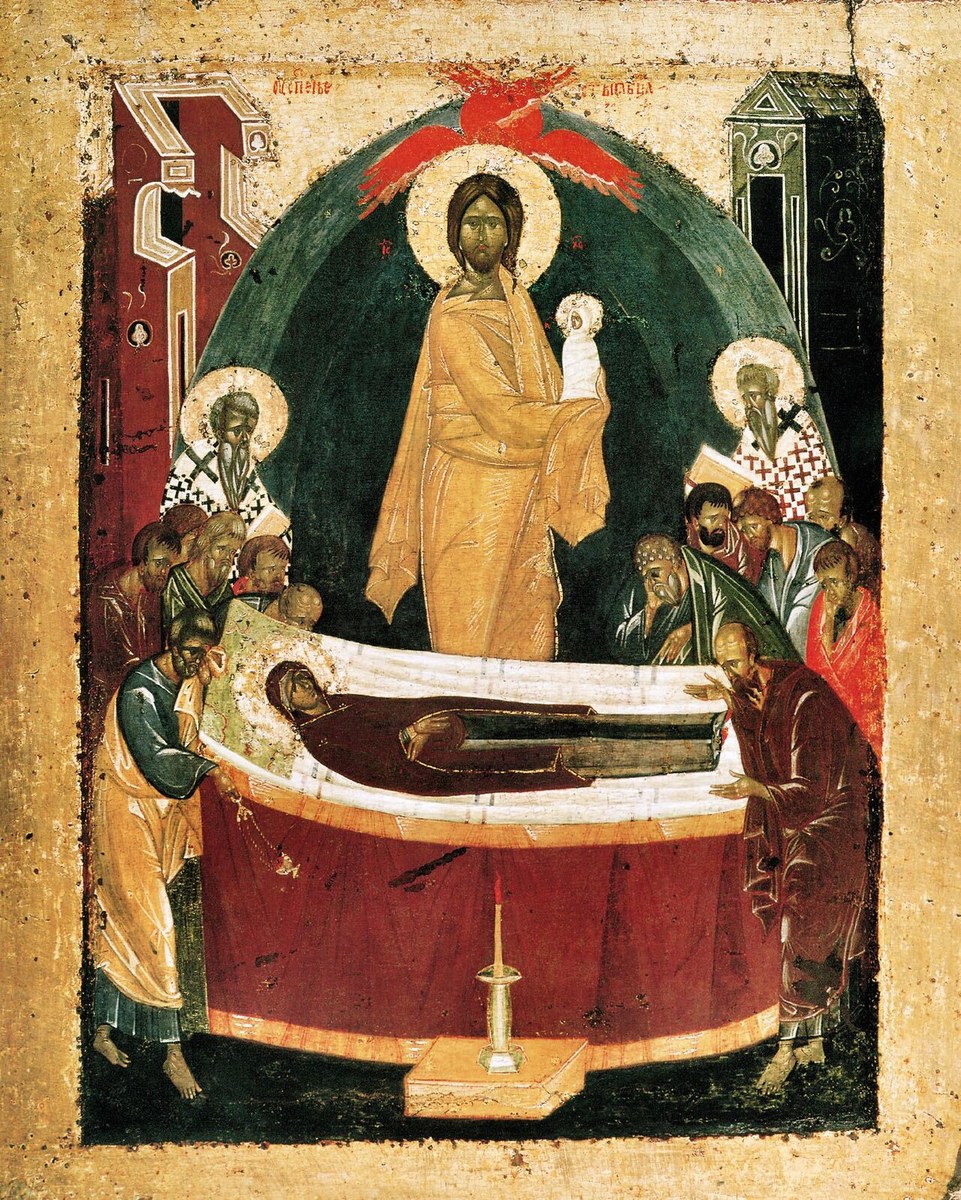
The stored icon is one of the supreme Russian examples: the Dormition painted about 1392 and attributed to Theophanes the Greek, on the reverse of the double-sided Don (Donskaya) Icon of the Mother of God, whose own feast is kept on August 19, within this feast's afterfeast; the panel is now in the State Tretyakov Gallery, Moscow. Its inscription reads Успение Богородицы across the top. Against a deep green mandorla Christ stands in a robe of pale gold, holding the swaddled soul in the crook of his arm, a scarlet six-winged seraph blazing above his head. The Mother of God lies on the bier below him, the white shroud thrown back; two hierarchs in white crossed omophoria lean in from left and right, and the apostles crowd in two grieving knots, one at each end, faces built out of the sharp white highlights that are this painter's signature. Two architectural blocks — dark red at the left, deep green at the right — close the composition. And in the exact centre of the lower edge, standing alone on the empty floor in front of the bier, there is a single tall candle with a small flame, the one lit thing at the bottom of a picture of a death: the most famous detail in Russian icon painting, and the whole theology of the feast in one flame.
The second stored image is a Cretan panel of the second half of the fifteenth century, by an unnamed painter of a Cretan workshop, and it is chosen because it carries the full developed programme that the Theophanes panel omits. At the centre Christ stands in a silver-grey mandorla thronged with angels, the swaddled soul in his hand; the Theotokos lies on a bier hung with red and gold; apostles crowd both ends and four bishops in crossed omophoria hold open scrolls. Below the bier, in the foreground, is the Jephonias episode — the angel in white with the sword raised, and the figure in red beneath him — which the Greek description of the panel names explicitly. And across the top, against the gold, is the Metastasis: the Mother of God enthroned in a blue oval mandorla, lifted by six red-winged angels, with two silvery clouds at the upper corners in each of which a group of apostles is being carried to Jerusalem. Two buildings mark Sion below. The panel is thus, unusually, all three moments of the feast at once — arrival, death, glorification — and is inscribed Ἡ ΚΟΙΜΗΣΙΣ ΤΗΣ ΘΕΟΤΟΚΟΥ across the upper corners.