
Euphrosyne of Moscow
Our Venerable Mother Euphrosyne, in the world Eudokia, Grand Princess of Moscow
Venerable · Princess · b. c. 1353 — d. 7 July 1407, Moscow
Commemorated 17 May — Her monastic tonsure in the Ascension Convent of the Kremlin, 1407, 19 May — Kept jointly with her husband Demetrius Donskoy in the Russian calendar, 7 July — Repose
Eudokia Dmitrievna (c. 1353 – 1407), daughter of the grand prince of Suzdal and Nizhny Novgorod, was the wife of Dmitri Donskoy, the victor of Kulikovo, and after his early death the guide of her sons and of the principality of Moscow through eighteen dangerous years. Beneath the dress of a grand princess she wore iron chains and kept a hidden ascetic discipline, and she spent her wealth on churches: the stone church of the Nativity of the Theotokos in the Kremlin, raised in memory of Kulikovo, and above all the Ascension Convent within the Kremlin walls, which she founded and which became for five centuries the burial place of the women of the Muscovite house. When her children were grown she took the monastic habit there, on 17 May 1407, with the name Euphrosyne — "gladness" — and reposed seven weeks later, on 7 July, at the age of fifty-four. Her commemoration on May 17 is the feast of that tonsure.

Daughter of Suzdal, wife of Donskoy
Eudokia was born about 1353, daughter of Dmitri Konstantinovich, grand prince of Suzdal and Nizhny Novgorod. In 1366, at some thirteen years of age, she was married at Kolomna to the young Dmitri Ivanovich of Moscow, afterwards called Donskoy — the match sealing a reconciliation between the two houses that had contended for the grand princely title, and the marriage proving, by the testimony of the chronicles, an unusually affectionate one. She bore him twelve children, of whom the eldest surviving son, Vasily I, succeeded his father.
Her married life spanned the whole crisis of the Tatar wars. She kept the city in 1380 while her husband rode out to the Don and the field of Kulikovo; two years later she saw Moscow taken and burned by Tokhtamysh, escaping with her children to Kostroma. In thanksgiving for Kulikovo she built in the Kremlin the stone church of the Nativity of the Theotokos, the feast on which the battle had been fought, and had it painted by the best masters of the day.
Widowhood, regency, and hidden ascesis
Dmitri died in 1389, not yet forty, of the effects of his campaigns; Eudokia was about thirty-six, and her sons were young. She did not remarry. For the remaining eighteen years of her life she was the moral centre of the Muscovite house: named in her husband's testament as the guardian of his sons and the arbiter between them, she held the family and its patrimony together in a generation in which the succession could easily have been disputed into ruin, and she is credited with restraining the quarrels of her sons and with holding Moscow's line with the Horde steady.
Under the brocade she lived as an ascetic. The tradition is specific: she wore iron chains next to her skin, fasted to the point of emaciation, prayed by night, and gave in alms and in the ransoming of captives what she did not spend on churches — all of it concealed, so that the court saw only a great lady richly dressed.
The concealment produced the episode by which she is chiefly remembered. Slander began to circulate in Moscow about the widowed princess's manner of life; her sons, hearing it, came to her in anger and shame. She received them, and then opened her garments and showed them the wasted body and the iron chains beneath. They were struck dumb, and would have taken vengeance on those who had spread the tale; she forbade it, saying that she had borne it willingly for the sake of a greater reward, and that they should let God be the judge. The Russian Life presents the scene as the summary of her whole life: a hidden ascesis mistaken for a scandal, and borne without self-defence until defence was needed for her children's sake.
The Ascension Convent, the tonsure, and the healings
Her great foundation was the Convent of the Ascension of the Lord (Voznesensky monastyr) within the Kremlin, beside the Frolov — later Spassky — gate. She had begun it in her widowhood as her own retreat, and it was to it that she came at the end. It became the principal women's house of the Muscovite capital and the necropolis of the grand princesses and tsaritsas of Russia, and it stood until 1929.
On 17 May 1407, her children being grown and her affairs settled, she took the monastic habit there with the name Euphrosyne. The Life records that the way to the convent was lined with the sick, and that on the road a blind man cried out to her, having seen her in a dream promising him his sight; she let fall the sleeve of her garment towards him, and he wiped his eyes with it and saw. Some thirty of the sick who touched her were healed that day. Whatever weight is given to the details, the day of her tonsure was clearly remembered in Moscow as a day of wonders, and it is that day, rather than the day of her death, that the calendars keep as her principal feast.
She lived in the convent as a nun for a little under two months. She laid the foundation of a new stone church of the Ascension there, and reposed on 7 July 1407, in her fifty-fourth year, and was buried in it.
Relics
Her tomb in the Ascension church was venerated from the first, and healings were recorded at it through the Muscovite centuries; candles were said to light of themselves at her grave. The convent was demolished in 1929 in the clearance of the Kremlin, and the sarcophagi of the grand princesses were removed to the crypt of the Cathedral of the Archangel Michael, where they remain. Her relics are there, among the royal remains, but they were not kept distinct in the transfer and cannot now be individually identified — a loss recorded plainly in the Russian sources.
Feast and commemoration
May 17 (church date; New Calendar civil May 17; Old Calendar civil May 30). The day always falls within the Pentecostarion, and what the movable cycle appoints for the year takes precedence over the fixed office. Her commemoration is kept in the Russian Church and in its daughter jurisdictions, notably the Orthodox Church in America, whose calendar styles her "Saint Euphrosynē, Great Princess of Moscow"; it is not a commemoration of the Greek or Antiochian books. In Moscow she is honoured as one of the patrons of the city, and a proper service and akathist exist in the Russian books. Her second commemoration on July 7, the day of her repose, is kept in the same jurisdictions.
Hymns
Apolytikion — Tone 8
In thee, O mother, the image of God was preserved unimpaired; for taking up the cross thou didst follow Christ, and by thy deeds thou didst teach us to despise the flesh, which passeth away, and to care for the soul, a thing immortal. Wherefore, O venerable Euphrosyne, thy spirit rejoiceth with the angels.
Iconography
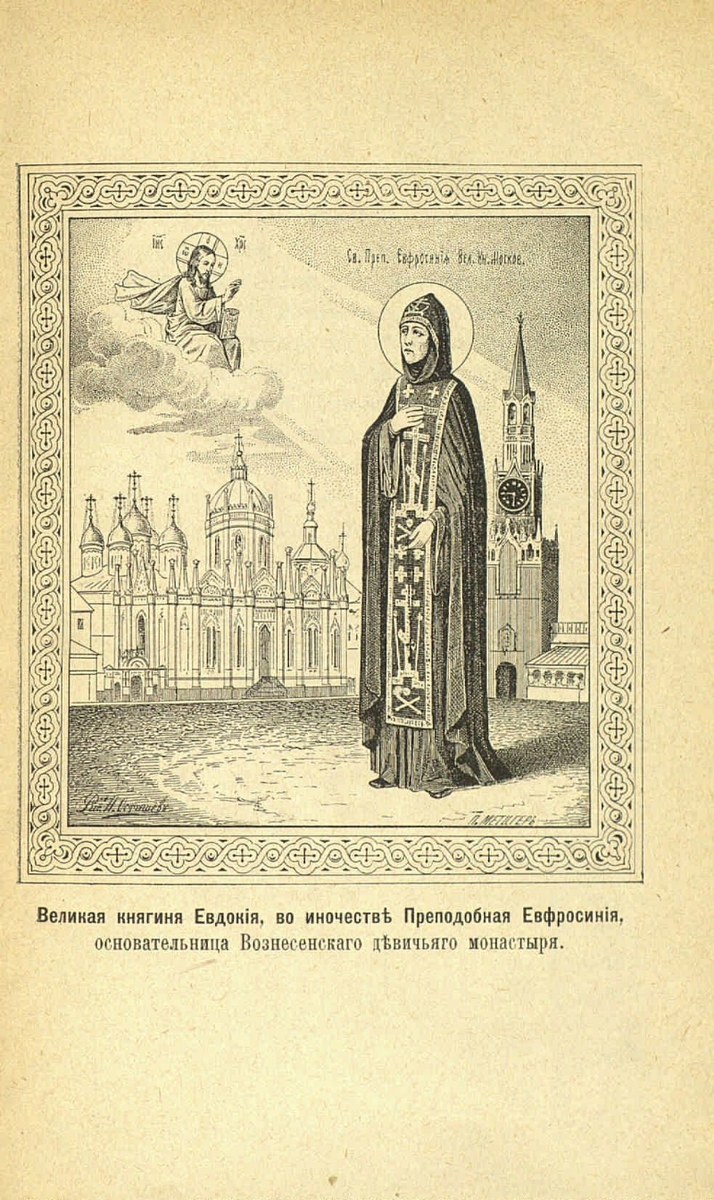
Euphrosyne is painted as a nun-princess: in the black mandyas and monastic veil, thin-faced and severe, her hands raised in prayer or holding a scroll, and often with the great schema worked in crosses over the breast. Her distinguishing attribute is the Ascension Convent — a walled church held in her hands or set beside her — and she is regularly shown against the Kremlin, with the Spasskaya tower and the convent's domes behind her, since she is a patron of the city and not only a nun. Where the princely origin is to be marked, a crown or a princely mantle is laid aside at her feet. Two scenes recur in the marginal cycles: the showing of the iron chains to her sons, and the healing of the blind man on the road to her tonsure.
The stored image is an 1899 lithograph from the Efimov press in Moscow, inscribed in the picture Св. Прп. Евфросиніи Вел. Кн. Московск. and captioned beneath, "the Grand Princess Eudokia, in monasticism the Venerable Euphrosyne, foundress of the Ascension convent of virgins." She stands in the monastic schema before the Ascension convent, with the Spasskaya tower of the Kremlin at her right and Christ blessing her from the clouds — the standard composition described above, in the idiom of the late Russian devotional print. The Wikimedia Commons file carries a Creative Commons licence applied by the uploader of the scan; that grant cannot touch the underlying 1899 lithograph, which is a pre-1900 two-dimensional work long out of copyright, and the image is stored on that basis.
Disputed questions
- Which day is her feast? She is commemorated on May 17, the day of her tonsure, and on July 7, the day of her repose. The calendars are not uniform about which is principal: the Slavic and OCA usage leads with May 17, which this entry follows as primary, entering July 7 as secondary; some Russian sources treat July 7 as the principal day, as would be the ordinary rule for a saint who reposed in peace. The anomaly is real and is recorded rather than resolved.
- Eudokia or Euphrosyne. She is Eudokia in the chronicles and in all secular history, and Euphrosyne only for the last weeks of her life; Russian church usage names her "Euphrosyne, in the world Eudokia," and this collection follows it, keeping Eudokia among the alternate names.
- The century of indexing. She reposed in 1407 and is indexed under the fifteenth century accordingly, though nearly the whole of her life belongs to the fourteenth.
- Not to be confused with Euphrosyne of Suzdal (†1250, September 25), the princess of Chernigov who became a nun at Suzdal — a genuine occasion of confusion, since both are Russian princess-nuns named Euphrosyne with a Suzdal connection (the one by her monastery, the other by her father's principality); nor with Euphrosyne of Alexandria, the virgin who lived as a monk in a men's monastery (September 25).