
Euphrosyne of Suzdal
Our Venerable Mother Euphrosyne, Princess of Suzdal
Venerable · Princess · b. 1212 — d. September 25, 1250
Commemorated 18 September — Glorification (1698) and uncovering of the relics (1699), 25 September — Repose, 1250
Euphrosyne of Suzdal (1212–1250), in the world the princess Theodulia, eldest daughter of the martyred prince Michael of Chernigov, was betrothed in youth to a prince of Suzdal who died on the very day appointed for the wedding. Refusing to return to her father's house, she entered the convent of the Deposition of the Robe (Rizopolozhensky) in Suzdal and became, under the name Euphrosyne, the most renowned woman ascetic of pre-Mongol and Mongol-era Russia: a teacher of nuns and laywomen, an ascetic of severe fasting, and a seer whose prayers, the tradition holds, spared her convent when Batu's horde burned Suzdal in 1238. She reposed on September 25, 1250, and was glorified in 1698.

Origins and early life
Theodulia was born in 1212, the first child of Michael Vsevolodovich, later prince of Chernigov and grand prince of Kiev, and his wife Theophania (so the Life names her; the chronicles leave her unnamed). The Life relates that the pious couple, long childless, prayed at the Kiev Caves monastery and were promised a daughter, and that the Mother of God thereafter appeared to them, directing them to give the child to God. The girl was raised at Chernigov in piety and letters — her Life credits her tutor, the boyar Theodore, her father's future companion in martyrdom, with her unusual education in the Scriptures and even in the profane learning of the day — and grew celebrated for beauty and mind alike.
Her parents betrothed her to a prince of Suzdal — the Life calls him Mina (Menas), of the ancient Suzdal line — and sent her north for the marriage. But the girl, who had secretly vowed herself to Christ and prayed to be spared the marriage bed, arrived to find the wedding would never take place: on the day appointed for it her betrothed died. Theodulia did not return to Chernigov. She presented herself at the women's convent of the Deposition of the Robe of the Theotokos in Suzdal, and there received the tonsure with the name Euphrosyne — after the great ascetic of Alexandria whose feast, September 25, would also become the day of her own repose.
Ascetic struggle
The young princess-nun gave herself to a severity of life that astonished the community: prolonged total fasts, vigil, prostrations, silence, and unbroken prayer, joined — her Life insists — to a sharp and cultivated mind that made her the convent's teacher. Nuns and townswomen gathered to her instruction; under her influence the community grew, and a division of the convent's life was made between virgins and widows (the widowed sisters receiving in time their own house of the Holy Trinity, founded at her counsel). She endured, like the desert fathers whose lives she knew, overt demonic assaults, which she overcame by the sign of the Cross and psalmody; the visions and consolations recorded of her include appearances of Christ and the Theotokos. In time she took upon herself the direction of the convent as its superior.
The catastrophe of her age reached Suzdal in February 1238, when the horde of Batu took and burned the city. The tradition preserved in her Life relates that Euphrosyne foresaw the invasion, prepared the sisters, and by her prayer obtained that the convent alone be spared — the Tatars, it is said, could not find it, as though a cloud hid the place — while refugees crowded within its walls; and that she afterwards laboured among the survivors, healing and consoling.
In 1245–1246 came her family's own passion: her father Michael, summoned to the Horde, was martyred with his boyar Theodore for refusing the pagan rites. The Life of Euphrosyne records that she wrote to strengthen her father in his resolve to confess Christ whatever the cost, and that on learning of his death she gave thanks that her house had been counted worthy of a martyr's crown. The convent kept the memory of both; the kinship of the two commemorations — father on September 20, daughter on September 25 — stamps this week of the Russian calendar.
Repose
Euphrosyne reposed in peace on September 25, 1250, and was buried at her convent. Miracles of healing at her tomb are recorded from the earliest memorials and continued to be registered by the convent through the centuries.
Relics and translations
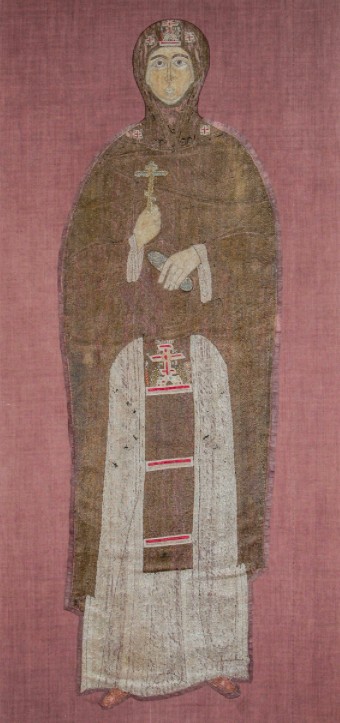
Local veneration at Suzdal is attested from soon after her death; her Life, with a service, was composed in the sixteenth century by the Suzdal monk Gregory. Formal glorification came under Patriarch Adrian in 1698, at the petition of Metropolitan Hilarion of Suzdal, and on September 18, 1699 her relics were solemnly uncovered and placed in a shrine in the convent church; September 18 remains the feast of her glorification. The relics were seized in the anti-religious campaign of 1919 and held in the Suzdal museum through the Soviet era; in 1988 they were returned to the Church, and since the reopening of the Rizopolozhensky convent (1999) they rest again in its cathedral. The sixteenth-century embroidered shroud (pelena) from her shrine, worked between 1526 and 1542 and preserved at Suzdal, is the image stored with this entry.
Feast and commemoration
September 25 (church date; Old Calendar civil October 8), the day of her repose, is the principal feast, shared with Sergius of Radonezh and Euphrosyne of Alexandria; September 18 (Old Calendar civil October 1) commemorates her glorification of 1698 and the uncovering of the relics of 1699. She is also honoured in the Synaxis of Vladimir saints (June 23). The commemoration is Russian: it is kept by the Moscow Patriarchate and the Slavic calendars and by the OCA (styled "Venerable Euphrosynē of Suzdal"), and does not appear in the Greek synaxaria.
Hymns
Troparion — Tone 4
Thy holy memory makes glad the land of Suzdal, and calls together all the faithful to thine all-honourable temple, where now thine all-glorious memory is celebrated, O venerable Euphrosyne: pray to Christ God that our souls may be saved.
Original translation from the Slavonic
Kontakion — Tone 2
Having filled the pure vessel of thy virginity with the oil of prayer and love, thou didst kindle an unquenchable lamp in thy heart, O venerable one; and going forth with it, watchful, to meet the heavenly Bridegroom, thou wast received into His most radiant bridal chamber. There now, dwelling with the choirs of angels and saints, pray, we beseech thee, to Christ God, that we may be delivered from the portion of the foolish virgins.
Original translation from the Slavonic
Iconography
Euphrosyne is depicted as a Russian nun in mantle and cowl, sometimes with a princess's attributes discreetly indicated, holding a cross or scroll, her face narrow and ascetic; she appears both alone and beside her father Michael of Chernigov, and in synaxis icons of the Vladimir and Suzdal saints. Narrative scenes — the deathbed of her betrothed, her tonsure, the sparing of the convent in 1238, her repulse of the demons — accompany her vita icons and the illuminated copies of her Life. The stored image is the embroidered shroud (pelena) of 1526–1542 from her shrine at Suzdal: the saint full-length in monastic habit, a cross in her right hand.
Disputed questions
- The betrothed. The sixteenth-century Life names her betrothed Mina (Menas), a prince of Suzdal of Varangian descent. Historians have long noted that no such prince is known to the chronicles, and many identify the intended bridegroom instead as Theodore Yaroslavich (†1233), elder brother of Alexander Nevsky, who did in fact die suddenly on the day appointed for his wedding and is himself venerated (June 5); on this view the Life has displaced the name. The identification is attractive but unproven, and this entry keeps the Life's account while recording the debate.
- Chronology. The birth year 1212 and the repose in 1250 are the received dates (so the OCA and the Russian reference books); the Life's internal chronology is loose, and some scholarship places her death as late as c. 1258. September 25 as the day is uncontested.
- The two Euphrosynes of September 25. She is not to be confused with Euphrosyne of Alexandria, the fifth-century saint commemorated the same day, in whose honour she received her monastic name; nor with Euphrosyne of Polotsk (May 23), the other great Russian princess-nun, nor with Euphrosyne (Eudokia) of Moscow (May 17, the day of her tonsure, and July 7, the day of her repose) — the wife of Dmitri Donskoy, with whom the confusion is easy, both being Russian princess-nuns named Euphrosyne with a Suzdal connection: the one by her monastery at Suzdal, the other by her father's principality of Suzdal and Nizhny Novgorod.