
Euthymius of Novgorod
Our Father among the Saints Euthymius II, Archbishop of Novgorod, the Wonderworker of Vyazhishchi
Bishop · b. c. 1380s, at Novgorod — d. 11 March 1458, at Vyazhishchi near Novgorod
Commemorated 11 March — Repose at the Vyazhishchi monastery
Euthymius II (c. 1380s – 1458), Archbishop of Novgorod from 1434 to his death, was the great builder-hierarch of the last age of the Novgorod Republic. Born in the city and baptized John, given by his parents to God in fulfilment of a vow, he was tonsured young at the Vyazhishchi monastery of Saint Nicholas, served as its steward under Archbishop Symeon, and after a long delay — for there was then no metropolitan resident in Rus' — was consecrated archbishop in 1434. Through fires, Muscovite pressure, and the last decades of Novgorod's freedom he adorned the city with churches and rebuilt its cathedral of Holy Wisdom; his most famous monument is the Faceted (Vladychny) Chamber of the archbishop's court, raised in 1433 with Western masters. A defender of his Church's ancient liberties and a lover of learning who fostered the copying of books, he reposed at Vyazhishchi on March 11, 1458; his relics were found incorrupt, and he was numbered among the saints at the Council of 1549.

Birth, vow, and monastic beginnings
The future hierarch was born in Novgorod the Great in the early 1380s and baptized John. The tradition holds that he was a child of prayer — born to parents long childless, who had vowed that a son should be dedicated to God — and that he was given while still a boy to a monastery, so that he never knew any life but the ascetic one. He received the monastic tonsure, with the name Euthymius, at the monastery of Saint Nicholas at Vyazhishchi (the Nikolo-Vyazhishchi monastery) a little north of the city, and was still young when his gravity and gifts drew the notice of Archbishop Symeon of Novgorod, who took him into the archiepiscopal household and made him steward (ekonom) of the see — the administrator of its lands and revenues, a trust that schooled him for the government of the whole Church of Novgorod.
Archbishop of Novgorod
At the end of 1429 the men of Novgorod — clergy, boyars, and people, by the free election that was their ancient right — chose Euthymius to be their archbishop. But his consecration was long delayed: these were the years of the Muscovite dynastic wars and of the vacancy and confusion of the metropolitan see of all Rus', and there was no metropolitan to lay hands on him. Only in 1434 was he at last consecrated, by Metropolitan Gerasim at Smolensk, and returned to take up the throne of Novgorod, which he would hold for nearly a quarter of a century.
His episcopate fell in the last generation of the Novgorod Republic, when the free city, with its veche and its elected archbishop, was being drawn slowly and inexorably under the hand of Moscow. Euthymius stood, in the manner of the Novgorod hierarchs, as a guardian of his Church's independence and of the city's liberties, and his relations with the grand princes and with the metropolitans of Moscow were often strained; yet he laboured also for peace, and in 1456, after Novgorod's defeat by Vasily II, he took part in the embassies that sought to compose the quarrel between Novgorod, Pskov, and Moscow. The tension outlived him: it is told that after his death a letter of absolution was sent from the Metropolitan of Moscow and laid, by the custom of the age, in the hand of the reposed hierarch — a reconciliation sealed over his grave.
The builder of Novgorod
Euthymius is remembered above all as a builder. Novgorod in his day was swept by great fires — those of 1431 and 1442 among them — and much of his energy went to raising up again the churches and courts that the flames destroyed. He restored and enriched the ancient cathedral of Holy Wisdom (Hagia Sophia), the heart of the city, adorning it with new furnishings and precious things; he built and rebuilt a long list of churches within the city and on the archiepiscopal lands; and in 1433, in the Detinets (the Novgorod kremlin), he raised the great hall known as the Faceted or Vladychny Chamber (Грановитая палата) — the archbishop's audience-hall and refectory, built with the help of Western (Hanseatic German) masters in a vaulted Gothic manner unique in Russia, where the council of the lords of Novgorod met and where the see received its guests. He raised too a bell- and clock-tower (the chasozvonya) over the archbishop's court. Under him Novgorod's scriptoria flourished, and he fostered the copying of books and the keeping of the chronicles, so that his age is one of the richest in the written memory of the city. In all this he acted not as a private patron but as the father of his Church, clothing the faith of Novgorod in stone and letters.
Repose, relics, and glorification
Euthymius reposed on March 11, 1458, at his own monastery of Vyazhishchi, where he had asked to be buried, and where his relics were laid. In time they were found incorrupt, and miracles were reported at his tomb; his local veneration was established by about the year 1500, and he was formally numbered among the saints of the Russian Church at the Council of 1549 under Metropolitan Macarius, which glorified many of the wonderworkers of the land. His relics remained the treasure of the Vyazhishchi monastery, and he is honoured as its patron and as a wonderworker of Novgorod.
Feast and commemoration
Euthymius is commemorated on March 11 (church date; Old Calendar civil March 24), the day of his repose, kept by the Russian Church and listed by the OCA as "Euthymius, Bishop of Novgorod." His feast, like the others of this part of March, ordinarily falls within Great Lent, so that his office is sung with the Lenten order and, on a weekday, without the full Liturgy. He is not to be confused with Euthymius the Great (†473, the father of Palestinian monasticism, kept January 20) or with the hieromartyr Euthymius of Sardis (†831, the iconodule confessor-bishop); nor with Euthymius I "the Bearded" (Bradaty), the earlier archbishop of Novgorod (†1429) whom he immediately succeeded — a distinct hierarch of the same city and name.
Iconography
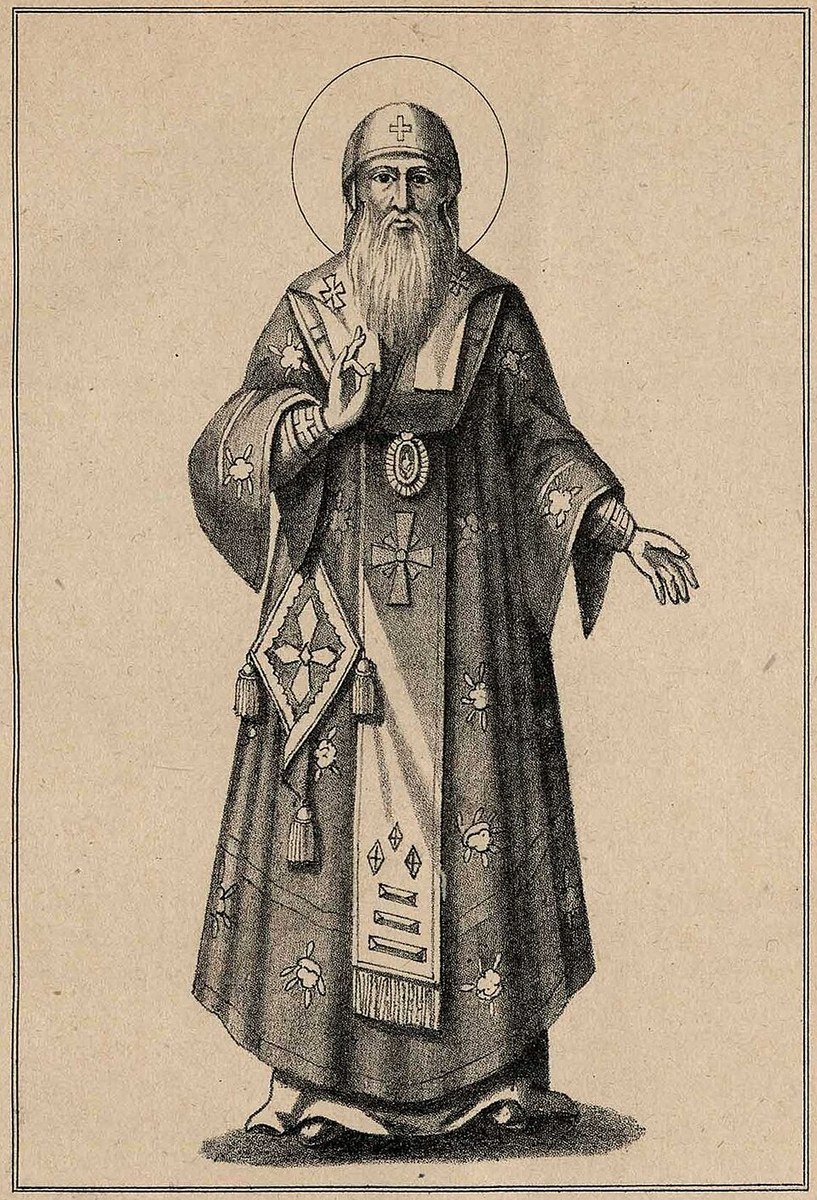
Euthymius is shown in the type of the Russian hierarch-saint: an archbishop in the sakkos or the cross-figured polystavrion and the omophorion, wearing the white klobuk proper to the archbishops of Novgorod, holding the Gospel-book and blessing, his beard full and greying — distinguished among the Novgorod wonderworkers, with whom he is often painted in a company, chiefly by his inscription. Narrative scenes attach to his building of the churches of Novgorod and to the laying of the letter of absolution in his hand.
The stored image is a drawing of 1891 from the album The Cathedra of the Hierarchs of Novgorod (Кафедра новгородских святителей, Novgorod, 1891), by V. Moiseev, depicting Euthymius as an archbishop of Novgorod in klobuk and omophorion (source, public domain, pd-old-work).