
Euthymius of Sardis
The Holy Hieromartyr and Confessor Euthymius, Bishop of Sardis
Hieromartyr · Confessor · Bishop · b. c. 754 — d. December 26, 831
Commemorated 8 March — Secondary commemoration (OCA), 26 December — Repose after scourging under the iconoclast emperor Theophilus
Euthymius (c. 754 – 831) was metropolitan of Sardis in Lydia and one of the most steadfast defenders of the holy icons through the second iconoclast persecution. A confessor at the Seventh Ecumenical Council (Nicaea, 787), he spent the last quarter-century of his life in a succession of exiles under four emperors — Nicephorus I, Leo V, Michael II, and Theophilus — refusing to the end to abandon the veneration of images. Under Theophilus he was scourged so cruelly that he died of the wounds, on December 26, 831, and the Church honours him as both confessor and hieromartyr, reckoning him among the first martyrs of the renewed iconoclasm. His Life was written soon after by Methodius, later patriarch of Constantinople, who had known him.

Origins and episcopate
Euthymius was born about the year 754, according to the tradition in Lycaonia, in the interior of Asia Minor, and embraced the monastic life before being raised, on account of his virtue and learning, to the metropolitan see of Sardis, the ancient city of Lydia. He governed the church of Sardis in the last decades of the first iconoclast period, and when the empress Irene and her son Constantine VI convened the Seventh Ecumenical Council at Nicaea in 787 to restore the veneration of the holy icons, Euthymius was among its fathers. He subscribed to its definition and took a leading part in its deliberations, denouncing the iconoclast heresy — the beginning of a public witness to the icons that would cost him the rest of his life.
Exiles and confession
Euthymius's troubles began under the emperor Nicephorus I (802–811). Whether for his outspokenness in defence of the images or, as some accounts have it, on a charge of political disaffection, he was deprived of his see and banished — to the island of Pantelleria (the "Patalareia" of the synaxaria), off the coast of Sicily, where he remained for years. The restoration of iconoclasm as imperial policy under Leo V the Armenian in 815 found him unbroken: recalled and pressed to conform, he refused, and was sent again into exile, to Assos on the Asian coast and thence to the island of Thasos. Under Michael II the Stammerer (820–829) the same demand was made and the same refusal returned; the emperor had him flogged and confined. Through more than twenty years and four reigns Euthymius neither yielded the doctrine of the Council nor purchased his freedom by silence — the pattern of the confessor, who suffers imprisonment, exile, and torture for the faith without dying of it.
Martyrdom
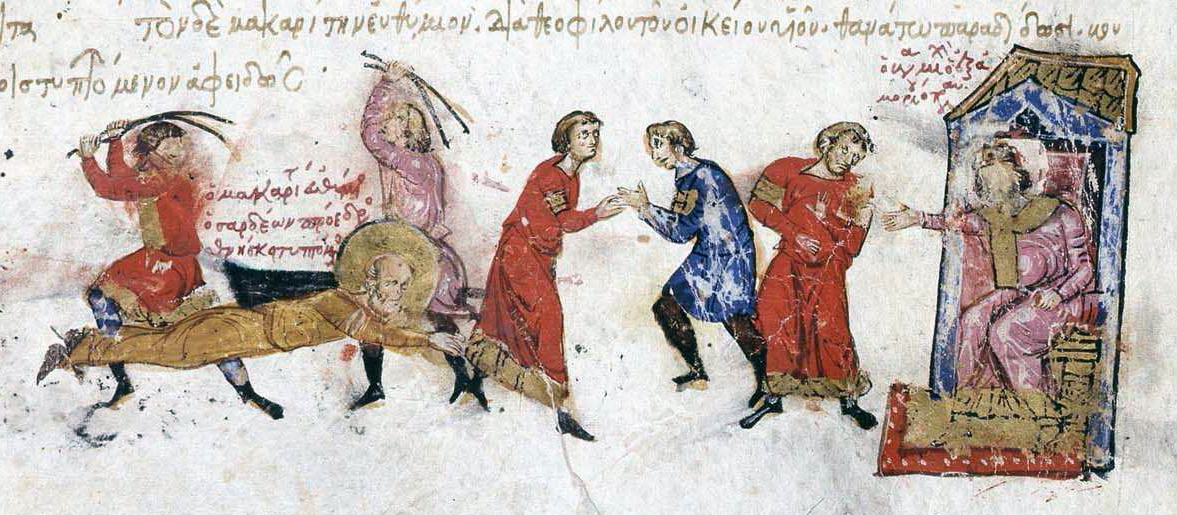
Under the last of the iconoclast emperors, Theophilus (829–842), the confession became a martyrdom. Brought once more before authority and once more unmoved, Euthymius, now an old man, was subjected to a brutal scourging: the tradition relates that he was stretched upon stakes and beaten with thongs of raw ox-hide until his body was broken. He survived the beating only a few days, and reposed of his wounds on December 26 — by the reckoning of his biographer, in the year 831. The Church accounts him therefore not a confessor only but a hieromartyr, his death the direct fruit of the torture inflicted for the icons; and the later tradition names him among the first of the martyrs of the second iconoclast persecution, the forerunner of the confessors whose steadfastness would win the final Triumph of Orthodoxy in 843.
Sources of his Life
The principal source for Euthymius is the encomium (Life) composed shortly after his death by Methodius, the future patriarch Methodius I of Constantinople (843–847), himself a confessor of the same persecution who had known Euthymius and shared something of his sufferings. Methodius's Laudatio is a near-contemporary witness of unusual value for the period, and modern scholarship rests the date of the martyrdom — December 26, 831 — chiefly on it. The martyrdom is also depicted in the illustrated chronicle of John Skylitzes (the Madrid manuscript), which sets the scourging in the reign of Michael II; the divergence over the emperor and the year is noted below.
Feast and commemoration
The principal commemoration is December 26 (church date; Old Calendar civil January 8), the day of his repose — which falls, in the fixed calendar, on the Synaxis of the Most Holy Theotokos and within the afterfeast of the Nativity, so that his service is kept together with the festal hymns of the Nativity cycle. The OCA also notes a commemoration on March 8. As one of the confessors of the second iconoclasm, he is honoured with the whole company of the defenders of the icons on the Sunday of Orthodoxy, the first Sunday of Great Lent.
Hymns
Troparion — Tone 4
Partaker of the ways of the Apostles and successor to their throne, thou didst find in action, O God-inspired, the ascent to contemplation; wherefore, rightly dividing the word of truth, thou didst contend for the faith even unto blood, O Hieromartyr Euthymius. Entreat Christ our God to save our souls.
Original translation from the Greek
Kontakion — Tone 4
The Church knoweth thee for a shining star, O Euthymius, made radiant by the confession of the icons; contending unto blood against the ranks of the impious, thou didst receive the crown of martyrdom from Christ our God, whom thou dost entreat for us all.
Original translation from the Greek
Iconography
Euthymius is depicted as an aged bishop in the vestments of a hierarch — the omophorion over the phelonion or sakkos, the Gospel book in his hand — with the thin white beard of his old age; the inscription styles him "the Confessor" or "the Hieromartyr." Because his memory belongs above all to the struggle over the icons, he is figured most characteristically not in a static hierarch portrait but in the historical scene of his martyrdom, among the confessor- bishops of the iconoclast persecution.
The stored image is such a scene: a miniature from the thirteenth-century illustrated chronicle of John Skylitzes (the "Madrid Skylitzes," Biblioteca Nacional de España), depicting the scourging and death of the iconophile bishop Euthymius of Sardis at the hands of the iconoclast emperor's men. The manuscript sets the martyrdom in the reign of Michael II; the near-contemporary Life of the saint places the fatal scourging a little later, under Theophilus.
Disputed questions
- Date and circumstance of death. Methodius's Life places the fatal scourging under Theophilus and the death on December 26, 831, and this is the date generally accepted. Some synaxaria and calendars, however, give the repose as about 840 (the figure carried, for instance, in the Slavic calendar), and the Madrid Skylitzes attributes the martyrdom to Michael II (hence a date in the 820s). The frontmatter follows the 831 dating of the near-contemporary Life while recording the variant.
- Grounds of the first exile. The tradition presents all of Euthymius's banishments as suffered for the icons. The exile under Nicephorus I in particular may have had a political colouring — an accusation of complicity in disaffection against the emperor — which the hagiographic tradition subsumes into the single witness of his confession. Whatever its immediate pretext, his lifelong refusal to abandon the images is not in doubt.
- Not to be confused with the several other saints named Euthymius — Euthymius the Great of Palestine (January 20), Euthymius the New of Thessalonica (October 15), or Euthymius of Novgorod (†1458, March 11) — nor with Meliton of Sardis, the second-century bishop of the same see.