
Febronia of Nisibis
The Holy Venerable Virgin-Martyr Febronia of Nisibis
Venerable Martyr · Virgin · Martyr · b. c. 284 — d. c. 304, at Nisibis in Mesopotamia
Commemorated 25 June — Martyrdom under the prefect Selenus
Febronia was a young nun of the convent of the abbess Bryene at Nisibis on the Roman–Persian frontier, tortured to death about the year 304 in the persecution of Diocletian. Offered marriage to the prefect's nephew Lysimachus and the wealth that went with it, she answered that she had a Bridegroom who does not die; she was then scourged, burned, her teeth broken and her tongue cut out, her hands and feet struck off before the people of the city, and at last beheaded. The crowd turned against the persecutor as it watched. Her Life and Passion — written in Syriac, and presented as the work of her fellow-nun Thomais, who says she saw it — is the longest and most consciously literary of the Syriac women's martyr-acts, and it carried her cult from the Mesopotamian frontier to Constantinople, to southern Italy and Sicily, and into every Byzantine calendar. She is commemorated on June 25, the same day as the Russian Peter and Fevronia of Murom, with whom she is constantly confused.
_-_%D0%B8%D0%BA%D0%BE%D0%BD%D0%B0_10251_%D0%A4%D0%B5%D0%B2%D1%80%D0%BE%D0%BD%D0%B8%D1%8F.png)
The convent at Nisibis
Everything transmitted about Febronia comes from a single narrative, the Life and Passion of Febronia (BHO 302), and that narrative is one of the few pieces of early Syriac hagiography that describes a women's monastery from the inside. The house stood at or near Nisibis — Syriac Ṣōḇā, modern Nusaybin on the Turkish–Syrian border — the great fortress-city of the Roman frontier, the see of St James of Nisibis and the home of St Ephrem before the city was ceded to Persia in 363. It was a small community, some fifty women, living under the abbess Bryene (Βρυαίνη, Bryaine) on a rule of exceptional severity: one meal a day, no meat, and a strict enclosure that kept the nuns out of sight of the city.
Febronia was brought there as a small child — the tradition says at two years old — and was Bryene's own niece. She was raised inside the enclosure, saw nothing of the world, and was formed as a reader and expositor of Scripture by the abbess and by the senior nun Thomais. Because her learning became known in Nisibis, the community allowed a limited traffic with the outside: on appointed days women of the city came to hear her read and comment on the Scriptures, and she taught them from behind a curtain, so that she was heard and not seen. Bryene kept the arrangement deliberately austere, fearing what praise would do to a young nun, and the Life is candid about the tension — the abbess reproving, the girl obedient, the household proud of her.
Among the women who came was a wealthy young pagan widow of senatorial family named Hieria. One conversation undid her: she went home and wept the night through, brought her parents and her whole household to the faith, and was baptised. Hieria has her own commemoration in the Greek books on June 3, and her entry in this reference sets out the rest of her story.
The persecution of Diocletian
The narrative opens in the world of the imperial administration. The consul Anthimus provides for his son Lysimachus, whose mother had secretly been a Christian and had died having taught him something of Christ; the boy is put under the guardianship of his uncle Selenus, a prefect sent east with a commission against the Christians and a temper the Life describes without restraint. Selenus takes the young man and a third officer, Primus, on his circuit through Palmyra and the Mesopotamian cities.
Word of the coming persecution reached the convent, and Bryene sent the community away into hiding. Three remained: the abbess herself, Thomais, and Febronia — who at that moment was ill and could not be moved, a detail the Life insists on, because it makes her martyrdom something she was given rather than something she sought. Lysimachus, who had no appetite for the work and was looking for a way out of it, sent Primus ahead to warn the house and to urge flight. Bryene refused to leave. What follows in the Life is one of its most extraordinary passages: an entire night in which the three women wait, the abbess prepares the girl for what is coming, and Febronia asks only that, whatever is done to her body, she should not be uncovered before men.
The passion
Febronia was taken and brought before Selenus. He began, as the passions regularly have it, with inducement: she was young, she was beautiful, she was learned; let her sacrifice, and she would be married to Lysimachus, the prefect's own heir, with a fortune and a place in the world. Her reply is the sentence the whole tradition remembers — that she had a Bridegroom who is immortal, a bridal chamber in heaven not made with hands and a wedding feast that has no end, and that she would not exchange Him for a man who dies.
The tortures that follow are set out at a length unusual even for this literature, and they are set out in public, in the open square of the city, with the population of Nisibis watching. She was stripped and scourged; stretched on a rack over a fire; her teeth were broken out one by one; her tongue was cut out; her breasts were cut off; and then her hands and feet were struck off in turn. Between the torments Selenus kept returning to the offer of marriage, and she kept refusing it. Lysimachus would not take part and turned away. The crowd, which had come to see a spectacle, began first to weep and then to shout against the emperor and against the prefect; the Life has the women of the city cry out that the gods who demand this are no gods. It was out of that crowd that Hieria stepped forward and reproached Selenus to his face for his cruelty. At the end Febronia was beheaded. She was about twenty years old.
The narrative closes the account with a judgement: Selenus went out of his mind, ran about bellowing, and dashed his head against a marble column and died. Lysimachus and Primus were baptised and took the monastic habit. Hieria gave her whole fortune to the convent, was received in Febronia's place, and died there in peace. Bryene gathered the pieces of the martyr's body — the Life is exact and terrible about the gathering — and they were laid in the convent, where a shrine was built over them; the text ends by noting that Bryene lived two years after the dedication of the shrine, and by naming its author.
The Syriac Life, and Thomais
The Life and Passion of Febronia survives in Syriac in some eight manuscripts (British Library, the Vatican, and the library of the Syrian Orthodox Patriarchate at Damascus), and was printed by Paul Bedjan in the fifth volume of his Acta Martyrum et Sanctorum (Paris, 1890–97). It is one of the three great Syriac lives of holy women — with those of the Martyrs of Ḥeliopolis and of Shmona's companions — and the one that reads least like a protocol and most like a novel: it has scene-setting, dialogue, interior reflection, a named narrator, and a sustained interest in the psychology of the abbess, the reluctant officer and the converted noblewoman.
The text presents itself as the work of Thomais (ܬܐܘܡܐܝܣ), the senior nun who stayed in the house with Bryene and Febronia and who succeeded to the leadership of the community; she writes as an eyewitness. Modern scholarship — Sebastian Brock and Susan Ashbrook Harvey, who translated the Life into English in Holy Women of the Syrian Orient (1987), and J.-M. Fiey before them — treats the eyewitness claim with reserve: naming a woman of the community as author is a recognised device of the genre, and the text as it stands is generally placed in the later fifth or sixth century, two centuries after the events it narrates. What is not in doubt is that the Life was written for a women's monastery, about a women's monastery, and that whoever wrote it knew such houses from within. That is why the text matters far beyond the cult of one martyr: it is a primary witness to female monasticism in the Syriac-speaking Church of the Antiochene sphere, its rule, its learning, its relations with the city, and its sense of itself.
The cult: Nisibis, Antioch, Constantinople, Italy
A convent and shrine of Febronia stood at Nisibis, and healings were reported at her reliquary. The Greek tradition records a translation of her relics to Constantinople in 363 — the year Jovian surrendered Nisibis to the Persians and the Christian population of the city was evacuated westward, which gives the notice its plausibility. Portions were said to have been placed in a church associated with St James of Nisibis.
The cult is attested at Antioch and in the Antiochene orbit early, and it is from there that it travelled. In Constantinople, Febronia had a chapel in the church of St John the Forerunner at Oxeia — the church of the Miracles of St Artemius, where she appears as a healing saint associated with Artemius, whose relics lay in the same church. The two saints were invoked together there, and this collection's entry on Artemius records the arrangement from the other side. Jeanne-Nicole Saint-Laurent, who has traced the diffusion of the dossier, notes that firm evidence for the Constantinopolitan cult is not earlier than the seventh century, whatever the date of the translation notice.
From Constantinople and from Syria the Life passed into Greek, Latin, Armenian, Georgian, Arabic and Ethiopic. A Latin version appears in the ninth century, the age of the Syrian popes at Rome, and with it a substantial Western cult: her supposed relics at Patti and Palagonia in Sicily, at Trani in Apulia, and a shrine at San Carlo ai Catinari in Rome; she is one of the saints of the colonnade of St Peter's Square. In the Latin and vernacular transmission her name is deformed into Phebronia, Sephronia, Sophronia and — in the Amalfitan cult — Trofimena. The Syriac Orthodox Church keeps her tomb-church at Ḥimo, near Qamishli in the Jazira of north-eastern Syria, within a few miles of Nisibis itself, so that the cult has never left the country of its origin.
Feast and commemoration
June 25 (church date; New Calendar civil June 25, Old Calendar civil July 8). The commemoration is universal: Antiochian, Greek, Russian, Romanian, Georgian, Syriac and Coptic calendars all keep it, and the Roman martyrology has kept it since the medieval Latin transmission of the Life. Some Western and older Eastern lists have also carried a February 12 memory of her, which appears to be a secondary Western date rather than a Byzantine one; the Byzantine rite knows only June 25.
The day is subordinate in the Typikon to the leavetaking of the Nativity of the Forerunner, whose feast was kept the day before with a vigil. In practice this means the Menaion for June 25 gives Febronia her stichera, her canon and the common apolytikion of a woman martyr, but the kontakion of the day is the Forerunner's — Ἡ πρὶν στεῖρα σήμερον — and the apodosis takes the leading place at Liturgy. In Antiochian and other New Calendar usage June 25 falls inside the Apostles' Fast in most years, though not in all: the fast's start is governed by Pascha and it always ends on June 28, so its position on this day is not fixed and is not asserted here.
In the Slavonic books the day is dominated instead by Peter and Fevronia of Murom, and Febronia of Nisibis stands second; in Greek usage the order is reversed and the Murom saints do not appear at all. Greek usage also brings to this day Orentius and his six brothers, whom the Slavonic books keep on June 24.
Hymns
Apolytikion — Tone 4 (common of a woman martyr)
Thy ewe-lamb, O Jesus, cries out with a great voice: For Thee, my Bridegroom, do I long; for Thee I contend; with Thee am I crucified, and in Thy baptism am I buried. I suffer for Thy sake, that I may reign with Thee; I die for Thee, that I may live in Thee. Receive me as a spotless offering, sacrificed to Thee in love. At her intercessions, O Merciful One, save our souls.
Kontakion — Tone 6
Espoused from childhood to the immortal Bridegroom, thou didst spurn a mortal marriage and a perishing dominion, O all-praised Febronia; and giving thy members one by one to the tormentors, thou didst gather in heaven the crown that cannot be taken away. Wherefore Nisibis boasteth in thee, and the Church of the faithful crieth: Rejoice, O bride of Christ unwedded.
Original translation from the Greek
Iconography
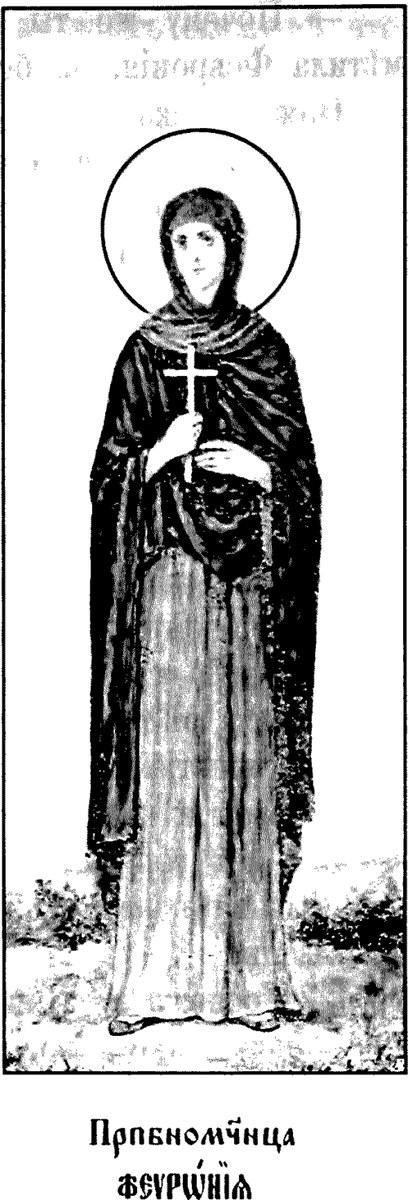
Febronia is painted as a nun-martyr: a young woman, unlined and grave, in the dark monastic mandyas with the veil drawn close about the head and no hair showing, holding the martyr's cross in her right hand, the left hand open at the breast or bearing a scroll. The habit and the cross together are the whole of her type — the habit says venerable, the cross says martyr, and Byzantine and Slavic painters ask nothing more of her image. She is inscribed in Greek Ἡ ἁγία Φεβρωνία and in Slavonic Прпбномчница Февронїа, "the venerable-martyr Febronia," which is the surest way to distinguish her image from that of the princess-nun Fevronia of Murom, who is inscribed prepodobnaya, venerable, and is normally paired with her husband.
Where a narrative cycle exists — and the Life invites one more than most passions do — the scenes are the teaching from behind the curtain, the night of waiting with Bryene and Thomais, the offer of marriage before the tribunal, the dismemberment in the public square with the crowd recoiling, Hieria's protest, and the gathering of the relics. In the Sicilian and Apulian cult her martyrdom became a subject for baroque altarpieces, of which the best known is Guglielmo Borremans's Martyrdom of Saint Febronia (1728, Palermo); it is out of copyright, but it is a Western devotional canvas and not an icon, and it has not been stored here.
The stored image is the engraved icon-plate of the venerable-martyr Febronia from the June volume of the illustrated Russian Lives of the Saints after St Demetrius of Rostov (1903–1911) — an anonymous work whose term of copyright has long expired. It gives the type exactly: the young nun standing full length in mandyas and veil, nimbed, the cross held upright before her, with the Slavonic inscription Прпбномчница Февронїа beneath.
Disputed questions
- Not to be confused with Peter and Fevronia of Murom. This is the single commonest error attaching to June 25, and it is structural rather than accidental: Fevronia is simply the Slavonic form of Febronia, and the Russian princess-nun of Murom (†1228) took that name in religion because she was named for this martyr, whose feast is the day of the Murom couple's repose. The two share a name, a calendar day and a monastic habit and nothing else. Febronia is a Mesopotamian virgin-martyr of the early fourth century who died under torture in a Roman provincial city; Fevronia of Murom is a Russian peasant healer who married a prince, was exiled with him, ruled beside him and died a nun in her bed. Popular Russian and English writing has repeatedly merged them, transferring the martyrdom to Murom or the marriage-patronage to Nisibis; both entries here carry reciprocal notes. On the Old Calendar the confusion is compounded by the fact that both fall on civil July 8, which is also modern Russia's Day of Family, Love and Fidelity.
- Nisibis or Sivapolis? The Syriac Life places the convent at Nisibis. The Greek recension, and after it the OCA and much English-language usage, place it at Sivapolis (Σιβάπολις) in Assyria. No such city is otherwise known, and the name looks like a corruption or a learned substitution in the Greek transmission; the Syriac reading is to be preferred as the earlier, and the epithet "of Nisibis" is used here. The Greek calendar meanwhile gives her disciple Hieria the epithet "of Mesopotamia," which is neutral between the two.
- The date. The persecution is that of Diocletian (284–305); the martyrdom is conventionally placed at 304, and the birth-date of 284 given in reference works is simply that figure less the twenty years the Life implies. No year is transmitted in the text itself.
- Did she exist? The Life is a composition of the fifth or sixth century about events of the early fourth, and it is written to a literary pattern; some reference works accordingly mark her historicity as uncertain. Against pure invention stand the antiquity and geographical concentration of the cult at Nisibis, its independent attestation in Syriac and Greek, and the tomb-shrine in the Jazira. The honest position is that a martyred nun of Nisibis stands behind the text and that the text as we have it is a work of hagiographic art rather than a court record.
- Virgin-martyr or venerable-martyr? Both, and the calendars differ in emphasis. The Greek books style her ὁσιοπαρθενομάρτυς — venerable virgin-martyr — the Slavonic преподобномученица (venerable-martyr, the reading on the stored icon), and English jurisdictional calendars usually "Virgin Martyr." She was a tonsured nun and died a virgin under torture, so all three are accurate; this entry carries all three terms.
- Not the martyr Febronia of the Egyptian calendar. The Coptic Church keeps her on Gregorian July 8 / Julian June 25 — the same saint on a differently reckoned day, not a second Febronia. Nor is she the eighteenth-century pseudonym Justinus Febronius (J. N. von Hontheim), from whom the term Febronianism derives; the coincidence of name has no bearing on the saint.