
Peter and Fevronia of Murom
The Holy Right-Believing Prince Peter, in monasticism David, and his Consort the Holy Right-Believing Princess Fevronia, in monasticism Euphrosyne, Wonderworkers of Murom
Prince · Princess · Venerable · Wonderworker · b. Peter — later 12th century, of the princely house of Murom; Fevronia — of the village of Laskovo in the Ryazan land — d. both on 25 June 1228, at Murom
Commemorated 25 June — Repose of both on the same day and hour
Peter, prince of Murom on the Oka, and his wife Fevronia, the daughter of a tree-honey gatherer from the village of Laskovo, are the Russian Church's patrons of marriage. The story as Russia has it — that Peter was scaled with sores from the blood of a serpent he had killed, that the peasant girl who healed him made him promise to marry her, that the boyars drove them out and then begged them back, and that they took the monastic habit as David and Euphrosyne and died in the same hour on 25 June 1228, and were found twice in one tomb after being buried apart — comes from the Tale of Peter and Fevronia, written by the priest Yermolai-Erasmus about 1547. Behind it stands a real prince of Murom who died in 1228. They were glorified at the Moscow council of 1547, their relics rest in the Holy Trinity convent at Murom, and modern Russia keeps their day, Old Calendar civil July 8, as the Day of Family, Love and Fidelity. Their Fevronia is the Slavonic form of the name of the Mesopotamian martyr Febronia of Nisibis, with whom they share this feast and with whom they are constantly confused.

The princes of Murom
Murom sits on the left bank of the Oka at the eastern edge of the Russian forest zone, an old Finno-Ugric town — the Muroma gave it its name — Christianised late and violently by Constantine and his sons Michael and Theodore at the turn of the twelfth century, whose entry is at May 21. Peter belongs to the third or fourth generation after that baptism, in a small principality that had detached itself from Chernigov and would be wrecked by the Mongols within a decade of his death.
The Tale makes him the younger son of Prince Yuri Vladimirovich and the brother of Prince Paul, and says he came to the throne of Murom in 1203. The chronicles, which do not know the Tale, record for the same seat a prince David Yurievich, who ruled from 1205 and died in 1228 — the year and the family the Tale gives, under the other of the two names it attaches to its hero. The relation between the two names is the entry's chief historical question and is taken up below.
The serpent, and the sores
The Tale opens with a flying serpent that came to Paul's wife in the shape of her husband. She contrived to learn from it the manner of its death — "by Peter's shoulder and by Agricus's sword" — and Peter, hunting for the meaning of the riddle, found the sword hidden in the wall of a church of the Exaltation of the Cross in a monastery outside the town. He killed the serpent; it reverted to its own shape as it died, and its blood splashed him, and from the blood he broke out in scabs and sores which no physician in Murom could touch. The condition the Tale describes and Russian usage calls prokaza — leprosy, in the broad medieval sense of a disfiguring skin disease.
Fevronia of Laskovo
He was carried into the Ryazan land looking for a cure, and his servant came to the village of Laskovo, where he found a girl alone at a loom with a hare leaping in front of her. She spoke to him in riddles — that it was a pity the house had no ears and the room no eyes, meaning a dog to give warning and a child to look out of the window; that her father and mother had gone to weep on borrowed tears, meaning a funeral, and her brother had gone to look death in the eye, meaning that he gathered wild honey from the tops of trees. She was Fevronia, daughter of a drevolaz, a climber for forest honey, and she healed with herbs.
She undertook to cure the prince on one condition: that he marry her. Peter, the Tale says without softening it, agreed and did not mean it, and thought a prince could not take a tree-climber's daughter. She sent him a vessel of leavened bread-dough with the order to anoint every sore but one and to bathe; and the sores went, all but the one, and from that one the disease broke out over him again. He came back, and this time the promise was kept. It is a folk-tale motif — the wise girl who answers in riddles and outwits the prince — and the Church kept it, because in the Tale the wisdom is not cunning but discernment, and it is the woman who holds the man to his word.
Her other riddling exchange became proverbial. Peter, to test her, sent a bundle of flax and told her to weave him a shirt, a pair of trousers and a towel from it while he bathed; she sent back a stick from the loom and told him to make her a loom out of it in the same time. He said it could not be done; she said neither could the other.
The boyars, and the exile
They were married and reigned in Murom. The boyars, and above all their wives, would not have a commoner over them, and the Tale has one of them complain that she rose from the table gathering the crumbs into her hand like a hungry woman — at which Peter opened her hand and found incense and myrrh. In the end the nobles put it to the prince: put her away, or leave the throne. He chose his wife. The couple went down the Oka by boat into exile, taking nothing.
Two scenes belong to the journey. A man in the boat looked at the princess with desire; she told him to draw water from one side of the vessel and drink, then from the other, and asked whether the water differed; and when he said it did not, she said neither does one woman differ from another, and let him leave his own wife alone. And on the bank at evening, when Peter's heart failed him at the thought of the principality lost, she pointed to the poles cut for the cooking-fire and said they would be trees by morning; and in the morning they were trees in leaf, and she said that if God can do that with dry wood He can restore a prince to his seat.
Murom meanwhile fell into blood: the boyars fought over the throne and killed one another, and the city sent to beg the couple to come back. They came back, and ruled, the Tale says, not as lords but as father and mother to the city, keeping open house and refusing no one.
The one hour and the one tomb
In old age they took the monastic habit in separate houses, Peter as David and Fevronia as Euphrosyne, and prayed to be allowed to die together and be buried in one coffin — a single stone sarcophagus, made ready beforehand with a thin partition down the middle.
The death-scene is the most famous passage in early Russian literature. Euphrosyne was embroidering an aer, the veil for the holy gifts, for the cathedral church, when David sent word that he was dying and was waiting for her. She sent back word to wait until she had finished the work. He sent a second time. He sent a third, saying he could wait no longer; and she finished the face and the hands of the saint she was working, stuck the needle into the cloth and wound the thread about it, sent word that she was ready, and prayed, and they died together — the same day and the same hour, 25 June 1228.
The city would not bury a monk and a nun in one grave. They laid him in the cathedral of the Nativity of the Theotokos inside the walls and her in the convent church of the Exaltation of the Cross outside them, and left the double coffin empty. In the morning the two bodies were in the double coffin. They were separated again; in the morning they were together again. After that they were left where they had put themselves, and there they lay.
Relics and cultus
The joint tomb in the cathedral of the Nativity of the Theotokos at Murom became a place of pilgrimage, and healings at it are recorded through the sixteenth century. Metropolitan Macarius glorified the couple at the Moscow council of 1547, in the great enrolment of Russian saints that also glorified the earlier Murom princes; the service and the Tale were written for that occasion. Ivan IV, who took Kazan on a campaign that passed through Murom, endowed the shrine.
The cathedral was destroyed in the Soviet period; the relics passed to the Murom museum and were returned to the Church in 1989, and since 1992 they have rested in the church of the Holy Trinity convent in Murom, where the queue on the feast is one of the longest in provincial Russia. In 2008 the Russian state instituted the Day of Family, Love and Fidelity on July 8, the Old Calendar civil equivalent of their church date, and set up monuments to the couple in scores of cities; in 2012 the Russian Church added a second commemoration on the Sunday preceding September 19, for the sake of couples who wish to be married and cannot on a day inside the Apostles' Fast. That second feast is governed by a movable rule and is not entered in the feast list above.
The Tale of Peter and Fevronia
The narrative was written by Yermolai-Erasmus (Yermolai Pregreshny, "the sinful"), a priest of the Kremlin and one of the more independent writers of the age of Ivan IV, about 1547, for the glorification. It is not a vita in the ordinary sense: there is no childhood piety, no asceticism, no miracle-list, and almost no ecclesiastical furniture until the last page. It is a work of art built out of folk material — the serpent-slaying, the wise maiden, the riddles, the posthumous reunion — and it has been read since the nineteenth century as the finest piece of narrative prose in sixteenth-century Russian. Its themes have been compared to Tristan and Iseult (the wound only the woman can heal, the sea-voyage, the death together) and to the Yaroslavl and Murom local legends; the comparison is a matter of shared motif rather than demonstrable dependence.
The same Yermolai-Erasmus wrote the Account of Basil of Ryazan, another Murom-and-Ryazan text of the same campaign of local glorification, so the two entries in this reference stand behind the same pen.
Feast and commemoration
June 25 (church date; New Calendar civil June 25, Old Calendar civil July 8), the day of their repose. The commemoration is Russian: it is kept by the Moscow Patriarchate, by the Orthodox Church in America and by Russian-tradition parishes generally, and it is not in the Greek books, where June 25 belongs to Febronia of Nisibis and, in Greek usage, to Orentius and his six brothers. Antiochian parish calendars in North America, which draw on both traditions, commonly list the Murom couple after Febronia.
The day is also the leavetaking of the Nativity of the Forerunner, kept the day before with a vigil, which takes the leading propers; and in most years it falls inside the Apostles' Fast, whose start is governed by Pascha and is therefore not fixed. That fast is the reason for the second, movable Russian commemoration on the Sunday before September 19, instituted in 2012 so that weddings might be blessed on the couple's day outside a fasting season.
Peter and Fevronia are invoked at betrothals and weddings, and for the healing of marriages; they are the patrons of the modern Russian civil Day of Family, Love and Fidelity (July 8), whose emblem is the camomile.
Hymns
Troparion — Tone 8
As a branch of the right-believing root, ye ruled your city in godliness, O blessed Peter, and with thee thy true helpmeet Fevronia; and having pleased God by almsgiving and by prayer, ye laid down the princely crown for the monastic habit, and having been made one in the world ye were not parted in the tomb. Wherefore pray to Christ our God that our city be preserved, and that our souls may be saved.
Original translation from the Slavonic
Kontakion — Tone 8
Having lived in the world in the wisdom of God, and having consecrated your life to Him, ye were shown forth as a rule of faithful love; and dying in one hour, ye were not divided even in death, but rose up together into the one tomb prepared for you. Wherefore, receiving grace to heal the sick and to bind up the broken household, we cry to you: Rejoice, O Peter and Fevronia, sure intercessors for our marriages.
Original translation from the Slavonic
Iconography
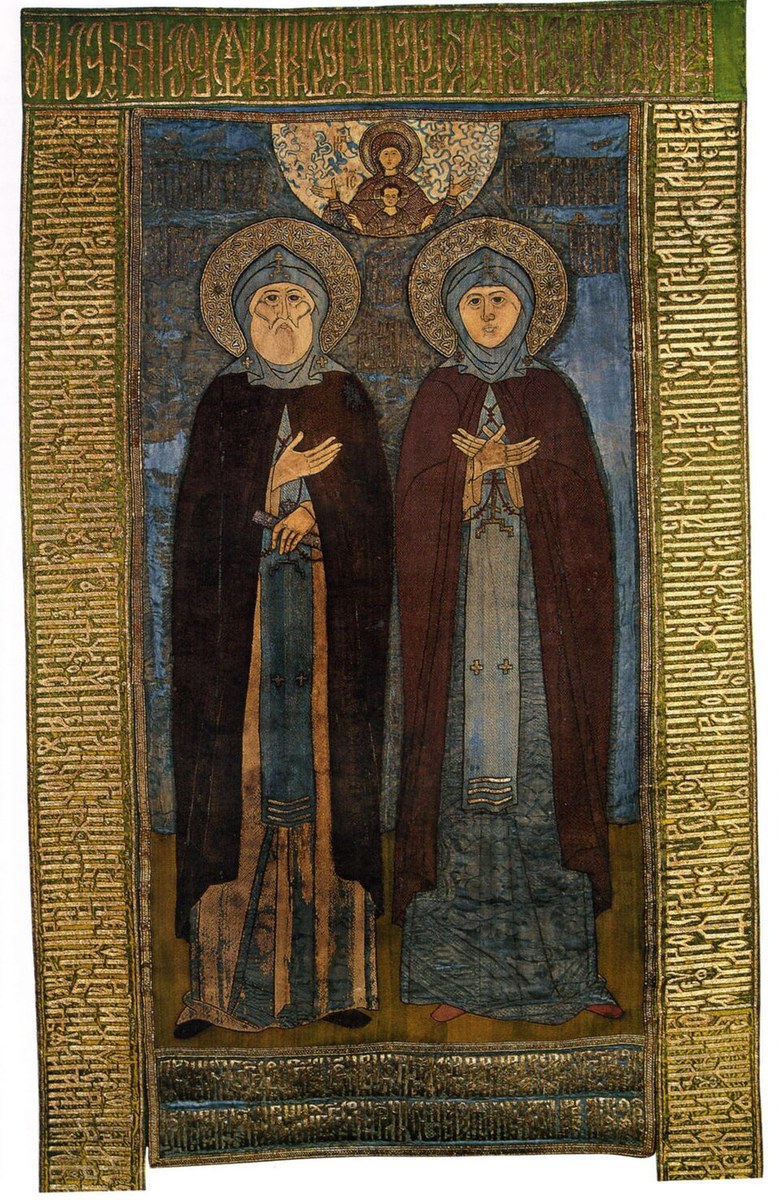
The couple is painted together and always in the monastic habit, not in princely dress: this is their distinguishing mark against every other pair of right-believing princes, and it follows the Tale, which ends them as David and Euphrosyne. The prince stands at the left, an older man with a rounded grey beard, in the dark mandyas over the analavos, the schema cowl drawn over his head; the princess at the right in the same habit, her face uncovered and framed by the veil. Their hands are raised in prayer, or one holds a scroll, or the two hold a model of the church between them. Above them, in the fuller compositions, is the Mother of God of the Sign, toward whom the prayer is made. Later Russian workshops added the boat on the Oka, the serpent and the sword, the sick prince and the girl at the loom, in border scenes; and in the Murom compositions the couple stands in a row with the other saints of the city before its walls.
The stored image is the embroidered shroud-cover (pokrov) of 1593, made in the workshop of Tsaritsa Irina Fyodorovna Godunova for the joint tomb in the cathedral of the Nativity of the Theotokos, and now in the Murom Museum of Art and History. It is the classic statement of the type: the two monastics standing full length on a gold ground, in mandyas and cowl, the Theotokos of the Sign in a medallion above, the whole framed by a broad embroidered border of Slavonic inscription. A shroud-cover of this kind lay over the reliquary itself, which is why the figures are shown at the length of a body.
Disputed questions
- Not to be confused with Febronia of Nisibis, the virgin-martyr of Mesopotamia (†c. 304), who is commemorated on the very same day. Fevronia is the Slavonic form of Febronia: the princess bore the martyr's name, and the two feasts coincide because the couple died on the martyr's day. Nothing else is shared. Russian and English popular writing merges them regularly — attributing the martyrdom to Murom, or the patronage of marriage to Nisibis — and Old Calendar reckoning deepens the confusion by putting both on civil July 8, the Russian Day of Family, Love and Fidelity. Both entries in this reference carry the note.
- Peter or David? Which was the baptismal name? The Tale says the prince was Peter in the world and David in monasticism. The Laurentian and other chronicles know a prince of Murom called David Yurievich, who died in 1228 and whose wife was called Euphrosyne; they say nothing of any Peter. If the chronicles are right the Tale has the names the wrong way round, and the historical prince was David in the world and Peter in religion, his wife Euphrosyne in the world and Fevronia in religion. Most Russian historians take this view; the Church's usage follows the Tale, and this entry keeps the liturgical form (Peter and Fevronia, in monasticism David and Euphrosyne) while recording the reversal. Neither arrangement affects the identification: one couple, one death-date, one tomb.
- How much of the story is history? The prince, the date, the principality and the joint burial are historical or very likely so; the flying serpent, the sword of Agricus, the riddles and the growing poles are folk-narrative that Yermolai found already attached to the tomb and wrote up. The Tale itself was not accepted into the Great Menaion Reader of Metropolitan Macarius, which is generally read as an editorial judgement on precisely this point — that it was too much a story and too little a life. That did not affect the glorification.
- Were they childless? The Tale says nothing of children; the chronicles give David Yurievich sons, and one Murom line descends from him. The silence is the Tale's, not the record's, and the modern presentation of the couple as patrons of the fruitful family rests on the chronicles rather than on the text that made them famous.
- The other Murom saints. They stand in the same local company as Constantine, Michael and Theodore (May 21), the baptisers of the city, and Juliana of Lazarevo (January 2), the almsgiving noblewoman of the Murom district; the three groups are painted together before the walls of Murom.