
Forty Martyrs of Sebaste
The Holy Forty Martyrs of Sebaste
Martyr · d. 320, at Sebaste in Armenia
Commemorated 9 March — Martyrdom on the frozen lake of Sebaste under Licinius
The Forty Martyrs of Sebaste (†320) were forty soldiers — many of them men of the Twelfth "Thundering" Legion garrisoned in Lesser Armenia — who, in the persecution of the emperor Licinius, refused to sacrifice to the gods and were condemned to freeze to death overnight on a frozen lake outside Sebaste, a warm bath-house set aglowing on the shore to tempt them to apostatise. Through the night they encouraged one another and prayed that all forty might finish the course; one lost heart, ran to the bath, and died on its threshold, while a pagan guard named Aglaius, seeing thirty-nine radiant crowns descend from heaven, confessed Christ and stripped himself to complete the number. At dawn the survivors' legs were broken and their bodies burned; the youngest, Meliton, still breathing, was carried to the pyre in the arms of his own mother, who would not let him be parted from his companions. Their bones were cast into the river, gathered by the faithful, and dispersed across the Christian world. Kept on March 9, always within Great Lent, they are among the most beloved of all the martyrs, praised in famous homilies by Basil the Great and Gregory of Nyssa.

Sebaste, the legions, and the persecution of Licinius
Sebaste (Sebastea, the modern Sivas) in Armenia Minor was, like the neighbouring Cappadocia, a nursery of martyrs; a generation before the Forty it had already given the Church Eustratius and his companions, the Five Martyrs of Sebaste, and it would keep the memory of Blaise its bishop and of the martyr Severian, who trained the Forty for their contest. The region was heavily garrisoned, and its churches counted many soldiers among the faithful — for the frontier legions of the East had been Christianised in numbers long before the peace of the Church.
The setting of the martyrdom is the brief but sharp persecution launched by Licinius. In 313 Licinius had joined Constantine in the Edict of Milan that granted the Christians peace; but as the two Augusti drifted toward the civil war that would end in Licinius's defeat (324), Licinius, ruler of the East and increasingly the champion of the old gods against his Christian rival, turned against the faith in his own dominions. He purged Christians from the army and the court and, in the provinces, revived the sacrifice-test. It was in this setting, about the winter of 320, that a company of soldiers stationed at Sebaste — the tradition names them men of the Twelfth Legion, the "Fulminata" or Thundering Legion, an old unit long associated in Christian memory with the "rain miracle" under Marcus Aurelius — were commanded to prove their loyalty by sacrificing to the idols, and refused as one body.
The officers charged with the province are named in the acts as the dux Lysias and the governor Agricolaus (Agricola) — the same pair of names that recurs across the Armenian martyr-acts of the period. Before them the forty soldiers confessed themselves Christians and soldiers of Christ before Caesar. Threats, then flattery — promotion, the emperor's favour — were tried and failed; the martyrs answered that they would not exchange the imperishable for the perishable, and were cast into prison to await sentence.
The night on the ice
The sentence devised for them was calculated to break the will rather than the body outright, and to make apostasy easy at every moment. On a bitter winter night the forty were stripped naked and driven out onto the surface of a frozen lake (or pond) beside the city, there to stand exposed to the killing cold until morning. On the shore, in full view, a bath-house was heated and left open and steaming: any man who could bear no more had only to leave the ice and step into the warm water — and, by that act, to renounce Christ. The cruelty was in the choice held out all night long, a hand's breadth away.
Through the dark the martyrs stood together and kept up one another's courage, praying — in words the hymnography loves to repeat — that the cold might not carry off any of their number before the crown, that all forty might arrive together: "Sharp is the winter, but sweet is Paradise; painful the ice, but delightful the enjoyment. Let us not turn aside, O fellow-soldiers; let us endure a little, that we may be crowned. Forty have entered the contest; let forty be crowned; let not one be wanting from the number." As the night deepened one man's resolve failed: unable to endure, he broke from the company and ran for the bath — but the shock of the sudden heat upon his frozen body killed him on the very threshold, so that he lost both his life and his crown, a warning the homilists dwell on. Thirty-nine remained.
Then came the wonder that completes the story. The guards set to watch the lake had lit fires and taken turns sleeping; one of them, a soldier named Aglaius (Aglaïos), lying awake, saw a great light over the lake and thirty-nine radiant crowns descending from heaven, one hovering above each of the standing men — thirty-nine, not forty, the fortieth wanting because of the deserter. Understanding what he saw, and moved past all fear, Aglaius roused his fellow guards, cast off his own clothes, cried out "I too am a Christian!", and ran onto the ice to take the empty place and complete the number. So the company of forty was made whole again — a pagan executioner exchanged for the fallen confessor — and forty crowns came down.
The morning, and the mother of Meliton
At daybreak the martyrs were found still alive, though frozen past standing, and the governor ordered them dispatched. Their legs were broken with hammers (crurifragium), and their bodies gathered up to be burned on a pyre and the ashes flung into the river, that the Christians should have no relics to venerate.
Here the tradition sets its most tender and most famous scene. The youngest of the company, Meliton, a mere youth, was still breathing when the executioners came to load the bodies onto the carts for the fire; thinking that so young a man might yet be saved if his mother pleaded with him, they left him lying on the ground. But his mother stood by, and she would not have it. Refusing to let her son be separated from his brothers in the contest, or to see him live only to fall away, she took up his broken body in her own arms and carried him after the carts to the pyre, urging him onward to the crown — "Go, my child, go with thy companions; be not left behind from the forty; do not deprive me of the glory of being mother of a martyr." He died as she bore him, or upon the fire beside the rest, and so the forty went together into death as they had stood together in life. The image of the mother carrying her martyred son to the flame is one of the most cherished in Orthodox hagiography and passes straight into the day's hymns.
The bodies were burned and the bones cast into the river. But the relics were not lost: the tradition tells that the bones, gathered downstream, shone in the water, and that the bishop of Sebaste (a Peter, not to be confused with Peter of Sebaste the brother of Basil) was shown in a vision where they lay, so that the Christians recovered them by night and kept them.
The Testament of the Forty
Among the treasures of the early Church that have come down from this martyrdom is the Testament of the Forty Martyrs (Testamentum XL martyrum), a document dictated by the martyrs in prison, before their contest, and preserved in Greek. In it the forty — many of them named — set down their common last will, directing above all that their relics not be divided but kept together in one place, at the village of Sarim near the town of Zela, in the care of named presbyters, and greeting by name their kinsmen and fellow Christians. The Testament is a rare first-person voice from the age of the martyrs, witnessing both to the reality of the company and to the early conviction that their bones were a shared inheritance of the whole Church, not to be scattered — a wish which, as it happened, the devotion of the faithful soon overrode.
The roster of names
The tradition transmits the names of all forty, and though the spellings vary across the Greek, Slavonic, and Latin recensions (and one or two names differ between manuscripts), the received roll is:
Cyrion (Quirio), Candidus, Domnus, Hesychius, Heraclius, Smaragdus, Eunoicus, Valens, Vivianus, Claudius, Priscus, Theodulus, Eutyches, John, Xanthias, Helianus, Sisinius, Angius, Aetius, Flavius, Acacius, Ecdicius, Lysimachus, Alexander, Elias, Gorgonius, Theophilus, Dometian, Gaius, Leontius, Athanasius, Cyril, Sacerdon, Nicholas, Valerius, Philoctimon, Severian, Chudion, Aglaius, and Meliton.
Cyrion (Quirio) and Candidus are named at the head as the two most learned and the spokesmen of the company; Meliton is the youngest, the son carried by his mother; and Aglaius is the convert guard who took the deserter's place, so that the man who completed the forty had begun the night as their executioner.
Relics and their dispersal
Contrary to the martyrs' own request that their bones be kept together, the relics of the Forty were soon dispersed as widely as those of any saints of the early Church — a measure of how quickly and how universally their cult spread. Within two generations their relics were at Caesarea in Cappadocia, where Basil the Great built a martyrium for them and preached on their feast; at Annisa in Pontus, where the mother of Basil and Gregory of Nyssa, the righteous Emmelia, obtained a portion and was herself buried beside them; at Constantinople, where the empress Pulcheria built and enriched churches in their honour, and where the relics were the object of a celebrated discovery-narrative told by Sozomen; and in the West, at Brescia, where bishop Gaudentius enshrined relics brought from the East and preached upon them. From these centres the veneration of the Forty radiated through the whole Christian world, East and West, so that few companies of martyrs are so nearly universal.
Homilies and the literary legacy
The Forty were, from the fourth century, a favourite theme of the great preachers, and their martyrdom is unusually well attested in contemporary oratory:
- Basil the Great delivered a homily on the Forty Martyrs (Homily 19) at Caesarea on their feast, about the year 373 — the earliest and most influential encomium, source of much of the tradition's language, including the martyrs' cry on the ice and the reflection that a company of forty, unlike a single martyr, offers every city and household a share in its patronage.
- Gregory of Nyssa, Basil's brother, preached more than one homily In the Forty Martyrs (the manuscripts transmit two or three), in which he recalls that his own mother Emmelia possessed their relics and that he had venerated them from childhood at the family shrine — a personal witness that ties the Cappadocian family to the cult.
- Gregory the Theologian and, in the Syriac East, Ephrem the Syrian also composed encomia; Gaudentius of Brescia preached on them in the Latin West; and the Testament and the passion-acts circulated widely.
This density of fourth-century testimony — the Testament, and homilies by Basil, the two Gregories, Ephrem, and Gaudentius, all within a century of the event — makes the Forty one of the best-documented martyrdoms of the age.
Feast and commemoration
The Forty are kept universally on March 9 (church date; Old Calendar civil March 22), the day always falling within Great Lent or, at the very earliest, on its threshold. Their commemoration is one of the very few fixed feasts to which the Lenten Typikon grants a distinguished, festal rank (polyeleos): the ordinary austerity of the weekday services is relaxed in their honour. On a Lenten weekday the Liturgy of the Presanctified Gifts is served with festal additions proper to the martyrs; wine and oil are permitted; and where the day falls on a Saturday or Sunday a full Liturgy is celebrated. The Menaion provides a rich proper service — stichera, a polyeleos, two canons, and the famous kontakion — and the tradition surrounds the feast with customs that number the martyrs: forty prostrations, in some places forty small loaves, and, most beloved, the baking of little "larks" (Russian zhavoronki), sweet breads shaped as birds, symbolising the forty souls taking flight to heaven and greeting, on the old-calendar March 22, the return of spring. The feast is universal to the Antiochian, Greek, and Slavic calendars alike, without variance.
Hymns
Troparion — Tone 1
By the pains of Thy holy ones, which they suffered for Thy sake, be Thou entreated, O Lord; and heal all our sorrows, we pray, O Thou who lovest mankind.
Original translation from the Greek
Kontakion — Tone 6
Forsaking all the army of the world, ye cleaved to the Master in the heavens, O forty prize-bearers of the Lord; for passing through fire and through water, O blessed ones, ye worthily received glory out of heaven, and a multitude of crowns.
Original translation from the Greek
Stichera
"Sharp is the winter, but sweet is Paradise; painful the frost, but joyful the reward. Let us endure yet a little, O brothers, that we may be crowned; forty have entered the lists — let not the number be broken; for the Master Himself holds out to us the crowns."
Appointed readings
Epistle — Hebrews 12:1–10
1Wherefore seeing we also are compassed about with so great a cloud of witnesses, let us lay aside every weight, and the sin which doth so easily beset us, and let us run with patience the race that is set before us, 2Looking unto Jesus the author and finisher of our faith; who for the joy that was set before him endured the cross, despising the shame, and is set down at the right hand of the throne of God. 3For consider him that endured such contradiction of sinners against himself, lest ye be wearied and faint in your minds. 4Ye have not yet resisted unto blood, striving against sin. 5And ye have forgotten the exhortation which speaketh unto you as unto children, My son, despise not thou the chastening of the Lord, nor faint when thou art rebuked of him: 6For whom the Lord loveth he chasteneth, and scourgeth every son whom he receiveth. 7If ye endure chastening, God dealeth with you as with sons; for what son is he whom the father chasteneth not? 8But if ye be without chastisement, whereof all are partakers, then are ye bastards, and not sons. 9Furthermore we have had fathers of our flesh which corrected us, and we gave them reverence: shall we not much rather be in subjection unto the Father of spirits, and live? 10For they verily for a few days chastened us after their own pleasure; but he for our profit, that we might be partakers of his holiness.
Gospel — Matthew 20:1–16
1For the kingdom of heaven is like unto a man that is an householder, which went out early in the morning to hire labourers into his vineyard. 2And when he had agreed with the labourers for a penny a day, he sent them into his vineyard. 3And he went out about the third hour, and saw others standing idle in the marketplace, 4And said unto them; Go ye also into the vineyard, and whatsoever is right I will give you. And they went their way. 5Again he went out about the sixth and ninth hour, and did likewise. 6And about the eleventh hour he went out, and found others standing idle, and saith unto them, Why stand ye here all the day idle? 7They say unto him, Because no man hath hired us. He saith unto them, Go ye also into the vineyard; and whatsoever is right, that shall ye receive. 8So when even was come, the lord of the vineyard saith unto his steward, Call the labourers, and give them their hire, beginning from the last unto the first. 9And when they came that were hired about the eleventh hour, they received every man a penny. 10But when the first came, they supposed that they should have received more; and they likewise received every man a penny. 11And when they had received it, they murmured against the goodman of the house, 12Saying, These last have wrought but one hour, and thou hast made them equal unto us, which have borne the burden and heat of the day. 13But he answered one of them, and said, Friend, I do thee no wrong: didst not thou agree with me for a penny? 14Take that thine is, and go thy way: I will give unto this last, even as unto thee. 15Is it not lawful for me to do what I will with mine own? Is thine eye evil, because I am good? 16So the last shall be first, and the first last: for many be called, but few chosen.
Iconography
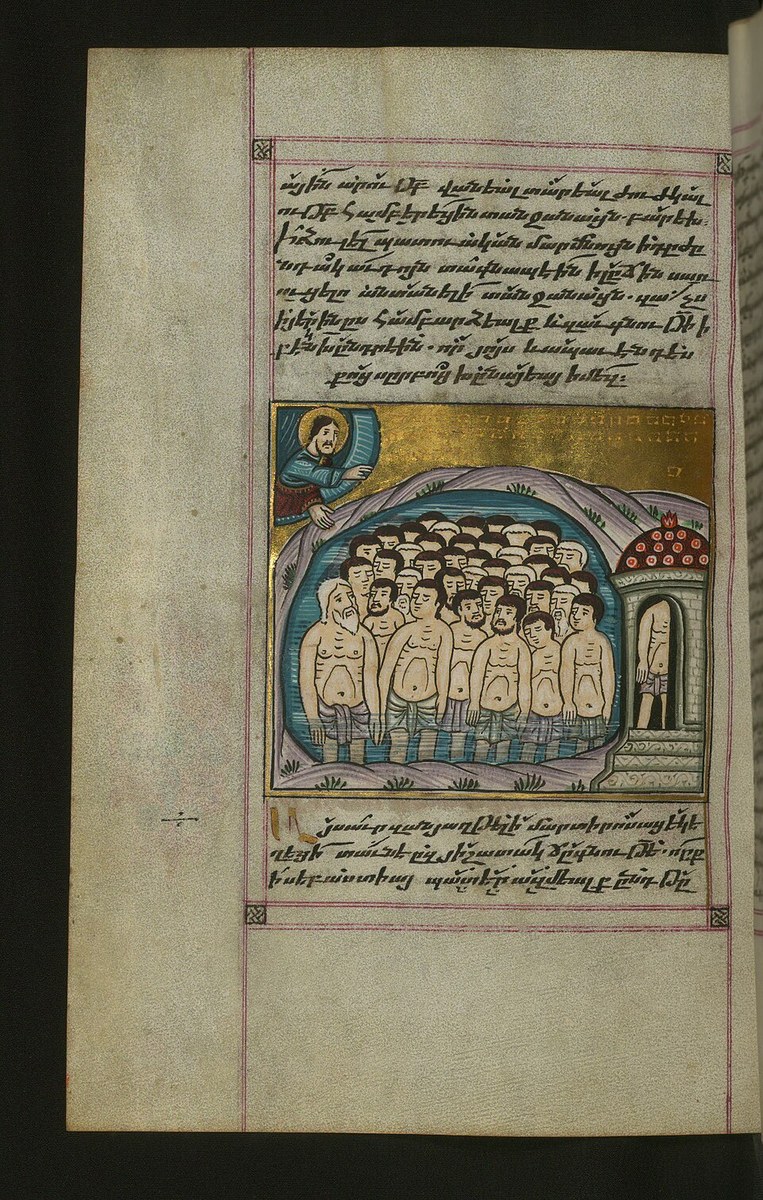
The Forty Martyrs of Sebaste are among the most recognisable subjects of Byzantine art, and their scene is fixed and unmistakable: a crowd of naked or near-naked young men huddled together on the ice of the frozen lake, their faces turned in prayer, their bodies bowed against the cold; above them the hand or figure of Christ in heaven, from whom crowns descend upon their heads; at one side, on the shore, the heated bath-house, often with the single deserter shown shrinking into its doorway — the one figure who has left the company. The number, the nakedness, the crowns, and the little domed bath-house together identify the scene at a glance; no other martyrdom is composed quite so. The subject appears in every medium — the famous tenth-century Byzantine ivory plaque (Bode Museum, Berlin), mosaics, frescoes, panel icons, and manuscript miniatures — and is a set-piece of the middle-Byzantine and later tradition.
The stored image is a manuscript miniature from an Armenian hymnal written by the priest Yakob Pēligratc'i at Constantinople in 1678 (Walters Art Museum, MS W.547, fol. 73v): the forty stand crowded together upon the blue ice, stripped to loin-cloths, Christ blessing them from a golden heaven at the upper left, while at the right the domed, red-roofed bath-house stands open and the lone deserter steps within — the whole received composition in miniature (source, CC0, pd-old-work).
Disputed questions
- The date and the persecutor. The martyrdom is placed by the tradition in 320, under Licinius, in the years just before his fall; the Greek synaxaria and the Cappadocian homilies agree in setting it late, in the last Eastern persecution rather than the Great Persecution of Diocletian. (The earlier Five Martyrs of Sebaste belong to the Diocletianic persecution of c. 296, a generation before.)
- The number and the deserter. That one fell away and a guard took his place is constant in the tradition; the deserter is left unnamed, and it is the convert Aglaius, not the youth Meliton, who completes the forty — Meliton is the youngest who endured, carried to the pyre by his mother. Confusions between the two figures occasionally appear in popular retellings and should be avoided.
- Not to be confused with the Five Martyrs of Sebaste (December 13, of the earlier persecution), nor with the several other numbered martyr-companies of the calendar — the Forty Virgin-Martyrs and Ammoun the Deacon, the Ten Martyrs of Crete, or Julian of Galatia and his forty companions. "The Forty Martyrs," without further qualification, means throughout the Byzantine tradition these forty soldiers of the lake of Sebaste.