
Forty-five Martyrs of Nicopolis in Armenia
The Holy Forty-five Martyrs of Nicopolis in Armenia — Leontius, Maurice, Daniel, Antony, Alexander, Anicetus, Sisinius, Menaeus, Virilad and those with them
Martyr · d. c. 319, at Nicopolis in Lesser Armenia
Commemorated 10 July — Martyrdom by mutilation and fire at Nicopolis under Licinius
The Forty-five Martyrs of Nicopolis are a company of Christians of Nicopolis in Lesser Armenia who suffered about the year 319, in the persecution which the emperor Licinius raised in the eastern half of the empire after his breach with Constantine. They were not hunted out: the sources are emphatic that they came forward of their own accord and presented themselves to the governor, so that the Church remembers them as volunteers rather than as victims. Their leaders are named — Leontius, Maurice, Daniel, Antony, Alexander, Anicetus, Sisinius, Menaeus and Virilad — and the rest, to the number of forty-five in all, are anonymous. After long imprisonment their hands and feet were struck off and they were thrown into a fire; their bones were cast into a river, recovered by the faithful, and laid in a church raised over the place when the peace of the Church returned.
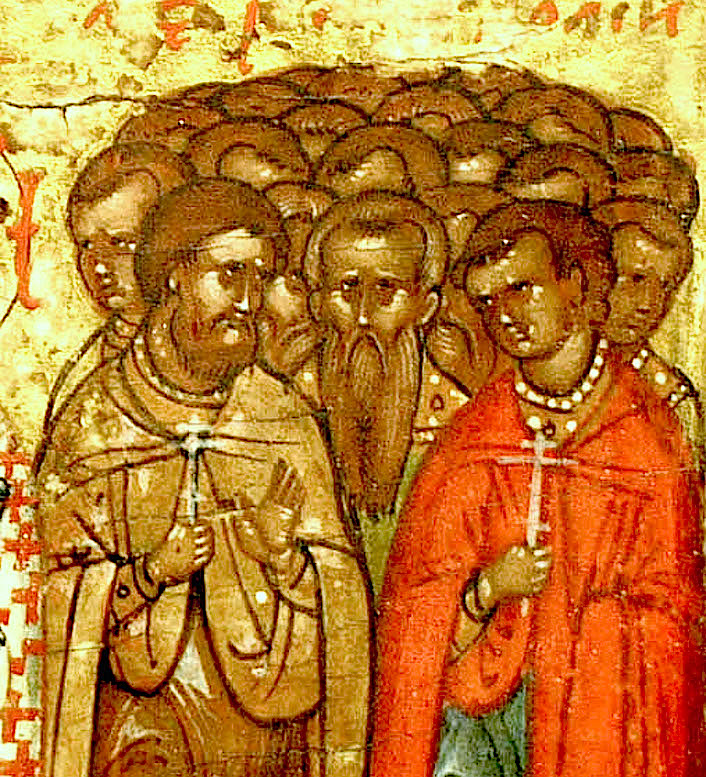
_-_July_-_14_-_Martyrs_of_Nicopolis_(Armenia).jpg)
Licinius and the last persecution of the East
The martyrdom belongs to the very end of the age of the persecutions. Licinius (311–324), Constantine's colleague and then his rival, had been a party to the edict of toleration; from about 320, as the two emperors drifted towards war, he turned again upon the Christians of his own dominions, purging them from the army and the court, forbidding synods, and permitting his governors to press for sacrifice. Armenia and the provinces of Pontus were among the regions where this last persecution bit hardest, and Nicopolis — the city founded by Pompey in Lesser Armenia, on the road from Sebaste to Satala — was one of its scenes.
The voluntary confession
A body of Christians of the city, under the leading of Leontius, took counsel together and resolved not to wait to be denounced. They went in a company before Lysias, the governor of the province (the name is also transmitted as Licias), and declared themselves Christians and refused the sacrifice.
Lysias tried first what persuasion could do. He set before them their youth, their standing and the emperor's favour, and warned them of what refusal would cost. Leontius answered for all: they were servants of the true God and would not exchange Him for stone and wood, and what the governor called kindness was the beginning of their destruction. The governor then had them beaten about the face with stones and shut up in prison.
The prison and the fire
The company lay long in confinement, in hunger and in irons, and their number is given as forty-five. The passion relates that they were strengthened there by a vision: a great light, and an angel who told them that their contest was accepted and that a crown was prepared. When they were brought out again and still refused, Lysias gave the sentence that distinguishes this martyrdom from most: their hands and feet were to be cut off, and the maimed bodies thrown into a fire kindled for the purpose. So they died together.
Their bones, unconsumed, were gathered up and thrown into a river that no relic might be left to the Christians. The faithful of Nicopolis recovered them out of the water and hid them; and when Licinius had fallen and the Church was free, a church was built on the place of the martyrdom and dedicated in their name, where the relics were laid and where the tradition reports that healings were given.
Transmission and the roll of names
The company is universally counted at forty-five, and the same eight or ten leaders are named in the Greek, Slavonic and Latin witnesses, though the forms vary considerably in transmission: Mauricius for Maurice; Ianicetus for Anicetus; Meneus or Menea for Menaeus; and, most unstably of all, Virilad, Belerad or Verelad. Some lists add a Timothy. The variation is the ordinary consequence of Armenian and Syriac names passing through Greek into Slavonic and Latin, and the corpus records the range rather than fixing a single spelling. The remaining thirty-six or so are not named in any witness; the entry follows §4 of the PRD in treating the company as a unit.
Feast and commemoration
July 10 (church date; Old Calendar civil July 23), kept universally. They are the principal ancient commemoration of the day in the Greek and Slavonic synaxaria alike, and head the July 10 list in the OCA and in the Greek calendars. The dedication of the church at Nicopolis kept their memory alive on the spot; in the wider Church their names come first in the day's synaxarion notice, after which the anonymous remainder is summed as "and those with them."
Hymns
Apolytikion — Tone 4 (common of several martyrs)
Thy martyrs, O Lord, in their contest received incorruptible crowns from Thee, our God; for possessing Thy strength, they cast down the tyrants and shattered the feeble insolence of the demons. By their intercessions save our souls.
Kontakion — Tone 2
Ye came of your own will to the tribunal, O forty-five, and were not driven; and having been maimed in hand and foot, ye ran the faster to Christ, and were made whole in the fire. Wherefore Nicopolis, the city of victory, is crowned with your victory, and the Church crieth to you: rejoice, O company of the unconquered.
Original translation from the Greek
Iconography
The forty-five are painted as a company, in the manner used for all the great numbered companies of martyrs: a dense crowd of heads rising in tiers, only the front rank fully drawn, each holding the small cross of martyrdom, and the whole group turned towards the blessing hand of Christ in the corner of the field. The front figures are differentiated by age and dress — an elder with a long grey beard, young men beardless, one or two in the red mantle of the well-born — so that Leontius, Maurice and their named fellows may be picked out, but individual inscriptions are rare. In menologion cycles and in the illustrated menaia for July they are shown at the moment of the fire, or with their severed hands and feet before them, which is the attribute peculiar to this company.
The stored image is a detail of a Russian menaion icon of the seventeenth century for the month of July (Church Archaeological Cabinet of the Moscow Theological Academy), showing the crowded company with crosses in their hands, an elder in the centre and a youth in a red mantle at the right, under a Slavonic inscription; the crop is identified as the Nicopolis martyrs by the source. (The Menologion of Basil II, the usual first resort for minor saints, covers only September to February and could not be used for a July commemoration.)
Disputed questions
- The year. The martyrdom is placed under Licinius, whose reign ran from 311 to 324; the received date is c. 319, sometimes given as 320. It cannot be fixed more closely.
- Nicopolis. Several cities bore the name. This is Nicopolis in Lesser Armenia (Armenia Minor), the Pompeian foundation in the upper Lycus valley — not the Nicopolis of Epirus, nor the Palestinian Nicopolis (Emmaus) where Sabbas the Sanctified and John the Silent are connected with monastic foundations.
- The martyrs' names. See above: the roll is stable in number and unstable in orthography.