
John the Silent
Our Venerable Father John the Silent, Bishop of Colonia
Venerable · Bishop · b. c. 454 — d. 558
Commemorated 30 March, 3 December — Principal commemoration
John the Silent, called the Hesychast (c. 454–558), was a bishop who became a hidden monk. Consecrated Bishop of Colonia in Armenia while still a young man, he fled the quarrels of the world, concealed his episcopal rank, and entered the Great Lavra of Sabbas the Sanctified near Jerusalem as a simple novice. When his secret was revealed and he could no longer be ordained, the Patriarch bade him live in silence — and in silence he remained for the rest of an extraordinarily long life, in his cell, in the desert (where a lion is said to have guarded him from the Saracens), and again at the Lavra, where he stood among the defenders of Orthodoxy against Origenism. He reposed at the age of 104 and is commemorated on December 3.
.jpg)
His Life was written by his younger contemporary Cyril of Scythopolis, the careful monastic historian of Palestine, who knew the Lavra and its traditions at first hand; it is among the best-attested of all sixth-century ascetic lives.
Origins and early life
John was born about the year 454 in the city of Nicopolis in Armenia, the son of a military commander named Encratius and his wife Euphemia. From boyhood he loved the study of Holy Scripture, and solitude and prayer above all. With the inheritance his parents left him he built a church of the Most Holy Theotokos, and at the age of eighteen he became a monk, gathering ten companions to live the ascetic life of fasting, prayer, and self-restraint at the church he had founded.
Bishop of Colonia
At the request of the citizens of Colonia in Armenia, the Metropolitan of Sebaste consecrated John, then twenty-eight years old, as their bishop. He did not relax his strict manner of life for the dignity of the office, and under his influence even his kinsmen who moved in the highest circles of the empire — his brother Pergamios, an associate of the emperors Zeno and Anastasius, and his nephew Theodore, an associate of Justinian — lived in a Christian way. But in the tenth year of his episcopate the governorship of Armenia passed to Pazinikos, the husband of John's sister Maria, and the new governor began to meddle in ecclesiastical affairs, so that there was unrest in the Church. John went to Constantinople and, through the archbishop Euthymius, entreated the emperor Zeno to protect the Armenian Church from him.
Flight to the Lavra of Saint Sabbas
Worn out by these worldly quarrels, John did a thing without precedent for a bishop: he secretly abandoned his diocese and sailed to Jerusalem (about the year 491), begging God with tears to show him a place where he might find salvation. A bright star, the tradition says, went before him and led him to the Great Lavra of Saint Sabbas in the Judean wilderness. Concealing that he was a bishop, John was received into the community as a simple novice, and under the guidance of the igumen Sabbas the Sanctified he laboured obediently for more than four years at every task he was given — carrying stone, serving the workmen who built the guesthouse and the monastery for novices, waiting on their meals. Seeing his humility and love of labour, Sabbas judged him worthy of ordination to the priesthood and brought him to Patriarch Elias of Jerusalem (494–517). There the secret came out: John was compelled to reveal that he was already a bishop, and Elias, astonished, told Sabbas that John could not be ordained, but must be left to live in silence, troubled by no one. Soon the Lord revealed John's hidden rank to Sabbas himself.
Silence, the desert, and the lion
John withdrew into his cell and stayed there four years, receiving no visitor and not going out even to church. Longing for still deeper solitude and abstinence, he then quit the Lavra altogether and went off into the desert, where he spent more than nine years living on wild plants and herbs. When a devastating raid of the Saracens swept the region, John alone was unharmed: the sources relate that God sent him a fierce lion as a guardian, which fell upon the raiders whenever they tried to harm the hermit and scattered them in terror. Only when Sabbas returned from a long stay at Scythopolis did he prevail on John to leave the wilderness and come back to the monastery — and it was then that God made his episcopal dignity known to the whole Lavra.
The struggle against Origenism, and repose
When John was seventy his spiritual father Sabbas died (532), and John grieved deeply that he had not been present. Sabbas appeared to him in a vision to console him, foretelling much toil ahead in the defence of the faith against heresy; and John did indeed have to leave his solitude to strengthen the brethren in the great sixth-century struggle against the Origenists, which convulsed the monasteries of Palestine until the Fifth Ecumenical Council (553). In all, John the Silent passed sixty-six years at the Lavra of Saint Sabbas. By unceasing prayer and humble wisdom he was granted an abundance of the grace of the Holy Spirit: he read the secret thoughts of those who came to him, healed the sick and the demon-possessed, and even in his lifetime delivered from destruction those who called on his name. Once he scattered dry fig-seeds on the bare rock, and a beautiful fruit-bearing tree sprang up and grew until it overshadowed his cell. He fell asleep in the Lord in peace at the age of 104, about the year 558.
Feast and commemoration
John the Silent is commemorated on December 3, within the Nativity Fast (Old Calendar civil December 16), in the Greek and Slavic service books alike; the Orthodox Church in America keeps a second commemoration on March 30 (Old Calendar civil April 12). He is styled "the Silent" (ὁ Σιωπηλός) and "the Hesychast" (ὁ Ἡσυχαστής) after the manner of life the Patriarch of Jerusalem laid upon him.
Hymns
Troparion — Tone 8
O guide of Orthodoxy, teacher of piety and holiness, luminary of the world, God-inspired adornment of monastics: O wise John, by thy teachings thou hast enlightened all, thou harp of the Spirit. Intercede with Christ our God, that our souls may be saved.
Original translation from the Greek
Iconography
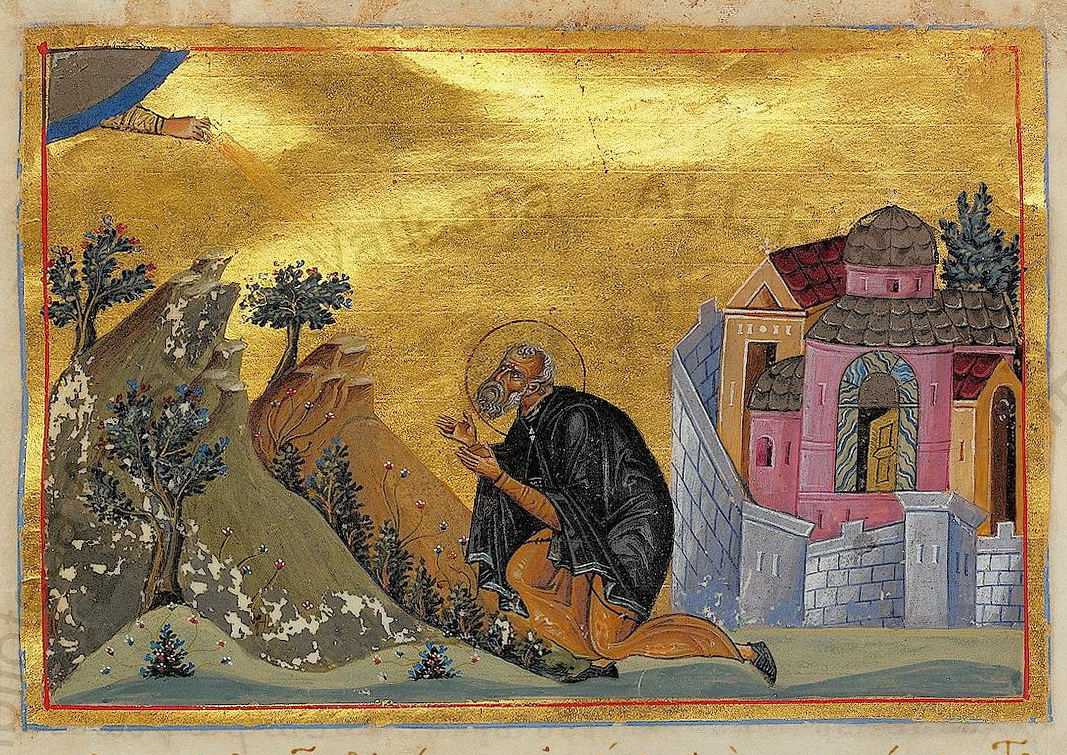
John the Silent is depicted as a white-bearded ascetic elder in the monastic mantle and analavos, often shown — as in the narrative icons — kneeling in the rocky Judean wilderness before the walls and cupolas of the Lavra of Saint Sabbas, with the hand of God or a guiding star appearing from heaven, an allusion to the star that led him to the monastery. The stored image is the miniature of the Menologion of Basil II (Constantinople, c. 985): the saint kneels in prayer among the desert crags, the Lavra at his right and the blessing hand of God above at the left.
Disputed questions
- The father of John the Silent — Sabbas the Sanctified (commemorated December 5), founder of the Great Lavra — must not be confused with Sabbas of Storozhevsk, the Russian abbot commemorated on this same December 3.
- Not to be confused with John the Solitary of Jerusalem (June 19), a hermit of the same Judean wilderness in the same sixth century whose epithet ("the Solitary," the Anchorite) is easily read as a synonym of this saint's "the Silent." They are distinct: John the Silent was bishop of Colonia before he became a monk of the Great Lavra, and is one of the best-documented ascetics of Palestine through the Life written by Cyril of Scythopolis; the June saint has no see, no monastery and no date, and survives only in a synaxarion notice about a cave, an icon of the Theotokos, and a lamp that never went out.