
Forty-Two Martyrs of Amorion
The Holy Forty-Two Martyrs of Amorion
Martyr · d. 6 March 845 (some 846), beheaded on the bank of the Tigris at Samarra
Commemorated 6 March — Beheading at Samarra after seven years' captivity
The Forty-Two Martyrs of Amorion (†845) were the Byzantine commanders and officers taken captive when the great Phrygian city of Amorion — the cradle of the reigning imperial dynasty — fell to the Abbasid caliph al-Mu'tasim in August 838, the calamity of the reign of the emperor Theophilus. Carried off to the caliphal capital of Samarra on the Tigris, they were held in prison for seven years, courted and threatened by turns to embrace Islam, and drawn into repeated debates on the truth of the two faiths. Steadfast to the end, they were led out on March 6, 845, and beheaded on the river-bank, their bodies cast into the water. Among them the tradition names Theodore (called Krateros, "the Mighty"), Constantine, Aetius, Theophilus, Callistus, Bassoes, and Melissenus, with their companions to the number of forty-two. Celebrated at once in a martyrdom-account written soon after their death, they are among the most honoured witnesses of the long Byzantine–Arab frontier war, hymned as "towers and guardians of the realm of the Romans."

The fall of Amorion (838)
Amorion (Amorium) lay in Phrygia, in the heart of Asia Minor, the chief city and military seat of the Anatolic theme and, above all, the ancestral home of the Amorian dynasty that then ruled at Constantinople — the house of Michael II and of his son, the reigning emperor Theophilus (829–842). To strike Amorion was therefore to strike at the dynasty in its own cradle, and this was precisely the design of the Abbasid caliph al-Mu'tasim (833–842) when, in the summer of 838, he launched against Byzantium one of the largest expeditions the Arab East ever sent into Anatolia. The campaign answered a Byzantine raid of the previous year, in which Theophilus had sacked the town of Zapetra (Sozopetra), reckoned al-Mu'tasim's own birthplace; the caliph swore to level the emperor's city as his own had been levelled, and — the sources relate — had the name AMORION painted upon the shields of his soldiers.
After defeating Theophilus in the field at Anzen (Dazimon) in July and taking Ancyra without resistance, the vast Abbasid host converged on Amorion and laid siege. The city was strong, its walls deep, its garrison resolute; the assault made little progress against the fortifications until, the Byzantine chroniclers relate, the besiegers were shown a stretch of wall recently and badly repaired. Even so the defence held, until — and here the Christian and the Arab sources agree in substance — the city was betrayed. An officer of the garrison, named in the Byzantine tradition Boiditzes (in the Slavic notices "Baditzes"), holding a sector of the wall, entered into parley with the enemy and, whether by treason or by fatal negligence, left his post open; through the breach the Arabs stormed in. Amorion fell in August 838, after a siege of some two weeks. The slaughter and the enslavement were immense — the sources speak of tens of thousands killed or led away — and the city, one of the greatest of Byzantine Anatolia, never recovered its former standing.
Captivity at Samarra
From the multitude of captives al-Mu'tasim reserved a company of the senior commanders, officers, and notables — the men whose rank made them worth a great ransom or a great apostasy — and carried them back to the new caliphal capital of Samarra, on the Tigris above Baghdad. There they were held in close imprisonment. The Byzantine government did not forget them: Theophilus, and after his death (842) the regency of the empress Theodora and the young Michael III, sent embassies and offered ransom, but the negotiations came to nothing, and the captivity dragged on for seven years.
Through those years the aim of their keepers was less their death than their conversion. The prisoners were pressed — by inducement and by threat, by the promise of honours and wealth in the caliph's service and by the fear of execution — to renounce Christ and embrace Islam. Learned Muslims were sent to reason with them, and the hagiographic account preserves the memory of these disputations: the Byzantines were challenged to say why, if their faith were true, God had given the victory and the wide dominion to the Arabs and the defeat to the Christians; and they answered that God's providence is not measured by worldly success, that he suffers the wicked to prosper for a season and tries the faithful as gold in the fire, and that the Cross conquers not by arms but by endurance. They confessed the divinity of Christ and the mystery of the Holy Trinity against the objections raised to them, and held to the worship of the God who was crucified. Neither the length of the imprisonment, nor the wearing alternation of flattery and menace, moved them; the company remained whole.
Martyrdom on the Tigris
At the last, the patience of their captors failing, the sentence was given. On March 6, 845 — seven years, or nearly, after the fall of their city — the forty-two were led out from the prison to the bank of the Tigris at Samarra and there beheaded, one after another, for their refusal to deny Christ; and their bodies were thrown into the river. The account has them go to death exhorting and encouraging one another, the elder strengthening the younger, and the whole company sealing with their blood the confession they had kept through the long years of trial. So perished, on one day and in one place, the whole band of the commanders of Amorion — a corporate martyrdom the like of which the middle-Byzantine centuries hardly show again.
The named martyrs and their ranks
The tradition fixes the number at forty-two and preserves the names and often the offices of the chief among them, though the manuscripts vary in the roll and in the spelling. The martyrdom-accounts and the synaxaria name, among others:
- Theodore, surnamed Krateros ("the Mighty," "the Strong") — a former officer of the imperial guard reckoned the leader of the company, remembered for his learning and for bearing the chief part in the debates.
- Constantine — of the great house of the Baboutzikoi, the highest in rank of the prisoners, bearing the dignity of magistros and kin by marriage to the imperial family.
- Aetius — patrikios and strategos of the Anatolic theme, the general in whose command Amorion had lain.
- Theophilus — a patrikios, otherwise little known.
- Callistus — an officer, associated by some accounts with the noble family of the Melissenoi, who had risen through the ranks of the army.
- Bassoes (Vassoes) — named among the leaders.
- Melissenus — of the Melissenos house, another of the commanders.
with their companions making up the forty-two. The variance among the lists is itself a mark of the tradition's antiquity; the names given above are those most constantly transmitted, and the entry gives them as the sources give them, without asserting a definitive roll where the manuscripts disagree.
Veneration and later cultus
The martyrs were commemorated almost at once. Within a short time of their death a Greek martyrdom-account was composed — the best-known version ascribed to the monk Euodios — and it was followed by a whole family of related recensions, so that no fewer than seven Greek Passions of the martyrs survive, edited together by Russian scholars (Vasilievsky and Nikitin) at the beginning of the twentieth century. These texts do more than narrate: the earliest of them turns the fate of Amorion into a theological reckoning with the reign of Theophilus, the last emperor to uphold the iconoclasm that the Church had condemned; the disaster is read as a chastisement, and the martyrs' steadfastness as the vindication of Orthodoxy in the very years when — in 843, between the fall of the city and the death of the captives — the holy icons were restored at Constantinople and the Triumph of Orthodoxy proclaimed. Their memory entered the Synaxarion of Constantinople and the Menaion under March 6, with a proper kontakion that hails them as "towers and guardians of the realm of the Romans," and they have been kept universally in the Byzantine calendar ever since — among the most celebrated of all the martyrs of the frontier, in whom the endurance of the Christian East against the power of the Caliphate found its purest emblem.
Feast and commemoration
The Forty-Two Martyrs of Amorion are kept universally on March 6 (church date; New Calendar civil March 6, Old Calendar civil March 19), the day of their beheading. The church date March 6 falls almost always within the Great Fast, whose bounds are movable; on the weekdays of Lent the full Divine Liturgy is not served and the readings follow the Lenten cycle, so that no fixed Epistle and Gospel are appointed to the martyrs of this day (see Readings). Their feast shares March 6 with the secondary commemoration of the finding of the Precious Cross and the Nails by the empress Helen — the memory of Helen's discovery at Jerusalem being kept on this day as a lesser echo of the great feast of the Elevation of the Cross on September 14 — and with the venerable Arcadius of Cyprus, the Bithynian ascetic Hesychius the Wonderworker, the martyrs Conon and his son Conon of Iconium, and, in the Russian Church, the venerable Job of Anzersk. Of all the day's commemorations the martyrs of Amorion are the principal, and the proper hymnography of March 6 is theirs.
Hymns
Troparion — Tone 5
The achievements of the holy Martyrs the powers of heaven beheld with wonder: how, clothed in a mortal body, by the power of the Cross they contended nobly against the bodiless enemy and unseen overcame him; and now they intercede with the Lord, that our souls may find mercy.
Original translation from the Greek
Kontakion — Tone 2
The newly-manifest men-at-arms of the faith, who eagerly gave themselves to the struggle for Christ, let us all worthily crown with wreaths of praise; for they intercede with Christ on our behalf, as towers and as guardians of the realm of the Romans.
Original translation from the Greek
Iconography
The martyrs of Amorion are shown in the Byzantine manner as a company of martyrs — a rank of men, often bearded and in the dress of officers or in the plain tunics of the condemned, holding the martyr's cross; the narrative image is the beheading on the river-bank, the executioner's sword above the kneeling commanders and the Tigris at their feet. Because their feast falls in March, they are absent from the great menologion of the first half of the year (the Menologion of Basil II covers only September to February), and their surviving mediaeval images are chiefly the historical miniatures of the illustrated chronicles rather than devotional panels.
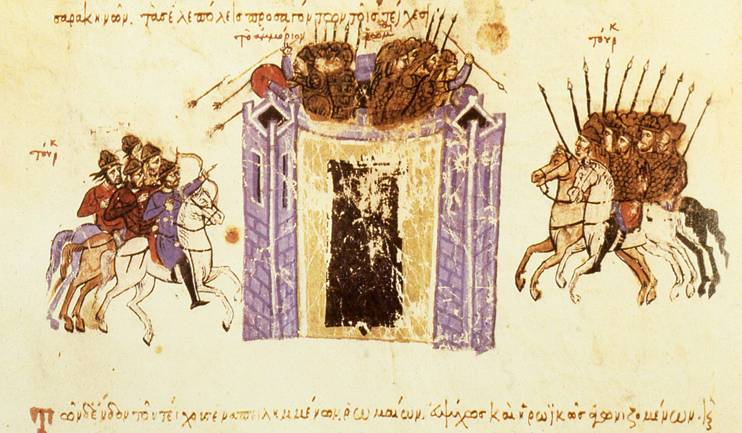
The stored image is of this documentary kind: a miniature from the twelfth- or thirteenth-century Madrid Skylitzes (the illustrated Synopsis of Histories of John Skylitzes, Biblioteca Nacional de España, cod. Vitr. 26-2, fol. 59v) depicting the siege of Amorion by the Arabs in 838 — the very event in which the forty-two were taken. Mailed soldiers assail the walls of the Phrygian city; the fall here portrayed is the beginning of the seven-year road that ended on the Tigris.
Disputed questions
- The year — 845 or 846. The martyrdom is placed by most reckonings on March 6, 845, seven years after the fall of Amorion in August 838; some sources give 846. The day, March 6, is the fixed liturgical anchor; the year is given as 845 with the variant noted.
- The river — Tigris or Euphrates. Samarra, the caliphal capital where the captives were held and killed, stands on the Tigris, and the execution "on the river-bank" is accordingly to be placed there; some retellings of the Passion name the Euphrates instead, a slip of geography that the entry records without following.
- The number and the roll. "Forty-two" is the traditional and constant figure, but the surviving Passions differ in which names they preserve and in their spelling; no single manuscript gives an agreed list of all forty-two, and the names set out above are those the tradition transmits most steadily.
- Martyrs or passion-bearers. Some notices style the commanders passion-bearers; because they died explicitly for their refusal to deny Christ and embrace Islam, the calendars and this collection classify them as martyrs in the proper sense, the styling "passion-bearer" reflecting their station as soldiers and princes rather than any doubt of the cause of their death.
- The betrayal of the city. The Byzantine chronicles (Theophanes Continuatus, Genesios, Skylitzes) and the Arab historians (above all al-Tabari) together attest the fall of Amorion in 838 and the captivity that followed; the treason of the officer Boiditzes / Baditzes belongs to the Byzantine strand of the tradition, the Arab accounts stressing rather the weak-repaired wall.