
Job of Anzersk
Our Venerable Father Job of Anzersk, in the schema Jesus
Venerable · b. c. 1635, at Moscow (baptised John) — d. 6 March 1720, at the Golgotha-Crucifixion Skete on Anzer
Commemorated 6 March — Repose on Anzer; glorified by the Russian Orthodox Church in 2000
Job of Anzersk (c. 1635–1720), in the great schema named Jesus (Iisus), was a Russian ascetic of the far North, founder of the Golgotha-Crucifixion Skete on Anzer, an island of the Solovki archipelago in the White Sea. Born at Moscow and long a married parish priest of the capital — the tradition makes him a confessor and spiritual father to the court of Peter the Great — he was slandered and exiled to the Solovetsky Monastery, where he was tonsured a monk as Job. Withdrawing to the greater solitude of Anzer, he became head of its Trinity Skete, received the great schema with the name Jesus, and, after a vision of the Mother of God upon a hill he thereafter called Golgotha, founded there the Skete of the Crucifixion. He reposed on March 6, 1720, and was glorified by the Russian Orthodox Church in the year 2000. He is not to be confused with the Old Testament patriarch Job the Long-suffering (May 6), whose name he received at his tonsure, nor with Job of Pochaev (†1651), nor with Job of Ushchelsk (†1628, August 5) — the confusion likeliest of all, since that Job was also a hieromonk of Solovki and also a saint of the Russian north.

From Moscow priest to Solovki
The saint was born about the year 1635 at Moscow and baptised John (Ioann). He was ordained to the priesthood and served for many years as a married parish priest of the capital, where he became known for the strictness of his life and the wisdom of his spiritual direction; the tradition remembers him as a confessor and spiritual father sought out at the court of the young tsar Peter I, and he laboured much among the poor, the sick, and the imprisoned of Moscow. After the death of his wife he continued in the priestly ministry, a widowed presbyter of the city.
His life was overturned about the year 1701. He became entangled — through the seal of confession, which he would not break — in the affair of one Grigory Talitsky, a dissenter whose penitents were sought out by the authorities; rather than betray what had been confessed to him, the priest accepted disgrace, and he was exiled to the Solovetsky Monastery on its remote island in the White Sea. There, far from Moscow, he was tonsured a monk and given the name Job, after the long-suffering patriarch of the Old Testament — a name his own reversal of fortune made fitting.
Anzer and the great schema
At Solovki Job soon sought a deeper solitude, and withdrew to the neighbouring island of Anzer, to the Skete of the Holy Trinity, the hermitage founded a century before by Eleazar of Anzer. His holiness of life was such that he was made head (stroitel) of the skete, which he governed in strictness and love, gathering disciples and restoring its discipline. In 1710 he received the great schema — the highest degree of the monastic vows — and with it the name Jesus (Iisus), taken in honour of Jesus son of Navi (Joshua), the successor of Moses; from this the saint is known in the calendars as "Job, in the schema Jesus."
The vision and the Skete of the Crucifixion
The crown of his life was the founding of a new hermitage. The tradition relates that the Mother of God appeared to him upon a hill of Anzer, declaring that the mountain should henceforth be called Golgotha, and that a church and skete in honour of the Crucifixion of the Lord should be raised upon it. Obedient to the vision, in 1714 the schemamonk Jesus left the Trinity Skete and with his disciples established on the hill the Golgotha-Crucifixion Skete; a wooden church of the Crucifixion was completed there in 1715. He passed the remainder of his years in the austerity of that high and lonely place, and reposed in peace on March 6, 1720.
Veneration and glorification
The memory of the schemamonk Jesus was kept at Anzer and Solovki through the centuries that followed, and grew in the sufferings of the twentieth century, when the Solovetsky islands became a place of imprisonment and martyrdom for a multitude of Russian confessors — the Golgotha of Anzer, by a terrible aptness, becoming again a hill of crucifixion. With the revival of monastic life at Solovki after the fall of the Soviet power, the relics of Saint Job were recovered, and in the year 2000 he was glorified by the Russian Orthodox Church among the venerable fathers, his principal commemoration fixed on the day of his repose, March 6.
Feast and commemoration
Job of Anzersk is commemorated on March 6 (church date; New Calendar civil March 6, Old Calendar civil March 19), the day of his repose, in the Russian Orthodox Church; he is honoured also among the assemblies of the Saints of Solovki and of the Saints of Novgorod / the Russian North. His feast shares March 6 with the Forty-Two Martyrs of Amorion, who lead the day in the universal calendar. Because March 6 falls almost always within the Great Fast, no proper Liturgy of the saint is ordinarily served on the day (see the note on readings under the martyrs of Amorion).
Hymns
Troparion — Tone 8
In thee, O father, was preserved with exactness that which is according to the image; for taking up thy cross, thou didst follow Christ, and by thy deeds thou didst teach us to despise the flesh, for it passeth away, but to care for the soul, a thing immortal; wherefore thy spirit, O venerable Job, rejoiceth with the Angels.
Original translation from the Slavonic
Iconography
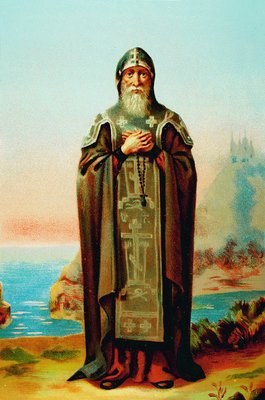
Job is depicted as a venerable schemamonk of the Russian North — an aged monk in the great schema, the analavos embroidered with the Cross and the instruments of the Passion falling over his habit, his hair and beard white, a scroll in his hand; behind or beside him is often set the hill of Golgotha at Anzer with its wooden church of the Crucifixion, marking his foundation. As a saint glorified only in the year 2000, his images are the work of modern iconographers and are under the copyright of their living artists; no pre-modern, public-domain icon of him exists. The stored image is an 1897 reproduction of his likeness.