
Gennadius of Kostroma
Our Venerable Father Gennadius of Kostroma and Liubimograd
Venerable · b. early 16th c., at Mogilev — d. 23 January 1565, at the Gennadiev Monastery, Kostroma
Commemorated 23 January — Repose, 19 August — Uncovering / glorification of his relics (1646)
Gennadius of Kostroma and Liubimograd (early sixteenth century – 1565) was a Russian monastic founder, a disciple of Cornelius of Komel and, through him, an heir of the great northern tradition of forest-dwelling ascetics. Born at Mogilev in a wealthy family under the name Gregory, he abandoned home and riches as a youth, was tonsured by Cornelius in the Vologda forest, and after sharing his master's flight into the deeper wilderness founded, on the shore of Lake Sura in the Kostroma country, the Monastery of the Transfiguration (afterwards called the Gennadiev Monastery). Famed for his labours, his charity, and a gift of spiritual counsel and foresight, he reposed on January 23, 1565, and was glorified when his relics were uncovered incorrupt in 1646.
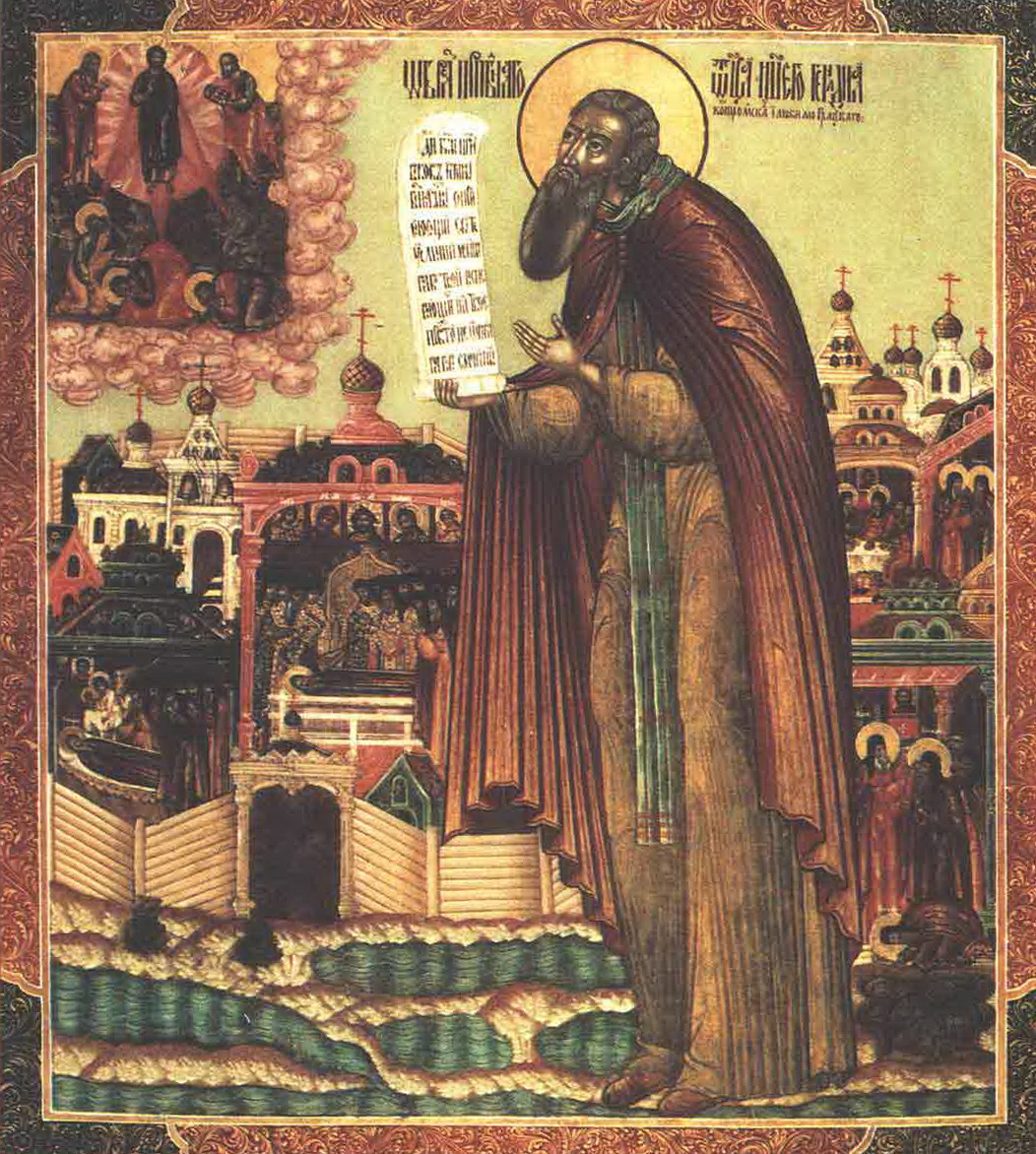
.jpeg)
From Mogilev to the Vologda forest
The saint was born, under the baptismal name Gregory, in the city of Mogilev (in the lands of Western Rus'), into a well-to-do family. From boyhood he showed an unusual love for the Church and for the monasteries, whose services and quiet drew him again and again — to the alarm of parents who had other plans for their son. Firmly resolved to give himself to God, Gregory changed his fine clothes for beggar's rags and secretly left home, journeying first to Moscow and then northward in search of a spiritual guide. The turning point, the Life relates, was a meeting with Alexander of Svir, who blessed the young seeker and sent him on to the Vologda forest, to the renowned ascetic Cornelius of Komel (commemorated May 19). By Cornelius he was received and tonsured, taking the name Gennadius.
Foundation in the Kostroma wilderness
Under Cornelius, Gennadius gave himself to the hard obediences of a northern coenobium — drawing water, cutting wood, baking, labouring in the fields — and grew in the ascetic life. When the growing number of visitors to Komel disturbed Cornelius's stillness, the elder withdrew with Gennadius still deeper into the forest, to the Kostroma country; and there, on the shore of Lake Sura (Surskoe), about the year 1529, a new hermitage arose, dedicated to the Transfiguration of the Lord. When Cornelius, at the summons of his own community, returned to Komel, he left Gennadius to build up and govern the new foundation, which grew into the monastery long known by his name — the Spaso-Gennadiev (Transfiguration-Gennadiev) Monastery, in the district of Liubim (whence his second title, "of Liubimograd").
Labours, charity, and gifts
As founder and elder, Gennadius was untiring in bodily labour — he dug ponds, raised buildings, planted, and adorned the churches with his own hand, being skilled in the painting of icons and the casting of crosses and other church work. He was open-handed to the poor and the wayfarer, and drew to himself a brotherhood and a stream of visitors seeking counsel. To him the tradition ascribes a gift of spiritual insight and foresight: most famously, that receiving the young noblewoman Anastasia Zakharyina-Yurieva he foretold that she would become Tsaritsa — as she did, marrying Tsar Ivan the Terrible and becoming the mother of the Riurikid line's last generation. Gennadius left short written counsels to his monks, on humility, obedience, and the fear of God.
Repose and glorification
Gennadius reposed on January 23, 1565. His Life was written soon after, by his disciple the abbot Alexis, between about 1584 and 1587. In 1646 his relics were uncovered, found incorrupt, and he was numbered among the saints; his glorification is kept on August 19. His monastery remained a centre of veneration, and he is honoured among the Saints of Kostroma, whose synaxis the Russian Church keeps on this same day, January 23.
Feast and commemoration
Gennadius is commemorated in the Russian Church on January 23 (church date; Old Calendar civil February 5), the day of his repose — the same day on which the Synaxis of the Saints of Kostroma is kept — and on August 19 for the uncovering and glorification of his relics (1646). His veneration is proper to the Russian Church (Moscow Patriarchate and the OCA).
Hymns
Troparion — Tone 8
In thee, O Father, that which is according to the image was preserved unimpaired; for taking up the Cross thou didst follow Christ, and by thy deeds thou didst teach us to despise the flesh, for it passeth away, but to care for the soul, a thing immortal. Therefore doth thy spirit, O venerable Gennadius, rejoice together with the Angels.
Original translation from the Slavonic
Iconography
Gennadius is depicted in the Russian manner as a monastic elder — in the mantle and analavos of the schema, with a long beard, holding a scroll of his counsels — often against his monastery on Lake Sura, and sometimes among the company of the Saints of Kostroma. The stored image is an early-eighteenth-century Russian icon of the venerable Gennadius (source, public domain, pd-old-work).