
Cornelius of Komel
Our Venerable and God-bearing Father Cornelius, Abbot of Komel, Wonderworker of Vologda
Venerable · Wonderworker · b. 1457, at Rostov the Great — d. 19 May 1537, at the Komel monastery near Vologda
Commemorated 19 May — Repose at the monastery of the Presentation in the Komel forest
Cornelius of Komel (1457 – 19 May 1537) was the founder of the monastery of the Presentation of the Mother of God in the Komel forest south of Vologda, and the most influential teacher of monks in the Russian north in his generation. Born of the boyar family Kriukov at Rostov and formed at the monastery of Cyril of White Lake, he spent some twenty years seeking a solitude that the fame of his own holiness kept taking from him, and settled at last in 1497 in an abandoned robbers' hut in the Komel woods. There he built two churches, fed the whole countryside through a famine, and wrote for his brotherhood a Rule — one of the earliest original Russian monastic rules — which quietly takes what it needs from Joseph of Volokolamsk and from Nilus of Sora, the two men whose disciples were then dividing Russian monasticism between them. From his community came a whole generation of founders: Cassian and Laurence of Komel, Cyril of Novoezersk, Gennadius of Kostroma, Adrian of Poshekhonye and Herodion of Iloezersk. He died at eighty, praying for the deliverance of his house from a Tatar raid, and his commemoration was established by the Church on 25 January 1600.

Origins and early life
Cornelius was born in 1457 at Rostov the Great, of the Kriukov family, boyars with a place at the Muscovite court. His elder brother Lukian served the grand princess — the mother of Ivan III — and Cornelius as a boy was taken into that service with him; but neither brother stayed in it. When Lukian, grown old, withdrew to the monastery of St Cyril at White Lake (Kirillo-Belozersk), the most exacting and the most prestigious school of the Russian northern monasticism, Cornelius went with him and was tonsured there.
The obediences he was given at White Lake were the heaviest the house had: he worked in the bakery, carrying and kneading, and he wore iron chains under his clothes. What leisure the work left him he spent copying books — the labour that would follow him all his life and that he handed on to his own disciples, so that the Komel house became a copying centre in its turn. Even here his reputation grew faster than he wished, and he left White Lake in search of obscurity.
Twenty years of wandering
The next stretch of his life is a series of failed escapes, and it is worth setting out because it explains the man. He went first to Rostov, his birthplace; then to Novgorod, where Archbishop Gennadius discerned what he was, tried to keep him in the city and pressed ordination on him — and Cornelius fled rather than accept it. He lived alone in the wilderness outside Novgorod; he tried the Savvatiev hermitage in the Tver country; and each time the same pattern repeated itself, that men found him out and came to him for counsel, and he moved on.
In 1497 he came into the Komel forest, on the river Nurma some fifteen miles south of Vologda, and settled in a deserted hut that had been a robbers' den — the detail is transmitted deliberately, as a sign that the place was as far outside human society as the region afforded. It was here that he stopped running, and here that the community he had spent twenty years avoiding finally gathered around him.
The monastery of the Presentation
Monks came, and Cornelius consented to receive them. In 1501 he built a wooden church of the Entry of the Mother of God into the Temple — the Presentation, whence the house is named — and in the same year, at Moscow, he accepted ordination to the priesthood at the hands of the metropolitan, which twenty years earlier he had fled Novgorod to avoid. By 1512 the brotherhood had grown enough to require a stone church in place of the wooden one; a second church was raised in honour of Anthony the Great, whom Cornelius venerated above all the fathers and took as his own model.
The community was, in the ordinary Russian way, an economy as well as a house of prayer, and Cornelius used it as one. He was known for the scale of his almsgiving; in a year of famine he opened the monastery's stores to the countryside and set up a shelter for orphaned and abandoned children, so that the house fed and raised those the villages could not. The Vologda tradition remembers this as his most characteristic work, and it is the practical fruit of the position he took in the great argument of his day about monastic property: a monastery may hold land, and its holding is justified by what it gives away.
The Rule
For his brotherhood Cornelius wrote a Rule — in Russian usage an ustav — one of the earliest original monastic rules composed in Russia, and the document on which his importance chiefly rests. It regulates the round of services, the labour, the silence, the reception of novices, the conduct of the refectory, and the government of the house; and its significance is that it draws, without polemic, on both of the traditions then in conflict. From Joseph of Volokolamsk it takes the cenobitic discipline, the exactness of the common life and the acceptance of monastic estates put to charitable use; from Nilus of Sora, whose own skete lay in the same northern forests, it takes the interior programme — guarding the heart, the warfare with the thoughts, silence, and the primacy of inward prayer over outward observance. Cornelius stood in the line of neither party and borrowed from both, which is why his disciples founded houses of both kinds.
The withdrawal to Lake Sura, and the return
Late in his life the honour paid him became insupportable, and there was murmuring in the community as well. He laid down the government and withdrew about seventy versts away to Lake Sura (Surskoe), and afterwards spent a season at the Trinity-Sergius Lavra. In his absence the brethren chose Cassian to govern with the elder's approval. The Grand Prince Basil (Vasily) III himself intervened to bring him back to Komel; Cornelius returned, Cassian laid down the office without a word, and the elder afterwards handed the abbacy on to Laurence, keeping for himself only the ordinary obedience of a monk.
Repose
He died on 19 May 1537, at the age of eighty, in a year when Tatar bands out of Kazan were burning the Vologda countryside. The tradition holds that his last prayer was for the deliverance of the monastery and of the people sheltering in it, and that the raiders passed it by; the same discipline of prudence he taught then — withdraw the brethren, do not expose them, bring them back when the danger has gone — was followed by Laurence at the next raid eleven years later. He was buried in his own church. His commemoration was established by the Russian Church on 25 January 1600, under Patriarch Job.
Disciples
Six of Cornelius's monks are themselves numbered among the saints, and through them the Komel discipline reached from the Kostroma country to the lakes of Olonets:
- Cassian of Komel (†1537, May 16) — abbot during the withdrawal to Lake Sura, who resigned the office on the elder's return.
- Laurence of Komel (†1548, May 16) — abbot from 1538, chosen on Cornelius's own recommendation.
- Cyril of Novoezersk (†1532, February 4) — founder on Red Island in the New Lake.
- Gennadius of Kostroma (†1565, January 23) — founder of the Liubimograd house at Lake Surskoe, where Cornelius himself had sheltered.
- Adrian of Poshekhonye (†1550, March 5) — founder and venerable-martyr.
- Herodion of Iloezersk (†1541, September 28) — founder on Lake Iloezero; not yet entered in this corpus.
Feast and commemoration
May 19 (church date; Old Calendar civil June 1) — the day of his repose. He is a saint of Russian and OCA usage, kept universally in the Russian Church since 1600 and with particular solemnity in the Vologda diocese, where he stands among the first of the local fathers; he is named in the Synaxis of the Saints of Vologda, in whose composite icons the ranks of northern monks are drawn up about him. His two disciples Cassian and Laurence are kept three days before him, on May 16, so that in the Vologda calendar the master follows his disciples. The day always falls within the Pentecostarion, and the movable hymns of the season take precedence over his own.
Hymns
Troparion — Tone 4
From thy youth, kindled with a burning desire for the love of God, thou didst forsake the tumult of this life, O venerable one, and becoming an emulator of Anthony the Great, thou didst follow Christ in stillness and in hardness of living, and by vigil and prayer and fasting wast made a pattern for thine own disciples. Wherefore pray to the Lord, O blessed Cornelius, that our souls may be saved.
Original translation from the Slavonic
Kontakion — Tone 8
When the Lord had shone forth upon the world from the holy Virgin, thou from thy childhood didst serve Him as an angel, O blessed one; and by His power thou didst make the wilderness as a city, and didst gather in it a multitude of disciples, whom thou didst enlighten with God-inspired teachings. Therefore we cry to thee: Rejoice, O our father Cornelius, divine adornment of monks.
Original translation from the Slavonic
Iconography
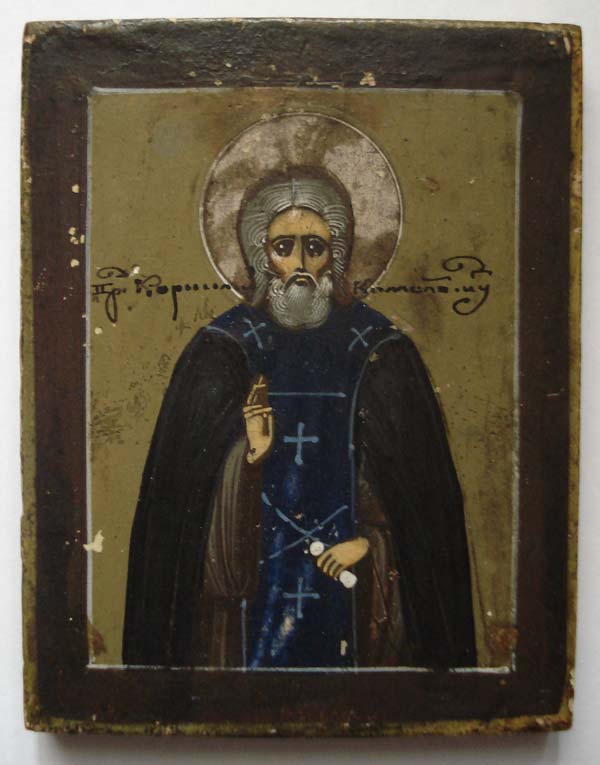
Cornelius is painted as a Russian monastic elder of the sixteenth century: long grey beard, the dark mantle thrown back over the schema with its embroidered crosses, the head either bare or in the pointed koukoulion, the right hand raised in blessing or at the breast, the left holding a scroll — his Rule — and sometimes a prayer-rope. Because he was the founder, he is frequently shown holding or standing beside a model of the monastery of the Presentation, and in vita-icons the scenes run from the tonsure at White Lake through the finding of the robbers' hut to the deliverance of the house from the Tatars. In the tiered composite icons of the Synaxis of the Saints of Vologda he stands in the front rank, with Cassian, Laurence and his other disciples about him.
The stored image is a very small panel icon of the nineteenth century (about 7 × 9 cm), painted in the workshop of the Kornilyev-Komelsky monastery itself and so representing the house's own received likeness of its founder: the elder full-length, grey-bearded, in the black mantle over the blue schema marked with crosses, blessing with the right hand and holding a scroll in the left, with the Russian inscription Пр. Корнилий Комельский written across the field. The underlying work is pre-1900 and the Commons file carries the faithful-reproduction tag; it is stored on that basis.
Disputed questions
- His name in the calendars. He is Cornelius of Komel or of Vologda; he is not Cornelius of the Pskov Caves (†1570, February 20), the abbot killed by Ivan the Terrible, nor Cornelius the Centurion of the Acts, nor the Cornelius of Paleostrov who shares this very day — four distinct saints, of whom two are commemorated together on May 19.
- Not to be confused with Innocent of Komel (March 19), who founded his hermitage in the same forest but was a disciple of Nilus of Sora, not of Cornelius. The identical epithet has led to their being taken for members of one brotherhood.
- The date of the Rule is not fixed. The OCA account attaches it to the building of the stone church about 1512; Russian scholarship has placed the surviving redaction later, in the last decade of his life. The corpus records the uncertainty rather than choosing.