
Glaphyra the Virgin
The Holy and Righteous Virgin Glaphyra
Virgin · Righteous · d. c. 322
Commemorated 26 April — Repose at Amasea, commemorated with the hieromartyr Basil of Amasea
Glaphyra was a Christian virgin of the imperial household at Nicomedia, a maidservant of the empress Constantia, wife of Licinius and half-sister of Constantine the Great. When the emperor conceived a passion for her, she took refuge with her mistress; and Constantia, putting out the report that the girl had gone mad and was dying, dressed her in men's clothing, gave her money and an escort, and sent her east out of reach. At Amasea in Pontus she was sheltered by the bishop, the hieromartyr Basil, and gave every coin she had to the church he was then building, writing to the empress for more when the funds ran short. That letter betrayed her: Licinius, learning she was alive, sent for her and the bishop together — but Glaphyra was already dead when the order reached the city, about the year 322. Basil was taken and beheaded, and the Church keeps the two of them together on April 26, the virgin whose flight cost the bishop his life.
_-_%D0%B8%D0%BA%D0%BE%D0%BD%D0%B0_08263_%D0%93%D0%BB%D0%B0%D1%84%D0%B8%D1%80%D0%B0.png)
In the household of the empress
Nothing is transmitted of Glaphyra's family, birthplace or age. She appears in the record already grown and already Christian, a serving-woman — the sources say a maidservant, which in an imperial household means one of the women of the empress's personal attendance — in the service of Constantia at Nicomedia, Licinius's capital. Her name, Γλαφύρα, is a good Greek word meaning "polished," "elegant," "finely wrought."
The court she served was a divided house. Constantia was a Christian, or at least the Church's friend, and had been married to Licinius in 313 at Milan to seal his alliance with her brother; Licinius, whose signature stood beside Constantine's on the edict of toleration, had by about 320 turned against the Christians of his own half of the empire — purging them from the palace and the army, forbidding bishops to assemble, and at length killing them. It is in that atmosphere, in a palace where the empress protected Christians and the emperor was beginning to hunt them, that Glaphyra's story is set.
Flight to Pontus
Licinius desired her, and she would not have him. The virtue of the account is its plainness: she did not temporize, did not flatter, and did not try to manage the emperor. She went straight to the empress and told her, and asked to be got away.
Constantia's plan was cool and complete. She gave out that Glaphyra had been struck with madness and was dying — an unanswerable story, since nobody inspects a dying madwoman — dressed her in men's clothes, put a sum of money in her hands and a trusted servant at her side, and sent her out of the capital by road, eastward, toward Armenia. The disguise belongs to a whole family of hagiographical narratives in which a woman escapes a man's power by ceasing, outwardly, to be a woman; here it is a matter of a few days' road-safety, not of a life lived under another name.
At Amasea: the church and the alms
The road east ran through Pontus, and at Amasea Glaphyra stopped. She found the bishop, Basil, told him who she was and what she fled, and he took her in — sheltered her, directed her, gave her the counsel of a father. That decision, taken by a bishop who could have sent her on and kept his hands clean, is the reason both of them are in the calendar.
Basil at that moment was building a church in Amasea and short of money for it. Glaphyra gave him the whole of the empress's provision — everything she had for her own keeping and her own further flight. When it proved not to be enough she wrote to Constantia, told her what the money had gone on, and asked for more so that the work might be finished; and the empress sent it. The church was completed.
Her repose
The letter — hers, or the empress's answer, or both — came into the emperor's hands. What Licinius read was that the woman he had been told was dying was alive and well in Pontus, that his wife had lied to him, that a bishop of his empire had hidden her, and that imperial money had been spent on a Christian church. He wrote at once to the governor of Amasea with orders to send him both bishop and maidservant.
Before the order came into the city, Glaphyra died. Every version of the account agrees on this — the accounts differ in almost nothing else so much as they agree here — and none of them attributes her death to violence: she is said simply to have gone to her rest, having given away all she had. Basil was arrested, taken to Nicomedia with the layman Elpidephorus and the deacons Parthenius and Theotimus, and beheaded; his body was thrown into the sea and recovered at Sinope. Glaphyra, spared the executioner by a few days, was buried at Amasea.
Veneration
Glaphyra is never commemorated alone. She stands in the Menaion, in the Synaxarion of Constantinople and in every jurisdictional calendar on April 26 beside the hieromartyr Basil, and the two entries are inseparable: hers explains his martyrdom, and his gives hers its weight. In Greek usage she is ἡ ὁσία Γλαφύρα, "Glaphyra the holy"; in Slavonic праведная Глафира дева, "the righteous Glaphyra, virgin"; in common English usage she has become "the Virgin-Martyr Glaphyra." She is a saint of a particular and unfashionable kind — a woman honoured not for a public confession under torture but for refusing an emperor, for telling the truth to her mistress, and for spending her whole means on a building she would not live to see used.
Feast and commemoration
April 26 (church date; New Calendar civil April 26, Old Calendar civil May 9), always jointly with Basil of Amasea. Because Pascha may fall as late as May 8, the day may come in Great Lent, in Holy Week, or well into the Pentecostarion depending on the year, and the propers are adjusted accordingly. No proper canon or distinct set of stichera is appointed to Glaphyra in the printed Menaion: she is named within the service of the hieromartyr, and where she is sung separately the common of a holy woman is used. In Slavonic practice the day is dominated by Stephen of Perm, and Glaphyra's name is often carried only in the calendar line.
Hymns
Apolytikion — Tone 4 (common of a holy virgin)
In thee, O blessed Glaphyra, the image of God was kept unclouded, for thou didst set thy heart on chastity above the favour of princes, and having given away all that was thine, thou didst find the treasure that is not taken away. Pray thou to Christ our God that our souls may be saved.
Iconography
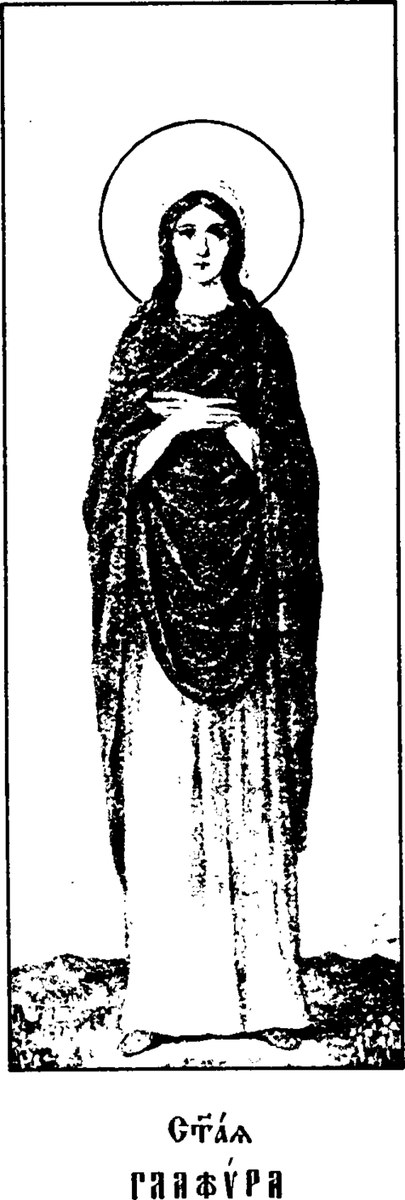
Glaphyra is painted as a young woman standing full-length, bare-headed or lightly veiled, in a long dark maphorion over a pale tunic, one hand held at the breast in the gesture of prayerful assent and the other sometimes holding a cross or scroll — the ordinary type of a holy virgin, without martyr's insignia in the stricter Greek and Russian models, in keeping with her classification as righteous rather than martyr. Where English-language icons style her a virgin-martyr she is given the red mantle and the martyr's cross. She very often appears not alone but beside the hierarch Basil of Amasea in the menaion icons and calendar compositions for April 26. The narrative scenes proper to her — her disguise in men's clothing, and her gift of the empress's money to Basil's unfinished church — are rare and belong to illustrated Lives rather than to panel icons.
The stored image is a Russian engraving of her icon-type published before 1911 in the illustrated Lives of the Saints after the Chetii-Minei, inscribed in Church Slavonic Стаѧ Глафѵра ("Holy Glaphyra"): the virgin standing full-length on a rocky ground, nimbed, in the dark maphorion falling to her feet over a white undergarment, her right hand at her breast. It is a print rather than a panel, and is stored as an honest witness to the received iconographic type; no pre-1900 panel icon or fresco of Glaphyra has been located for this repository.
Disputed questions
- Martyr or righteous? The Greek and Slavonic calendars are careful: she is hosia / pravednaya, not martys, precisely because she died before she could be brought to trial. Modern English service books and calendars — including the widely reproduced Orthodox Church in America notice — style her "Righteous Virgin Martyr," on the reasonable ground that she died in flight from an emperor's lust and under an imperial warrant, which is a kind of martyrdom for chastity. This repository follows the Greek and Slavonic classification (virgin, righteous) and records the English usage rather than adopting it. The disagreement is one of category, not of fact: no source claims she was executed.
- "Of Nicomedia" or "of Amasea"? Both epithets are found. Nicomedia names the court she served and fled; Amasea names the place of her repose and burial, and the church her alms built. Neither is a birthplace, which is unknown.
- The date. She died shortly before Basil, so her repose falls in the same year as his, c. 322 (a few calendars, following the later dating of Basil's beheading, give 323). Both fall inside Licinius's persecution, which ended with his defeat in 324.
- Constantia's identity. Some English retellings call Constantia Licinius's sister. She was his wife, and Constantine's half-sister; the point is set out in Basil of Amasea.
- Not to be confused with the two well-known secular Glaphyras of Roman history: the Cappadocian princess Glaphyra, daughter of Archelaus and successively wife of Herodian princes, and the earlier Glaphyra associated with Mark Antony. Neither has any connexion with this saint beyond the name.