
Stephen of Perm
Our Father among the Saints Stephen, Bishop of Great Perm, Enlightener of the Zyrians
Bishop · Venerable · b. c. 1340 — d. 1396
Commemorated 26 April — Repose at Moscow; the enlightener of the Permians and Zyrians
Stephen, bishop of Great Perm (c. 1340–1396), is the apostle of the Permians and Zyrians — the Finno-Ugric people known today as the Komi, on the Vychegda and the upper Kama in the Russian north-east. A cleric's son from Veliky Ustyug who had heard Zyrian spoken in the markets of his childhood, he was tonsured at Rostov, learned Greek in order to read the Fathers in the original, and there did the thing for which he is remembered: he devised an alphabet for the Permian tongue — the Abur or Anbur script — and translated the Scriptures and the offices into it, so that when he went out to the Vychegda in 1379 he could preach, catechise, baptise, and celebrate the Liturgy in the language of the people he came to. He felled their sacred birch, outfaced their chief sorcerer, was consecrated their first bishop in 1383, founded churches, monasteries, and schools among them, fed them in famine and defended them from tax-farmers and raiders, and died at Moscow on 26 April 1396. He is one of the very few missionaries of medieval Christendom, East or West, to have given a people its literacy in order to give it the Gospel.

Origins at Veliky Ustyug
Stephen was born about 1340 at Veliky Ustyug, at the confluence of the Sukhona and the Yug in the far north-east of the Russian lands — the frontier town of the Rostov diocese, and the trading point at which Russian settlers met the Permian peoples of the forests beyond. His father, Simeon, was a cleric of the cathedral church of the Dormition there; his mother was named Maria, and his Life makes much of her piety and of her part in forming him. A local Ustyug tradition, well attested in the town's own hagiography, has the holy fool Procopius of Ustyug bow to the ground before Maria when she was a child of three and greet her as the mother of a bishop who would enlighten Perm — a prophecy the townspeople remembered when it was fulfilled.
The boy was quick past the ordinary: his Life says he mastered the reading of the sacred books within a single year, and served in his father's church as canonarch and reader while still a child. Just as important for what came after, he grew up bilingual by ear. Zyrians came down to Ustyug to trade, and Stephen learned their speech as a boy learns a neighbour's language — not as a scholar's acquisition but as a native possession.
Rostov: the monastery of St Gregory the Theologian
Still young, he left Ustyug for Rostov the Great and was tonsured at the monastery of St Gregory the Theologian, called the Grigoriev zatvor — "Gregory's Recluse" — a house then famous in the north for the size of its library and the seriousness of its learning. There Stephen did what almost no Russian monk of his century did: finding that the Fathers he wanted were in translations he could not trust, he learned Greek, and read them in the original. The monastery was at that time also home to Epiphanius, later called the Wise, who knew Stephen there as a fellow monk and who would afterwards write his Life — which is why the record of Stephen is not a bare synaxarion notice but the testimony of a man who had argued theology with him in the same cell-block.
The Permian alphabet
At Rostov, out of that learning and that childhood ear, came the decisive work. The Permian tongue had no writing. Stephen made it one — the script called Abur or Anbur after the names of its first two letters, of about twenty-four characters, built from Greek and Cyrillic letter-shapes together with the incised property- and clan-marks (pasy) which the Zyrians already cut into wood and used as signs. It is a genuine adaptation rather than a transliteration scheme: the letters are shaped to a people who were used to reading marks, and it can be dated to about 1372, before his mission began.
Into this alphabet Stephen translated the liturgical books — the accounts name the Horologion and the Psalter, and the necessary lections — so that the mission arrived not with an interpreter but with a library. The principle at work is exactly that of Cyril and Methodius among the Slavs five centuries earlier, and Stephen appears to have understood himself as their successor. Bishop Arsenius of Rostov (1374–1380) ordained him hierodeacon for the work.
The road to Perm, 1379
In 1379 Stephen went to Moscow to seek a blessing and a commission for the mission. The metropolitan throne was then vacant and disputed — St Alexis had died in 1378 and the succession was tangled between Cyprian, Pimen and the ill-fated Mityai — and so the request was heard by Gerasimus, bishop of Kolomna, who was administering the metropolitanate. Gerasimus ordained Stephen hieromonk, gave him the antimension, the chrism and the vessels, and sent him out.
He travelled north down the Northern Dvina and then up the Vychegda, into the country of the Zyrians: a land of river-settlements, of bear- and elk-cult, of sacred groves and of sacrifices hung on trees. He settled at first about Pyras (later Kotlas) and then made Ust-Vym, at the mouth of the Vym on the Vychegda, the centre of the mission and afterwards his episcopal seat.
The sacred birch and the sorcerer Pam
Two episodes carry the whole of the mission's method in the memory of the Komi.
The first is the prokudlivaya bereza, the "mischief-working birch" — a great tree at Ust-Vym hung with the pelts of sacrificed beasts, the chief sanctuary of the district, before which offerings were made. Stephen cut it down and burned it. The Zyrians came with axes and bows to kill him, and he did not run; he stood and argued, and the argument was the one that mattered to them: your gods could not save their own tree; a god who cannot defend himself cannot defend you. They did not kill him. Many were baptised, and on the site of the birch he built the church of the Archangel Michael.
The second is his contest with Pam, the chief kudesnik or sorcerer of the Zyrians, called in the Komi tradition Pam-sotnik, "Pam the centurion." Pam saw plainly that the new teaching was destroying his standing, and rather than argue he proposed an ordeal: let the two of them pass together through a burning hut, and then be lowered through a hole in the ice of the Vychegda and drawn out through another downstream, and let the people believe whichever came out alive. Stephen agreed, took Pam by the hand, and went to the fire. Pam would not go in. The people, seeing their sorcerer's nerve fail, called for his death; Stephen refused it and had him only expelled from the country. The mercy is the point of the story as the Life tells it, and a second church — of St Nicholas, at Vishera — was built to mark the day.
Bishop of Great Perm, 1383
In 1383 Stephen went again to Moscow and was consecrated bishop of the new diocese of Perm — Malaya Perm, Little or Vychegda Perm, later styled Great Perm — with his seat at Ust-Vym. What he did as bishop is the least dramatic and the most substantial part of his life:
- He built churches along the rivers and staffed them with Zyrian clergy: he trained, ordained and settled priests, deacons, readers and singers from among the Zyrians themselves, so that the church among them should not be a Russian institution served by strangers.
- He founded schools beside the churches, in which children were taught to read the Permian script and the Slavonic letters together — the beginning of Komi literacy.
- He continued translating, and had the divine services celebrated in the Permian tongue.
- He founded monasteries as centres of the mission: the Saviour's Ulyanov hermitage on the upper Vychegda, the Stephen's monastery, the Archangel monastery at Ust-Vym, and the Archangel house at Yarenga.
- He acted as the people's protector in the civil order: he brought grain up from Vologda when famine struck the Vychegda, stood between the Zyrians and the extortions of the grand prince's tax-farmers, and interceded for them against the raids of the Vyatka men and the Novgorod river-pirates. This is why the Komi remember him not only as the man who baptised them but as the man who fed them.
Stephen and Sergius of Radonezh
In 1390, travelling to Moscow on the business of his diocese, Stephen's road passed some ten versts from the monastery of the Holy Trinity. He had no time to turn aside, and so he stopped in the road, faced the monastery, bowed, and said, "Peace be unto thee, my spiritual brother." At that moment Sergius of Radonezh was at table with his brethren; he rose, stood in silence, bowed in return, and said, "Rejoice, thou also, shepherd of the flock of Christ." The monks who had seen nothing asked, and were told.
The Trinity–St Sergius Lavra keeps the memory to this day: at the appointed point in the refectory meal a bell is rung, the brethren rise, and the greeting of the two saints is renewed. It is one of the most attractive incidents in the Russian record, and it places Stephen exactly where he belongs — inside the great generation of Russian holiness that produced Sergius, Cyprian of Kiev, Andrei Rublev and Epiphanius the Wise.
Repose and relics
Stephen died at Moscow on 26 April 1396, having come there again on diocesan business, and was buried in the Kremlin in the church of the Transfiguration of the Saviour "on the Bor" (Spas na Boru), the old monastic church within the palace precinct. The Zyrians sent to ask for their bishop's body and were refused: Moscow kept him. In 1933 Spas na Boru was demolished, and Stephen's relics were lost with the building — one of the more grievous of the losses of that decade, and the reason he has no shrine today.
Glorification and legacy
Veneration began at once and locally, and his service was composed in the first half of the fifteenth century by Pachomius the Logothete (Pachomius the Serb), the professional hagiographer of the Muscovite church; the Discourse on the Life and Teaching of Saint Stephen, Bishop of Perm was written by Epiphanius the Wise, probably within a year or two of Stephen's death, and is the single source for almost everything known of him. General canonisation followed under Metropolitan Macarius, in the great glorification council of 1547.
His work outlasted him. The diocese of Perm continued under his successors — Isaac, and then the three martyred bishops Gerasimus, Pitirim and Jonah, commemorated together on January 29 — of whom Jonah completed the conversion of Great Perm proper on the Kama. The Abur script remained in use for church and administrative purposes into the sixteenth and seventeenth centuries and survives in inscriptions and marginalia; the celebrated Zyryan Trinity icon, with its long dedicatory inscription in Permian letters, is traditionally attributed to Stephen himself. Among the Komi he became a figure of folk memory under the name Stepan Khrap, and their literary language, when it was created afresh in the nineteenth and twentieth centuries, was consciously understood as a resumption of what he had begun.
Feast and commemoration
April 26 (church date; New Calendar civil April 26, Old Calendar civil May 9). Because Pascha may fall as late as May 8, the day comes in some years within Great Lent or Holy Week and in others inside the Pentecostarion, and the service is sung accordingly; the Typikon provides for both.
In the Russian Church the feast is kept with a polyeleos and greatly outweighs the day's other commemorations, so that April 26 is in ordinary Russian usage simply "St Stephen of Perm." He is honoured with particular solemnity in the Komi Republic, where Ust-Vym is a place of pilgrimage, and in the Perm and Vologda dioceses; he is numbered among the Saints of Vologda and among the Saints of the Komi land in their local synaxes, and the Orthodox Church in America keeps his feast on the same day. The three martyred bishops of Perm who continued his work are commemorated together on January 29.
Hymns
Troparion — Tone 4
Being filled with the grace of God's Spirit, thou didst go forth to a people that sat in darkness, and didst give them letters that they might read the words of life; thou didst cast down the tree of sacrifice and plant in its place the Cross, O hierarch Stephen, first shepherd of the Permian land: pray to Christ our God that our souls may be saved.
Original translation from the Slavonic
Kontakion — Tone 8
The Word who gave tongues to the Apostles gave thee a tongue not thine own, that thou mightest speak to the Zyrians of His kingdom; and thou didst feed them with bread in their hunger and with the Gospel in their darkness. Therefore, O father Stephen, thy children cry to thee: Rejoice, enlightener of Perm.
Original translation from the Slavonic
Iconography
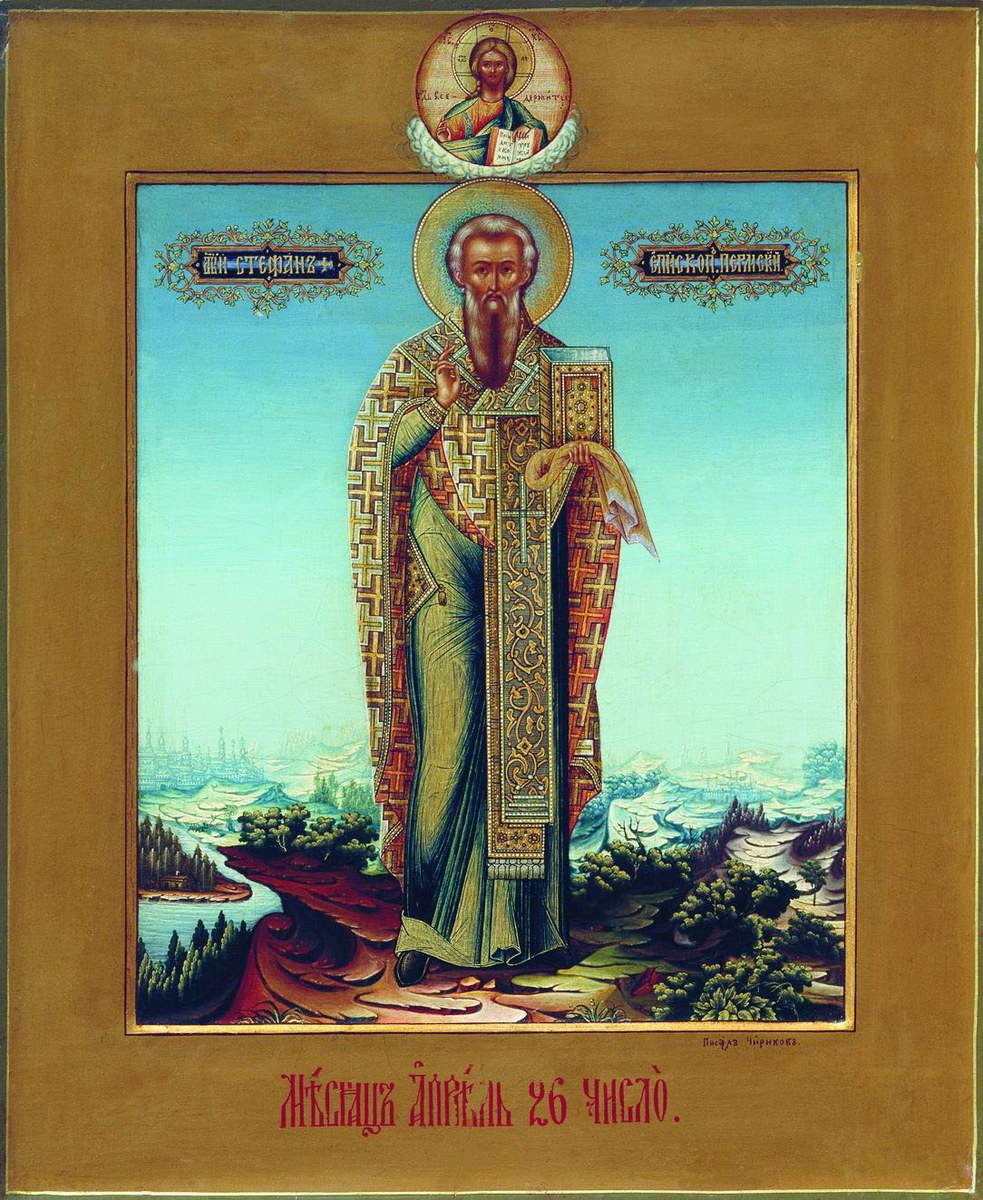
Stephen is painted as a hierarch: of middle height, with a high forehead, receding grey hair and a full grey beard of moderate length, vested in sakkos or phelonion and omophorion, blessing with the right hand and holding the Gospel or, characteristically, an unrolled scroll in the left. Two things distinguish his icons from the general run of bishop-saints:
- the scroll frequently bears a text, and in some Komi and modern icons the letters are written in his own Abur script — the visual signature of the man who gave a people its alphabet; and
- the landscape. He is very often set not against a plain ground but in the northern forest-and-river country of his mission, with the Vychegda winding behind him and dark firs on its banks; in narrative icons the felling and burning of the sacred birch at Ust-Vym is the standard scene, and the ordeal refused by the sorcerer Pam and the mutual bow with St Sergius of Radonezh are also found. In Trinity–Sergius compositions he appears bowing toward the monastery from the road.
The stored image is a nineteenth-century Russian menaion icon for the twenty-sixth day of April, signed by the icon-painter Osip Semyonovich Chirikov (State Museum of the History of Religion, St Petersburg): the saint stands full-length in a gold cross-patterned phelonion and green undervestment, blessing, with a white scroll in his left hand, before a wide northern river landscape with a walled town in the left distance; the inscriptions on the ground read St Stephen · Bishop of Perm, and along the lower border, in red, Month of April, the 26th day.
A second image is stored for its documentary value: the Zyryan Trinity (Troitsa Zyryanskaya), a large panel of the fourteenth century showing the Hospitality of Abraham beneath the oak of Mamre, with Abraham and Sarah at the left and the three angels at the table, and along the whole lower edge a long dedicatory inscription in the Old Permian (Abur) alphabet. Tradition ascribes the icon to Stephen himself and connects it with his church at Vozhem on the Vychegda. The attribution is not provable, but the inscription is genuine and is among the earliest surviving texts in the script he devised — the most eloquent single object connected with his mission.
Disputed questions
- 1396 or 1395? Russian usage, following Epiphanius and the service, gives 26 April 1396, and this is the date in the Moscow Patriarchate's calendar and in the Komi commemorations. The Orthodox Church in America's English notice gives 1395. The discrepancy is a matter of the reckoning of the year rather than of the day; 1396 is the better-supported figure and is used here, with the variant recorded.
- Is he "equal to the apostles"? The title isapostolos / равноапостольный is used in Orthodox practice for those who brought the faith to a whole people — Constantine and Helen, Mary Magdalene, Cyril and Methodius, Nina of Georgia, Patrick, Innocent of Alaska. Stephen's work answers the description almost exactly, and he is very often called the apostle of the Zyrians and the enlightener of Perm; the parallel with Cyril and Methodius, who also made an alphabet for the people they converted, is drawn by his own hagiographer. But the formal title is not the one the Church gives him. In the Slavonic books and in every jurisdictional calendar he is свѧтитель — hierarch, the rank of a holy bishop — and it is as Hierarch Stephen, Bishop of Great Perm that he is invoked and served. This repository classifies him accordingly (bishop, venerable, for his monastic tonsure and his monastic foundations) and does not assign equal-to-the-apostles, while noting that the argument for it is a real one and is made in popular and scholarly writing alike. The distinction matters: liturgical rank is a fact about the Church's practice, not a judgement about the scale of a saint's achievement.
- Which Perm? The diocese Stephen received in 1383 was Vychegda Perm (Malaya Perm, "Little Perm") — the Komi lands on the Vychegda and Vym, with the see at Ust-Vym, in what is now the Komi Republic. Great Perm on the upper Kama — the modern city and region of Perm — was evangelised later, chiefly by Bishop Jonah in the 1460s, and the title "of Great Perm" attached to Stephen retrospectively. He is thus the apostle of the Komi-Zyrians rather than of the present-day Perm Krai, though both honour him.
- Not to be confused with the many other Stephens of the calendar — the Protomartyr (December 27), Stephen the New (November 28), the confessor of the icons, Stephen of Surozh (December 15), Stephen the Hymnographer, and Stephen of Chenolakkos. None shares his date.