
Basil of Amasea
The Holy Hieromartyr Basil, Bishop of Amasea
Hieromartyr · Bishop · d. c. 322
Commemorated 26 April — Beheading at Nicomedia under Licinius, 30 April — Uncovering of his relics
Basil — in the Greek sources Basileus (Βασιλεύς), "the king," not the commoner Basileios — was bishop of Amasea in Pontus in the first decades of the fourth century, a subscriber of the canons of Ancyra (314) and Neocaesarea (c. 315), and one of the hierarchs destroyed in the last persecution the Roman world saw: that of Licinius, who turned on the Church in his eastern half of the empire in the years before his defeat by Constantine. His fall was occasioned by his sheltering the fugitive virgin Glaphyra, a maidservant of the empress Constantia who had fled Licinius's advances to Amasea and spent her mistress's money on the bishop's new church. Summoned to Nicomedia, Basil refused to sacrifice and was beheaded about the year 322; his body, flung into the sea, was recovered at Sinope after an angel three times directed his companion Elpidephorus to it, and was buried in the church he had built. He is honoured on April 26 together with Glaphyra.
_-_April_-_45_Basil_of_Amasea.jpg)
The see of Amasea
Amasea (Ἀμάσεια, the modern Amasya on the Yeşilırmak in northern Turkey) was the old royal city of the kings of Pontus and, under the later Roman administrative arrangement, the metropolis of the province of Helenopontus. It was a Christian centre of some weight: the martyrium of the Forty Martyrs' contemporary Theodore the Recruit lay in its territory at Euchaita, and a century after Basil the see would be held by the great preacher Asterius of Amasea. Basil was raised to this see, the sources say, by the choice of the people and clergy, in the years immediately after the peace of the Church under Galerius and Constantine — that is, around 313–314.
What is said of his episcopate is what a synaxarion says of a good bishop, and there is no reason to disbelieve it: that he was unwearied in preaching, in counselling the troubled, in consoling the bereaved, in confirming the wavering, and that he built up his flock with a diligence which made him conspicuous — and, in the event, dangerous to the pagan party in a city still largely given to the old cults.
The synods of Ancyra and Neocaesarea
Basil is not a saint known only from a passion. His name stands in the subscription lists of two of the earliest surviving councils of the Church, both held in the interval between the Edict of Milan and the Council of Nicaea and both convened in his own region of Asia Minor:
- the Synod of Ancyra, about 314, whose twenty-five canons deal chiefly with the reconciliation of those who had lapsed in the Diocletianic persecution — the great pastoral problem of that decade; and
- the Synod of Neocaesarea, about 314–319 (commonly given as 315), whose fifteen canons concern marriage, penance, and the discipline of the clergy.
Both bodies of canons were received into the canonical corpus of the Orthodox Church and are still cited; Basil of Amasea is therefore one of the small number of bishops of that generation whose hand is on documents the Church still obeys. His presence at Ancyra also places him among the neighbours and colleagues of Marcellus of Ancyra, Vitalis of Antioch, Agricolaus of Caesarea in Cappadocia, and Leontius of Caesarea — the pre-Nicene episcopate of the East at the moment it emerged from the catacombs.
Glaphyra and the wrath of Licinius
The occasion of his death was not a general edict but a personal fury. Licinius, Constantine's colleague and brother-in-law, ruled the East from Nicomedia; his wife was Constantia, Constantine's half-sister and a Christian. Among Constantia's household women was the virgin Glaphyra, on whom the emperor conceived a lust. Glaphyra told her mistress; Constantia dressed her in men's clothing, gave her money and a trusted escort, put out the story that the girl had lost her reason and was dying, and sent her away eastward toward Armenia.
Her road brought her to Amasea, and to Basil, who received her, hid her, and gave her the guidance of a father. He was then building a church in the city, and Glaphyra gave into the work the whole sum the empress had given her — and, the money proving insufficient, wrote to Constantia asking for more. The empress sent it. But the letter, or the answer, came into the emperor's hands, and Licinius learned at once that the woman he had been told was dead was alive, that his wife had deceived him, and that a bishop of his own empire was harbouring her. He wrote to the governor of Amasea to send him bishop and maidservant together.
Glaphyra died before the order arrived — the accounts are unanimous that she was already at rest when the soldiers came, and it is on this ground that the Greek and Slavonic calendars style her righteous or venerable rather than, strictly, a martyr, while the common English usage calls her a virgin-martyr. Her own entry sets out the question.
Trial and martyrdom
Basil was taken to Nicomedia. Three of his people would not leave him: Elpidephorus, a notable Christian of Amasea, and the deacons Parthenius and Theotimus, who followed their bishop to the capital and were with him to the end. Brought before Licinius, Basil was offered his life and his liberty — in one version even a place among the pagan priesthood — if he would sacrifice. He answered as a bishop must, refused the sacrifice and the office with it, and was beaten and then beheaded, about the year 322 (some calendars give 323). His body was thrown into the sea, so that the Christians should have no relics and no tomb.
The finding of the relics
The most memorable part of the tradition is what followed. Elpidephorus was three times visited in sleep by an angel who said that the bishop was at Sinope and was waiting for him. He and his companions went to Sinope — the great harbour of the Pontic coast, the city of St Phocas the Gardener — hired fishermen, and let down nets; and they drew up the body of Basil whole and incorrupt, with the severed head, the accounts say, rejoined to it. The relics were carried back to Amasea and laid in the very church Basil had been building when Glaphyra came to him, and which her alms had helped to finish.
Veneration
The commemoration of Basil is fixed at April 26 in the Greek, Slavonic, and Antiochian calendars alike, always in company with Glaphyra, whose story cannot be told apart from his. He appears in the Menaion, in the Synaxarion of Constantinople, and in the Russian Lives of Dimitri of Rostov; in the Russian menaion-icons of April he is painted at the head of the day's company, next to Stephen of Perm, whose very different feast falls on the same date. He has no widespread dedications, and his relics were lost with Christian Amasea; but he is one of the sure historical martyrs of the fourth century, and one of the last martyr-bishops of the Roman persecutions.
Feast and commemoration
April 26 (church date; New Calendar civil April 26, Old Calendar civil May 9). Because Pascha may fall as late as May 8, this day comes in some years within Great Lent or Holy Week and in others well inside the Pentecostarion, and in the latter case the service is sung with the paschal propers; the Typikon provides for both. Basil is always commemorated with Glaphyra, and shares the day in Slavonic usage with Stephen of Perm, whose feast greatly overshadows his in Russian practice.
Hymns
Apolytikion — Tone 4
As a sharer in the ways and a successor to the thrones of the Apostles, O divinely-inspired one, thou didst find in contemplation the means to ascend to divine heights; rightly dividing the word of truth, thou didst struggle for the faith even unto blood, O hieromartyr Basil: intercede with Christ God that our souls may be saved.
Kontakion — Tone 2
Thou wast a shepherd who laid down his life for the sheep, and the sword could not divide thee from Christ, O all-blessed Basil; wherefore the deep itself gave back thy body unharmed, and thou wast laid in the temple thou didst build. Cease not to intercede for those who honour thee.
Original translation from the Greek
Iconography
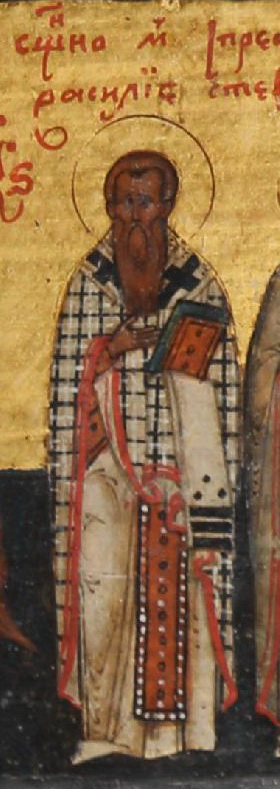
Basil is painted as a hierarch: middle-aged, with a full brown beard tapering to a point, in the polystavrion or cross-patterned phelonion and the crossed omophorion, his right hand raised in blessing and the jewelled Gospel in his left — the ordinary type of a bishop-saint, distinguished only by the inscription. As a hieromartyr he may also be given the small cross. His passion supplies two scenes for the fuller menologia: the beheading before Licinius, and the drawing of the body from the sea at Sinope in the fishermen's net, which is the image most particular to him.
The stored image is his figure from a Menaion icon for the month of April painted in Central Russia in the first quarter of the seventeenth century (Church Archaeological Cabinet of the Moscow Theological Academy). He stands at the twenty-sixth day of the month in the checked white polystavrion, blessing and holding the Gospel, with the red inscription above him naming the hieromartyr Basil and, beside him, Stephen of Perm.
Disputed questions
- The name. Greek sources overwhelmingly give Βασιλεύς (Basileus), a rarer name than Βασίλειος (Basileios, "Basil"), and the Slavonic and English traditions have regularised it to Vasily / Basil. Both forms refer to the same man; where precision matters, Basileus of Amasea is the better form, and it also keeps him clear of the many other Basils of the calendar — above all of Basil the Great (January 1) and of Basil of Ancyra, the martyr of the Julianic persecution.
- Date of death: 322 or 323? The persecution of Licinius ran from about 320 to his defeat at Chrysopolis in September 324. Most calendars put Basil's beheading in 322; some Greek sources give c. 323, and a few round it to "the fourth century" without more. Nothing in the sources decides it.
- The "great" of Athanasius. Several modern synaxaria state that St Athanasius the Great called Basil of Amasea "the Great" for his defence of the faith against heresy. This claim should be handled with care: Basil died in 322, three years before Nicaea and before the Arian conflict had properly opened, and Athanasius was then a young deacon. If the notice rests on a genuine text it is more likely a reference to Basil among the confessors who suffered under Licinius than a testimony to any anti-Arian activity of his; it may equally have arisen from confusion with a later namesake or with Basil the Great himself. Recorded here as reported, not asserted.
- Constantia's relation to Licinius. Some English retellings — including the widely circulated Orthodox Church in America notice — describe Constantia as Licinius's sister. She was in fact Licinius's wife, and Constantine's half-sister (daughter of Constantius I by Theodora), married to Licinius at Milan in 313 as the seal of their alliance. The confusion is simply a slip about whose sister she was; it does not touch the story, in which she acts precisely as an emperor's Christian wife protecting one of her own women.
- Not to be confused with the historically attested but distinct bishops of Amasea — Asterius of Amasea (c. 400), the homilist, and the later occupants of the see. Amasea's own Theodore the Recruit belongs to its territory, not to its episcopal list.