
Hermas, Patrobus, Linus, Gaius and Philologus of the Seventy
The Holy Apostles of the Seventy Hermas, Patrobus, Linus, Gaius and Philologus
Apostle of the Seventy · Apostle · Bishop
Commemorated 4 January — Synaxis of the Seventy Apostles, 31 May — Commemoration of the Apostle Hermas alone, with whom The Shepherd is traditionally associated, 5 November — The five apostles of the Seventy commemorated together
Hermas, Patrobus, Linus, Gaius and Philologus were five apostles of the Seventy whom the Byzantine calendar commemorates together on November 5. Each is named in the closing greetings of Paul's Epistle to the Romans or in the Second Epistle to Timothy, and each is remembered as a bishop of the apostolic age: Hermas at Philippopolis in Thrace, where he died a martyr; Patrobus at Puteoli and Naples in Italy; Linus at Rome, the successor of the Apostle Peter and the Linus of the Roman episcopal succession named in Second Timothy; Gaius at Ephesus, after Timothy; and Philologus at Sinope on the Black Sea, consecrated by the Apostle Andrew. The Church keeps their joint memory among the Seventy sent out by the Lord.
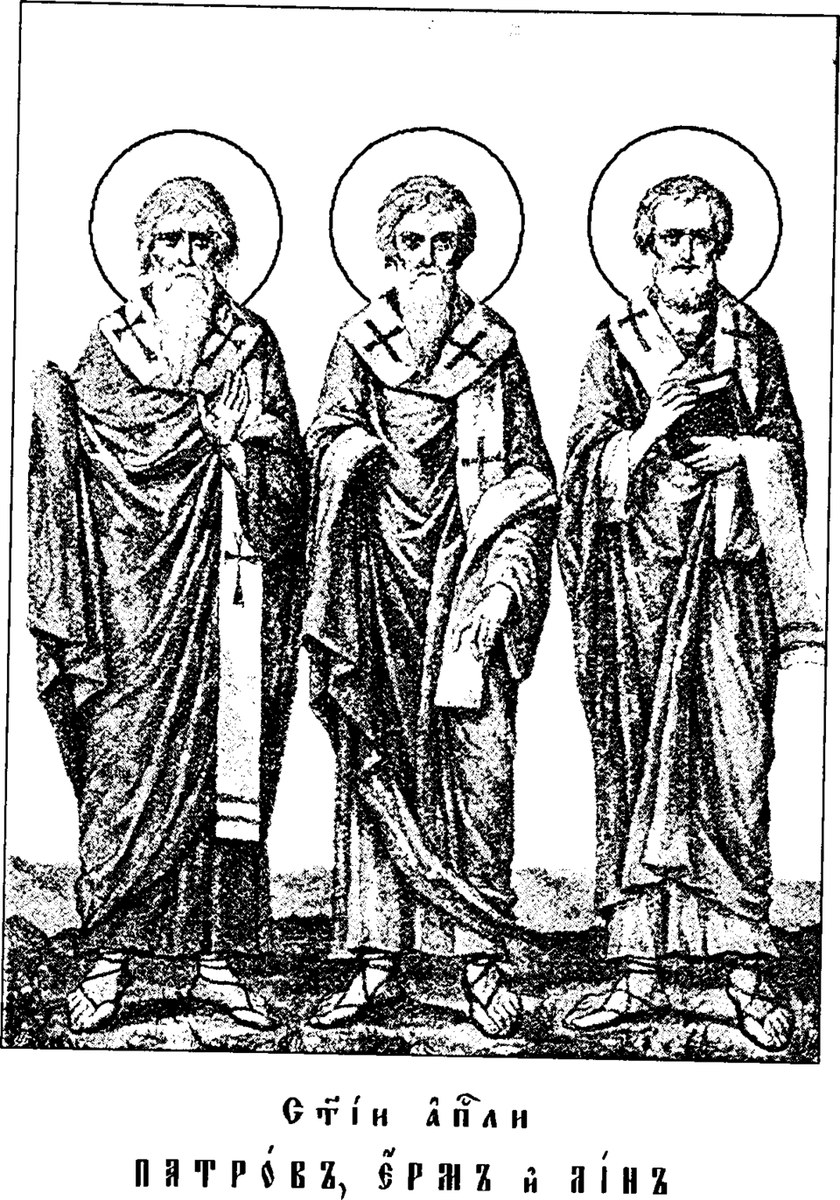
_-_%D0%B8%D0%BA%D0%BE%D0%BD%D0%B0_03053_%D0%9F%D0%B0%D1%82%D1%80%D0%BE%D0%B2,_%D0%95%D1%80%D0%BC_%D0%B8_%D0%9B%D0%B8%D0%BD.png)
The five are gathered on one day as members of the Seventy, each attested by a verse of the apostolic writings and by the tradition of the sees they afterward governed. Little connected biography survives for any of them beyond the New Testament greeting and the memory of their bishoprics; what the tradition transmits is set out member by member below.
Hermas
Hermas is greeted by Paul among a group of the faithful at Rome — "Salute Asyncritus, Phlegon, Hermas, Patrobas, Hermes, and the brethren which are with them" (Romans 16:14). The tradition numbers him among the Seventy and makes him bishop of Philippopolis in Thrace, where he is said to have ended his life as a martyr. He is sometimes identified in the tradition with the Hermas to whom the early Christian work The Shepherd is ascribed, though this identification is not secure and is generally set aside by scholarship.
Patrobus
Patrobus (Patrobas) is named in the same verse (Romans 16:14). The tradition makes him bishop of Puteoli and of Neapolis (Naples) in Italy. His name is given in the transmission in several forms, including Parrobus.
Linus
Linus is greeted at the close of the Second Epistle to Timothy — "Eubulus greeteth thee, and Pudens, and Linus, and Claudia, and all the brethren" (2 Timothy 4:21). He is the Linus of the Roman episcopal succession, remembered as the bishop who governed the Church of Rome after the Apostle Peter, and in the Western tradition as a martyr. His is the most historically prominent name of the company, appearing already in the early episcopal lists of Rome.
Gaius
Gaius is greeted in Romans as Paul's host — "Gaius mine host, and of the whole church, saluteth you" (Romans 16:23). The tradition makes him bishop of Ephesus, the successor of Timothy in that see. He is to be distinguished from the several other men named Gaius in the apostolic writings (the Macedonian and the Derbaean companions of Paul in Acts, and the Gaius to whom the Third Epistle of John is addressed).
Philologus
Philologus is greeted in Romans together with Julia — "Salute Philologus, and Julia, Nereus, and his sister" (Romans 16:15). The tradition relates that the Apostle Andrew consecrated him bishop of Sinope, on the southern shore of the Black Sea.
Feast and commemoration
November 5 (church date; Old Calendar civil November 18). The five apostles share a single synaxarion notice on this day; the day's proper service in the Greek Menaion belongs to the martyrs Galacteon and Episteme of Emesa, the apostles being commemorated without a proper office. All five are commemorated again with the whole company at the Synaxis of the Seventy Apostles on January 4.
Hymns
Troparion — Tone 3
Holy apostles, intercede with the merciful God, that he may grant our souls forgiveness of offences.
Original translation from the Greek
Iconography
The apostles of the Seventy are shown as apostles and bishops of the first age, in tunic and himation or in episcopal vesture, holding the Gospel book or a scroll and blessing. The stored image, an engraving from the Russian synodal Lives of the Saints (1903–1911), ranges three of the five together — Patrobus, Hermas and Linus — each named, standing with books and blessing hands.
Disputed questions
- Hermas or Hermes. Romans 16:14 names, in one breath, both a Hermas and a Hermes, and the tradition of the Seventy carries both, on separate days: the November 5 apostle is properly Hermas of Philippopolis, while a Hermes of the Seventy is commemorated on April 8 (with Herodion, Agabus, Rufus, Asyncritus and Phlegon) and on March 8. The two are readily confused, and some service notices — including the Orthodox Church in America's — give the November 5 name as "Hermes." This entry follows the synaxarion in reading the November 5 apostle as Hermas; the April 8 and March 8 Hermes of the Seventy, bishop of Dalmatia, is a distinct commemoration, authored separately (his entry records the same confusion from the other side — the Slavic books there reading the March 8 apostle as this Hermas of Philippopolis).
- Not to be confused with Hermias of Comana. The Apostle Hermas is also commemorated on May 31, and that day carries as its principal memory the martyr Hermias of Comana (†c. 166), an aged veteran soldier beheaded in Cappadocia — a wholly different person of a later century. The Greek forms Ἑρμᾶς and Ἑρμείας, and the single Slavonic form Ермий used for both, make this the most persistent confusion attaching to the apostle's name; see the Comana martyr's entry for the same distinction from the other side.
- Forward deduplication. When April 8 (Hermes and companions) and the Synaxis of the Seventy (January 4) are authored, this entry must be cross-checked so that Hermas/Hermes and Gaius are not duplicated; the several apostolic Gaii in particular require care.