
Hermias of Comana
The Holy Martyr Hermias, the Veteran Soldier, who suffered at Comana
Martyr · d. c. 166
Commemorated 31 May — Martyrdom by beheading at Comana
Hermias was an aged soldier — a veteran of the Roman armies — who confessed Christ at Comana and was tortured over many days and at last beheaded, about the middle of the second century. His passion is among the most elaborate in the synaxarion: flaying of the face, three days in a furnace, two cups of poison prepared by a sorcerer named Marus (who, seeing the poison fail, believed and was himself beheaded on the spot), boiling oil, the gouging out of his eyes, three days hung head-downward, and the healing of the men sent to remove his corpse, who found him alive and were struck blind with terror. The governor Sebastian, maddened at being unable to kill him, finally struck off his head with his own sword. He is to be sharply distinguished from the Apostle Hermas of the Seventy, commemorated on the same day.
_-_May_-_46_-_Hermias_of_Comana.jpg)
The old soldier at Comana
The synaxarion presents Hermias not as a young recruit but as a man already past his prime of service — a veteran, one who had completed the term of the legions and lived on in the town where he had been garrisoned. This detail governs the whole account: every torment inflicted on him is measured against his age, and the Greek verses and hymns of the day return again and again to the wonder of an old man's body enduring what would have broken a youth. He belonged to the Christian community of Comana, a city of the Cappadocian–Pontic interior, and when the persecution reached the town he did not conceal himself.
The persecution is placed by the Slavonic and Russian tradition in the reign of Antoninus Pius (138–161); the Greek synaxaristes carries the martyrdom a little later, to about 160 or the first years of Marcus Aurelius, whence the conventional date of c. 166 used here. The governor is named Sebastian — in the Greek accounts a doux, in the Slavonic a comes or military commander — and it was he who summoned the Christians of Comana to sacrifice.
The confession
Brought forward with the rest, Hermias was offered the ordinary inducements: the honours due to an old soldier, the emperor's clemency, a quiet remainder of life, in exchange for a handful of incense. The passion preserves the shape of his answer, which is an argument rather than a defiance: that it would be madness to exchange light for darkness, truth for falsehood, and life for death — that the gods of the city are nothing, and that a man who has served an earthly emperor faithfully to the end of his term does not desert the heavenly one at the end of his life. Sebastian, who had expected the age of the man to make the work easy, took the answer as insolence.
The tortures
What follows is a catalogue, and the sources agree on its main stages.
The martyr was first beaten about the head and face until the skin of his face was torn away and his jaw broken and his teeth struck out. He was then shut in a heated furnace and left there three days; when it was opened, expecting ashes, they found him unharmed and at prayer.
Sebastian therefore turned from force to craft. He sent for a sorcerer named Marus — the Greek synaxaria commemorate him on this same day simply as "the Holy Magus" — who compounded a lethal draught and gave it to the saint. Hermias drank it and was unhurt. A second and stronger poison was prepared, and this too he drank without harm. At that the sorcerer's own art condemned him: Marus understood that a power greater than his own stood in the way, confessed Christ before the governor, and was beheaded at once, receiving, as the tradition puts it, the baptism of his own blood without water.
The torments then resumed and grew worse: the martyr's body was raked with sharp iron, he was thrown into boiling oil, and his eyes were gouged out. He was hung head-downward for three days. On the third day Sebastian sent men to take down what he assumed was a corpse; they found Hermias alive, and at the sight were struck blind with terror and began to cry out to the martyr himself for help — and he, praying in the name of Christ, restored their sight. Flaying followed, and still he lived.
Repose and relics
At the last, Sebastian — the sources are unanimous that by now he was beside himself — drew his own sword and struck off the martyr's head with his own hand, unwilling to leave the work to an executioner. The Christians of Comana took up the body and buried it, and the relics became a source of healings, which is the note on which every version of the passion closes.
The character of the account
Read as a document, the passion of Hermias belongs to the class of long "contest" narratives in which the martyr's endurance is deliberately extended beyond the natural to make a theological point: that the body of a Christian is not the property of the magistrate, and that the persecutor's instruments are exhausted before the martyr's faith is. The historical residue is small but consistent — a veteran soldier, a town called Comana, a governor called Sebastian, a death by the sword, and a tomb that healed. The Church has never required more of the account than that, and the hymns of the day fasten not on the marvels but on the incongruity the marvels serve: the old man who fought like a young one.
Feast and commemoration
May 31 (church date; Old Calendar civil June 13) — the last day of the church month of May. Hermias is the principal commemoration of the day in the Greek books, where he has a proper office; the Slavonic and Russian calendars keep him together with the Apostle Hermas and the martyr Philosophus of Alexandria. The Greek synaxaria attach to his memory the separate notice of "the Holy Magus," the sorcerer converted in the course of his passion.
Hymns
Troparion — Tone 4 (common of a martyr)
Thy martyr Hermias, O Lord, in his contest received an incorruptible crown from Thee, our God; for possessing Thy strength, he cast down the tyrants and shattered the feeble insolence of the demons. By his intercessions save our souls.
Original translation from the Greek
Iconography
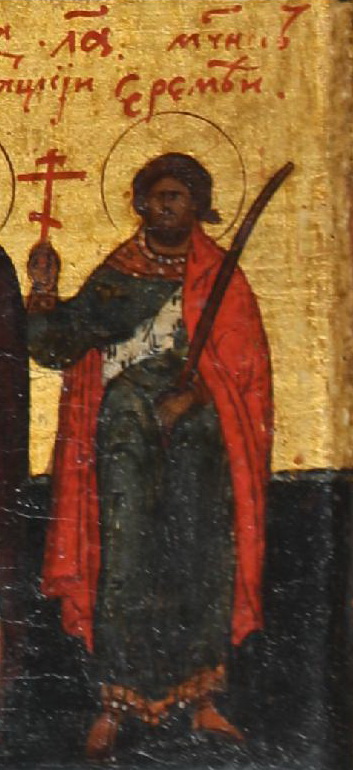
Hermias is painted as a martyr in secular dress of rank rather than as a monastic or a hierarch: a mature or elderly man, dark-bearded, in tunic and mantle — very often a red cloak, the colour of both blood and the soldier's chlamys — holding the martyr's cross in the right hand. Because he was beheaded by the governor's own sword, and because he was a soldier, the sword is his second attribute, and menologion images give it to him held upright beside the cross; this is what distinguishes him at a glance from the Apostle Hermas of the same day, who is shown as an apostle-bishop with the Gospel book. Fuller cycles of his passion show the furnace, the cup of poison with the sorcerer beside it, and the martyr suspended head-downward.
The stored image is his figure from a 17th-century Russian menaion icon for the month of May (Church Archaeological Cabinet of the Moscow Theological Academy), where he stands forty-sixth in the month's ranks — the Slavonic inscription above him naming the holy martyr Ермѣи — in a red mantle over a dark tunic, the cross raised in his right hand and the sword held upright in his left.
Disputed questions
- Not to be confused with the Apostle Hermas. The same day, May 31, carries the memory of the Apostle Hermas of the Seventy, bishop of Philippopolis in Thrace, greeted by Paul at Romans 16:14 and by tradition the author of The Shepherd. The two are wholly distinct — a first-century apostle who reposed in peace, and a second-century soldier beheaded at Comana — but the Greek forms Ἑρμᾶς and Ἑρμείας and the Slavonic Ермий are close enough that calendars, icon inscriptions and Wikidata searches routinely confuse them, and the sharing of the day makes the confusion almost inevitable. Confusion extends also to Hermes of the Seventy, bishop of Dalmatia (March 8, April 8), and to Hermas the Presbyter, martyred with Nicander of Myra (November 4). Only the Comana martyr is the subject of this entry.
- Which Comana? The passion names only "Comana." Two cities of that name were candidates in the Roman East: Comana in Cappadocia (Comana Cappadociae, on the Sarus) and Comana Pontica in Pontus, the town where John Chrysostom died in exile. The Greek tradition generally reads Cappadocia, and the martyr is commonly styled "of Cappadocia" in Greek collections; the question cannot be closed from the passion itself, and this entry follows the Greek reading while recording the ambiguity.
- The date. Antoninus Pius (138–161) in the Slavonic and Russian tradition; about 160, or under Marcus Aurelius, in the Greek. The spread is not large and turns on whether Sebastian's commission is placed at the end of one reign or the beginning of the next. "c. 166" is a conventional midpoint and should not be pressed.
- Marus the sorcerer. The Greek synaxaria list "the Holy Magus" as a separate commemoration of May 31, giving him no name; the name Marus comes through the Slavonic transmission of the passion. He has no proper office and no independent cultus, and he is treated here within the passion in which he appears rather than as a separate entry.