
Pentecost week, day 1 · 49 days since Pascha
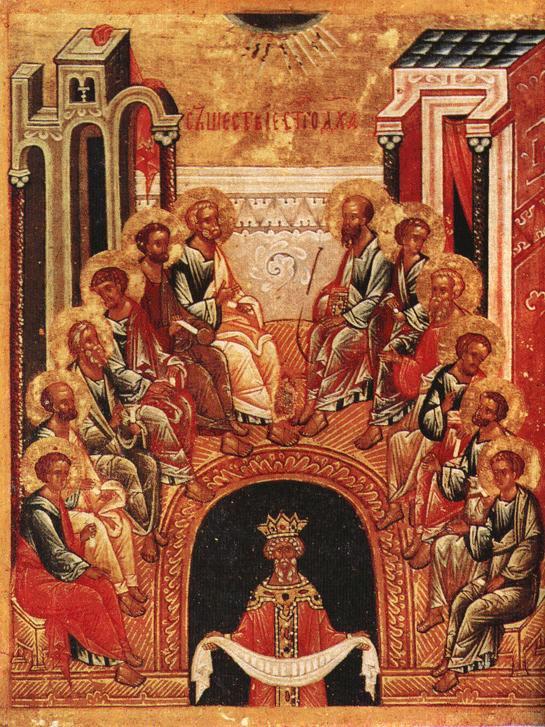
Holy Pentecost

Saints commemorated
-
Apostle Hermes of the Seventy
Hermas, Patrobus, Linus, Gaius and Philologus were five apostles of the Seventy whom the Byzantine calendar commemorates together on November 5. Each is named in the closing greetings of Paul's Epistle to the Romans or in the Second Epistle to Timothy, and each is remembered as a bishop of the apostolic age: Hermas at Philippopolis in Thrace, where he died a martyr; Patrobus at Puteoli and Naples in Italy; Linus at Rome, the successor of the Apostle Peter and the Linus of the Roman episcopal succession named in Second Timothy; Gaius at Ephesus, after Timothy; and Philologus at Sinope on the Black Sea, consecrated by the Apostle Andrew. The Church keeps their joint memory among the Seventy sent out by the Lord.
-
Apollo of the Thebaid
Apollo — Apollonius in the fuller form of the name — was one of the great abbots of fourth-century Egypt, the father of a community of some five hundred monks near Hermopolis in the Thebaid. Withdrawing to the desert at fifteen and living forty years in solitude before being called by a divine word to gather disciples and "destroy the wisdom of the wise" among the pagans of the region, he became the most celebrated ascetic of Upper Egypt in the generation after Antony. The History of the Monks in Egypt, whose authors visited his monastery, gives him one of its longest chapters, and records of him the note that made him famous: that his face was always radiant with joy, and that he would not have sorrow in the house of God. He reposed about 395, very old.
-
Eusebius and Charalampus
Eusebius and Charalampus were two Christians of Nicomedia who refused to sacrifice to the idols and were burned alive. The Greek synaxarion joins their memory to that of the martyrs commemorated the previous day — Romanus, Teletius (or Meletius) and Christina — with whom they were put to death in the same fire, and remembers them in a single couplet: that the fire of their zeal kindled two contenders before the fire that consumed them. Beyond the place, the manner of death and the company, nothing of their history is transmitted; not even the reign in which they suffered is recorded.
-
Eustathius of Constantinople
Eustathius was Patriarch of Constantinople from 1019 to 1025, in the last years of the emperor Basil II. He came to the throne of the Great Church not from a monastery or a provincial see but from the imperial palace, where he had been protopresbyter — the senior priest of the court clergy — and he governed the Church, in the words of the notice that preserves his memory, in a manner pleasing to God, reposing in peace towards the end of 1025. His sanctity is not carried by the printed Menaia: it survives in a manuscript synaxarion of the metochion of the Holy Sepulchre, which enters his commemoration on May 31, and he is one of the most obscure of all the canonised occupants of the see.
-
Five Martyrs of Ascalon
Five martyrs, whose names the tradition has not preserved, suffered at Ascalon on the coast of Palestine and were dragged along the ground until they died — the whole of what the synaxarion transmits of them, conveyed in a single verse which turns their death into an image of a bed made of the earth itself. Neither the reign, the year, nor the occasion of their martyrdom is recorded. They are kept on May 31 as one of the many small anonymous companies by which the fixed calendar holds open the memory of martyrs whose histories were lost while their number and their city were remembered.
-
Hermias of Comana
Hermias was an aged soldier — a veteran of the Roman armies — who confessed Christ at Comana and was tortured over many days and at last beheaded, about the middle of the second century. His passion is among the most elaborate in the synaxarion: flaying of the face, three days in a furnace, two cups of poison prepared by a sorcerer named Marus (who, seeing the poison fail, believed and was himself beheaded on the spot), boiling oil, the gouging out of his eyes, three days hung head-downward, and the healing of the men sent to remove his corpse, who found him alive and were struck blind with terror. The governor Sebastian, maddened at being unable to kill him, finally struck off his head with his own sword. He is to be sharply distinguished from the Apostle Hermas of the Seventy, commemorated on the same day.
-
Philosophus of Alexandria
Philosophus was a young Christian of Alexandria who was put to death in the persecution of the emperor Decius (249–251). His passion is remembered for one episode: when torture failed to move him, the magistrates changed their method and attempted to break him by defilement rather than pain, binding him hand and foot upon a soft bed and shutting a prostitute in the room with him. Unable to resist with his hands, he bit off his own tongue and spat it in her face, so that she fled from the room in horror; and his judges, defeated by an act they could not answer, ordered him beheaded. He stands in the synaxarion as the type of the martyr whose chastity, not merely his confession, was the thing on trial.
British Isles and Ireland
- SS. Winnow, Mancus and Myrbad, missionaries in Cornwall (6th C)
Troparia & kontakia
Apolytikion — Tone 8
Blessed art thou, O Christ our God, who hast shown forth the fishermen as all-wise, sending down upon them the Holy Spirit, and through them taking the whole world in thy net. O Lover of mankind, glory to thee.
Kontakion — Tone 8
When the Most High came down and confounded the tongues, he divided the nations; when he distributed the tongues of fire, he called all men into unity; and with one accord we glorify the all-holy Spirit.
Megalynarion — Tone 7
O Mother who hast not known man, Virgin Theotokos, who didst conceive without experience of corruption and didst lend flesh to the all-fashioning Word; vessel of him whom nothing can contain, place of thine own uncircumscribed Maker: thee do we magnify.
Oikos
Give swift and steadfast consolation to thy servants, O Jesus, when our spirits grow listless. Be not parted from our souls in afflictions, be not far from our minds in adversities, but come to us always before we call. Draw near to us, draw near, thou who art everywhere; and as thou wast ever with thine apostles, so unite thyself to those who long for thee, O compassionate one, that being joined to thee we may hymn and glorify thine all-holy Spirit.
Troparion — Tone 8 (common of a venerable father)
By a flood of tears thou didst make the barren desert fruitful, and by thy sighing from the depths thou didst bear fruit a hundredfold in labours; thou becamest a beacon, shining upon the world by thy miracles, O Apollo our father: intercede with Christ God that our souls may be saved.
Troparion — Tone 4 (common of martyrs)
O holy martyrs, who fought the good fight and received your crowns, intercede with the Lord that he may have mercy on our souls.
Troparion — Tone 4 (common of a hierarch)
O God of our fathers, who dealest with us ever according to thy gentleness: take not thy mercy from us, but by the prayers of our father among the saints Eustathius, direct our life in peace.
Troparion — Tone 4 (common of martyrs)
O holy martyrs, who fought the good fight and received your crowns, intercede with the Lord that he may have mercy on our souls.
Troparion — Tone 3
Holy apostles, intercede with the merciful God, that he may grant our souls forgiveness of offences.
Troparion — Tone 4 (common of a martyr)
Thy martyr Hermias, O Lord, in his contest received an incorruptible crown from Thee, our God; for possessing Thy strength, he cast down the tyrants and shattered the feeble insolence of the demons. By his intercessions save our souls.
Troparion — Tone 4 (common of a martyr)
Thy martyr Philosophus, O Lord, in his contest received an incorruptible crown from Thee, our God; for possessing Thy strength, he cast down the tyrants and shattered the feeble insolence of the demons. By his intercessions save our souls.
Readings
Vespers
Numbers 11.16-17, 24-29
16And the LORD said unto Moses, Gather unto me seventy men of the elders of Israel, whom thou knowest to be the elders of the people, and officers over them; and bring them unto the tabernacle of the congregation, that they may stand there with thee. 17And I will come down and talk with thee there: and I will take of the spirit which is upon thee, and will put it upon them; and they shall bear the burden of the people with thee, that thou bear it not thyself alone. 24And Moses went out, and told the people the words of the LORD, and gathered the seventy men of the elders of the people, and set them round about the tabernacle. 25And the LORD came down in a cloud, and spake unto him, and took of the spirit that was upon him, and gave it unto the seventy elders: and it came to pass, that, when the spirit rested upon them, they prophesied, and did not cease. 26But there remained two of the men in the camp, the name of the one was Eldad, and the name of the other Medad: and the spirit rested upon them; and they were of them that were written, but went not out unto the tabernacle: and they prophesied in the camp. 27And there ran a young man, and told Moses, and said, Eldad and Medad do prophesy in the camp. 28And Joshua the son of Nun, the servant of Moses, one of his young men, answered and said, My lord Moses, forbid them. 29And Moses said unto him, Enviest thou for my sake? would God that all the LORD’s people were prophets, and that the LORD would put his spirit upon them!
Joel 2.23-32
23Be glad then, ye children of Zion, and rejoice in the LORD your God: for he hath given you the former rain moderately, and he will cause to come down for you the rain, the former rain, and the latter rain in the first month. 24And the floors shall be full of wheat, and the fats shall overflow with wine and oil. 25And I will restore to you the years that the locust hath eaten, the cankerworm, and the caterpiller, and the palmerworm, my great army which I sent among you. 26And ye shall eat in plenty, and be satisfied, and praise the name of the LORD your God, that hath dealt wondrously with you: and my people shall never be ashamed. 27And ye shall know that I am in the midst of Israel, and that I am the LORD your God, and none else: and my people shall never be ashamed. 28And it shall come to pass afterward, that I will pour out my spirit upon all flesh; and your sons and your daughters shall prophesy, your old men shall dream dreams, your young men shall see visions: 29And also upon the servants and upon the handmaids in those days will I pour out my spirit. 30And I will shew wonders in the heavens and in the earth, blood, and fire, and pillars of smoke. 31The sun shall be turned into darkness, and the moon into blood, before the great and the terrible day of the LORD come. 32And it shall come to pass, that whosoever shall call on the name of the LORD shall be delivered: for in mount Zion and in Jerusalem shall be deliverance, as the LORD hath said, and in the remnant whom the LORD shall call.
Ezekiel 36.24-28
24For I will take you from among the heathen, and gather you out of all countries, and will bring you into your own land. 25Then will I sprinkle clean water upon you, and ye shall be clean: from all your filthiness, and from all your idols, will I cleanse you. 26A new heart also will I give you, and a new spirit will I put within you: and I will take away the stony heart out of your flesh, and I will give you an heart of flesh. 27And I will put my spirit within you, and cause you to walk in my statutes, and ye shall keep my judgments, and do them. 28And ye shall dwell in the land that I gave to your fathers; and ye shall be my people, and I will be your God.
Matins Gospel
John 20.19-23
19Then the same day at evening, being the first day of the week, when the doors were shut where the disciples were assembled for fear of the Jews, came Jesus and stood in the midst, and saith unto them, Peace be unto you. 20And when he had so said, he shewed unto them his hands and his side. Then were the disciples glad, when they saw the Lord. 21Then said Jesus to them again, Peace be unto you: as my Father hath sent me, even so send I you. 22And when he had said this, he breathed on them, and saith unto them, Receive ye the Holy Ghost: 23Whose soever sins ye remit, they are remitted unto them; and whose soever sins ye retain, they are retained.
Epistle
Acts 2.1-11
1And when the day of Pentecost was fully come, they were all with one accord in one place. 2And suddenly there came a sound from heaven as of a rushing mighty wind, and it filled all the house where they were sitting. 3And there appeared unto them cloven tongues like as of fire, and it sat upon each of them. 4And they were all filled with the Holy Ghost, and began to speak with other tongues, as the Spirit gave them utterance. 5And there were dwelling at Jerusalem Jews, devout men, out of every nation under heaven. 6Now when this was noised abroad, the multitude came together, and were confounded, because that every man heard them speak in his own language. 7And they were all amazed and marvelled, saying one to another, Behold, are not all these which speak Galilæans? 8And how hear we every man in our own tongue, wherein we were born? 9Parthians, and Medes, and Elamites, and the dwellers in Mesopotamia, and in Judæa, and Cappadocia, in Pontus, and Asia, 10Phrygia, and Pamphylia, in Egypt, and in the parts of Libya about Cyrene, and strangers of Rome, Jews and proselytes, 11Cretes and Arabians, we do hear them speak in our tongues the wonderful works of God.
Gospel
John 7.37-52, 8.12
37In the last day, that great day of the feast, Jesus stood and cried, saying, If any man thirst, let him come unto me, and drink. 38He that believeth on me, as the scripture hath said, out of his belly shall flow rivers of living water. 39(But this spake he of the Spirit, which they that believe on him should receive: for the Holy Ghost was not yet given; because that Jesus was not yet glorified.) 40Many of the people therefore, when they heard this saying, said, Of a truth this is the Prophet. 41Others said, This is the Christ. But some said, Shall Christ come out of Galilee? 42Hath not the scripture said, That Christ cometh of the seed of David, and out of the town of Bethlehem, where David was? 43So there was a division among the people because of him. 44And some of them would have taken him; but no man laid hands on him. 45Then came the officers to the chief priests and Pharisees; and they said unto them, Why have ye not brought him? 46The officers answered, Never man spake like this man. 47Then answered them the Pharisees, Are ye also deceived? 48Have any of the rulers or of the Pharisees believed on him? 49But this people who knoweth not the law are cursed. 50Nicodemus saith unto them, (he that came to Jesus by night, being one of them,) 51Doth our law judge any man, before it hear him, and know what he doeth? 52They answered and said unto him, Art thou also of Galilee? Search, and look: for out of Galilee ariseth no prophet. 12Then spake Jesus again unto them, saying, I am the light of the world: he that followeth me shall not walk in darkness, but shall have the light of life.