
Hermylus and Stratonicus
The Holy Martyrs Hermylus the Deacon and Stratonicus of Singidunum
Martyr · Deacon · d. c. 315, at Singidunum on the Danube
Commemorated 13 January — Martyrdom by drowning in the Danube under Licinius
Hermylus and Stratonicus (†c. 315) were martyred at Singidunum — the Roman fortress-town on the Danube that is now Belgrade — during the persecution of the emperor Licinius. Hermylus was a deacon of the city, arrested and cruelly scourged for refusing to sacrifice to the idols, which he called deaf and blind things of wood; Stratonicus was his friend, a keeper of the prison who had secretly held the faith and could not hide his grief as he watched his companion tortured, and so confessed Christ and shared his fate. Bound together in a net — in some accounts a wicker basket — the two were cast into the Danube and drowned; their bodies were recovered downstream after three days and buried near the city. Their heads were later treasured at Hagia Sophia in Constantinople. They are kept together on January 13, within the afterfeast of the Theophany.
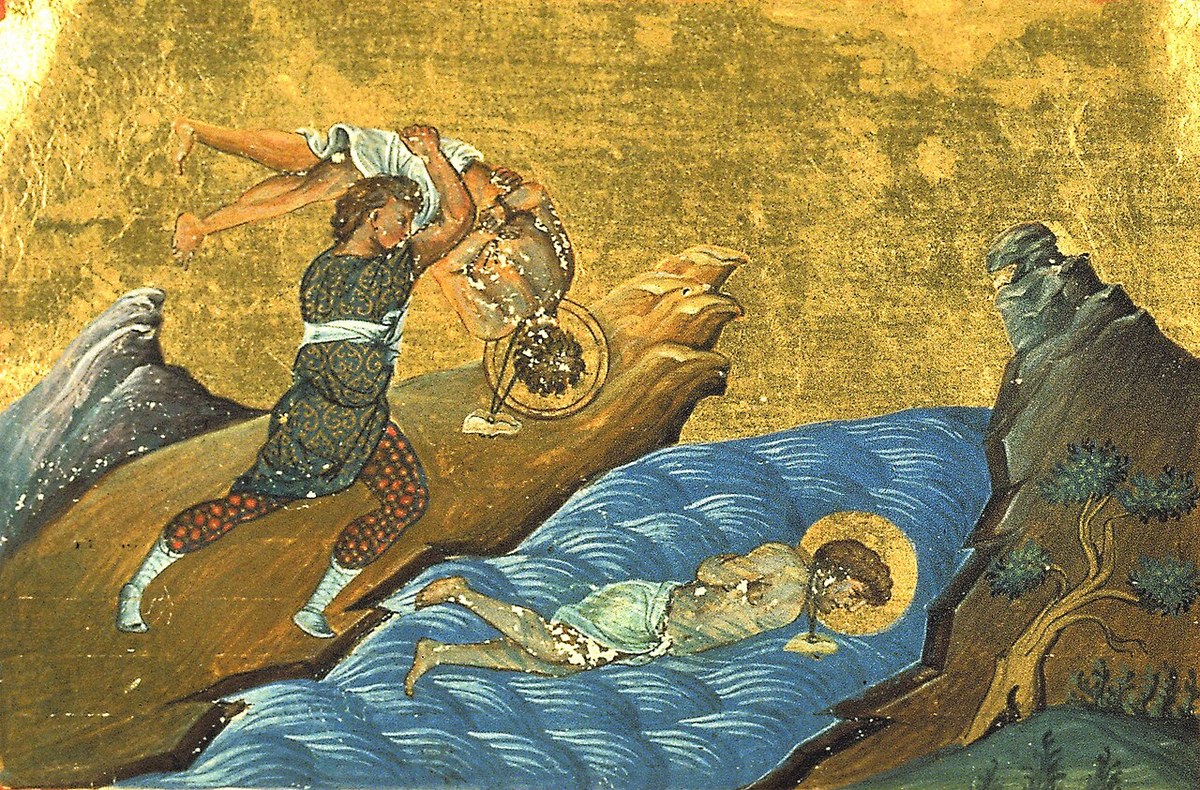
.jpg)
Singidunum under Licinius
The two martyrs belong to the last of the great Roman persecutions. When Constantine and Licinius divided the empire between them, Licinius held the Balkan and eastern provinces, and after his breach with Constantine he turned against the Christians of his territory — a persecution the sources place in the years around 315–320, before his final defeat and death in 324. Its scene here is Singidunum, the legionary fortress and town at the confluence of the Sava and the Danube, the frontier of the province of Moesia and the site of the modern Belgrade. The two saints are accordingly numbered among the early martyrs of the Serbian lands, though they suffered long before there was a Serbian people there, under Roman law and in the Greek-speaking Church of the Danube frontier.
Hermylus the deacon
Hermylus was a deacon of the church of Singidunum, a man of open and fearless confession. Denounced as a Christian, he was brought before the authorities — the tradition names Licinius himself as present, or his officers acting in his name — and commanded to sacrifice to the gods. He refused with scorn, calling the idols deaf, dumb, and blind things that could neither see their worshippers nor help them, and confessing the one living God. For this he was beaten about the face and then hung up and scourged, his sides torn; and through each round of torment, the account says, a voice from heaven strengthened him, promising him the crown. He is remembered too for a word of prophecy: that the tyrant who tormented him would himself be broken and perish for his idolatry — a saying the Church read as fulfilled in Licinius's downfall and death.
Stratonicus the jailer
Stratonicus was the keeper of the prison in which Hermylus was confined — and, though he had kept it hidden, a Christian himself, and Hermylus's friend. As he watched the deacon dragged out again and again to be tortured, and saw his mangled body, he could not master his grief: he wept openly, and his tears betrayed him. Questioned, he would not deny that he too was a Christian and a companion of the confessor, and so he was seized and beaten in his turn. The two friends — the deacon and the jailer who had guarded him — were now condemned together.
Martyrdom in the Danube
Sentence was passed that they should be drowned in the Danube. They were bound together — the accounts say enclosed in a net, or in a coarse wicker basket or eel-trap (Greek sargánē), the detail the synaxarion-verse fixes on — and cast alive into the river. So they died, about the year 315, giving their souls to God in the flowing water. Their bodies were carried down by the current and, after three days, were found on the bank and taken up by the faithful, who buried them together in a single grave near Singidunum, some eighteen stadia (a few miles) from the city, as the tradition specifies.
Relics
The memory of the two martyrs spread from the Danube to the capital. Their heads — and, the tradition holds, their relics — were brought to Constantinople and enshrined; the Russian pilgrim Anthony of Novgorod, who described the relics of the city about the year 1200, records seeing the heads of Hermylus and Stratonicus among the treasures of the Great Church of Hagia Sophia. Their joint commemoration passed into the Synaxarion of Constantinople and thence into the whole Byzantine calendar.
Feast and commemoration
Hermylus and Stratonicus are commemorated together on January 13 (church date; Old Calendar civil January 26), within the afterfeast of the Theophany. The Greek Menaion appoints a proper office for the two martyrs — an apolytikion, a kontakion, and stichera and a canon that dwell on the image the tradition loves: that the water which drowned them became for them the water of incorruption, so that the river of their death answered the river Jordan of the feast still being kept. The Antiochian, Greek, and Slavic calendars agree on the day and on the joint commemoration; the martyrs are also honoured in the Serbian Church as early witnesses of the Belgrade region.
Hymns
Troparion — Tone 3
A God-filled pair, confessing with faith the supra-divine Trinity, ye were shown forth as all-praised Martyrs: the glorious and unconquered Hermylus, and the steadfast and God-minded Stratonicus. Wherefore, as sharers together in the glory that surpasseth understanding, entreat for us the great mercy.
Original translation from the Greek
Kontakion — Tone 1
Having drowned in the deep of your struggles the enemy and persecutor, O valiant prize-bearers, ye met your end amid the streams of the river, and were guided to the water of incorruption, O divine Hermylus together with the renowned Stratonicus, magnifying Christ.
Original translation from the Greek
Iconography
The two martyrs are shown together as a pair — Hermylus in the vestments of a deacon (the sticharion and orarion), Stratonicus as a layman — and the scene proper to their feast is the martyrdom: the two men lowered or cast into the water of the Danube, bound in the net or basket, sometimes with the hand of God or an angel above them. The stored image is the miniature for January 13 in the Menologion of Basil II (Constantinople, c. 985; Vatican, Vat. gr. 1613), which depicts the two saints being drowned in the river.