
Theophany
The Holy Theophany of our Lord and God and Saviour Jesus Christ
The Holy Theophany of our Lord and God and Saviour Jesus Christ (January 6) is the Great Feast of the Lord that celebrates his Baptism by John in the river Jordan — and, at that baptism, the manifestation (θεοφάνεια, "the appearing of God") of the whole Holy Trinity to the world: the Son standing in the water, the Spirit descending upon him in the form of a dove, and the voice of the Father from heaven bearing witness, "This is my beloved Son." The sinless One enters the water not to be cleansed but to sanctify it, to bury the old Adam, to crush the heads of the serpent that lurked in the deep, and to give in his own baptism the pattern and the power of ours. One of the Twelve Great Feasts, kept in the East since the second century, it is the eighth of the year in the fixed cycle and among the most ancient of all — older than the feast of the Nativity, from which it was separated only in the fourth century. It is furnished, uniquely with the Nativity, with the full apparatus of a first-rank Dominical feast — a paramony with Royal Hours and a Vesperal Liturgy of Basil — and above all with the Great Blessing of the Waters, from which the whole Christian world draws the "Great Agiasma," the sanctified water of the feast.

The Gospel narrative
The Baptism of Christ is one of the very few events told by all four Evangelists, and the Church reads them together. The three Synoptics narrate the event; John the Theologian gives the Forerunner's own testimony to it.
Matthew tells it most fully. Jesus comes from Galilee to the Jordan, to John, to be baptized of him; but John forbids him, saying, "I have need to be baptized of thee, and comest thou to me?" And Jesus answers, "Suffer it to be so now: for thus it becometh us to fulfil all righteousness." Then John suffers him. "And Jesus, when he was baptized, went up straightway out of the water: and, lo, the heavens were opened unto him, and he saw the Spirit of God descending like a dove, and lighting upon him: and lo a voice from heaven, saying, This is my beloved Son, in whom I am well pleased" (Matthew 3:13–17). Mark, always spare, gives the same in three verses, and adds the one word the icon fixes upon — that the heavens were "rent asunder" (σχιζομένους, Mark 1:10) — and in Mark the voice speaks to Christ directly: "Thou art my beloved Son, in whom I am well pleased" (Mark 1:9–11). Luke sets the baptism in the fullness of his chronology (the fifteenth year of Tiberius), notes that Jesus was praying when the heaven was opened, describes the Spirit descending "in a bodily shape like a dove," and gives the age of the Lord as "about thirty years" as he began (Luke 3:21–23).
The Fourth Gospel does not narrate the baptism as an event but preserves the Baptist's witness to it, which the Church reads as its interpretation. John the Forerunner testifies: "I saw the Spirit descending from heaven like a dove, and it abode upon him. And I knew him not: but he that sent me to baptize with water, the same said unto me, Upon whom thou shalt see the Spirit descending, and remaining on him, the same is he which baptizeth with the Holy Ghost. And I saw, and bare record that this is the Son of God" (John 1:32–34). It is here too that the Forerunner names him "the Lamb of God, which taketh away the sin of the world" (John 1:29) — so that the manifestation at the Jordan already points to the Cross. All four accounts converge on the same three witnesses: the water and the One baptized, the descending Spirit, and the Father's voice.
"Theophany" and "Epiphany": the name of the feast
The feast bears in the Greek two closely related names. Theophaneia (Θεοφάνεια), "the manifestation of God," is the name the Byzantine East prefers, and it names precisely what the day proclaims: at the Jordan the one God is shown to be three — the Father witnessing from heaven, the Son in the stream, the Spirit in the dove — so that the feast is, before all else, the revelation of the Holy Trinity. Epiphaneia (Ἐπιφάνεια), "the appearing" or "the shining-forth," is the older and more general term, used already in the second century, and it passed westward into Latin as Epiphania, the source of the English "Epiphany." A third and beloved Greek name is ta Phōta (τὰ Φῶτα), "the Lights," and the feast is called the Feast of Lights: partly because Christ, the unapproachable Light, shines forth upon the world at his appearing; partly because baptism itself is called in Greek phōtismos, "illumination," and this was in antiquity the great baptismal day of the year, on which the catechumens were enlightened in the font.
East and West came to weight the one feast differently. In the Christian East the day is, and has always been, the feast of the Baptism in the Jordan and the Trinity's manifestation. In the West, where the Nativity on December 25 had early drawn to itself the adoration of the Magi, the January 6 Epiphany came to be kept above all as the manifestation of Christ to the gentiles in the persons of the Wise Men — the "showing" of the new-born King to the nations — with the Baptism and the wedding at Cana of Galilee (John 2) attached as second and third "manifestations." Hence the Western hymn tradition of the "three miracles" of this holy day: the star that led the Magi, the voice at the Jordan, the water made wine. The East gathers all these as manifestations of the one Lord but fixes the feast firmly on the Baptism; the Western focus on the Magi is a difference of emphasis within a shared and very ancient day.
The ancient unity of Nativity and Theophany
For the first three centuries the Church kept no feast of the Nativity. In the Christian East a single great festival on January 6 celebrated the whole entrance of God into the world in the flesh — his birth, the adoration of the Magi, and his Baptism — as one manifestation of God made manifest, the Theophaneia. The earliest notice of the day is from Clement of Alexandria, about the year 200, who reports that the followers of the gnostic Basilides already kept a feast of the Lord's Baptism on the night of the fifth into the sixth of the Egyptian month Tybi — that is, our January 6 — the oldest date attached to any feast of the incarnate Lord after Pascha.
The separate feast of the Nativity on December 25 arose in the West, at Rome, and spread through the East in the second half of the fourth century (its Antiochene reception is dated by a homily of John Chrysostom to about 386). Where December 25 was given to the Nativity, January 6 was left to celebrate the Baptism alone, and the twelve days between the two feasts were bound into a single festal season — the Twelve Days of Christmas, running from the Nativity to the eve of Theophany. The division was not universal at once: the Church of Jerusalem kept the old unified January 6 well into the fifth century, and the Armenian Church has never adopted December 25 at all, keeping to this day the ancient single feast of the Nativity-and-Theophany on January 6. The two feasts of the Byzantine calendar are thus, in origin, the two halves of one older whole, and their services are built on the same pattern and speak with one voice; much of what the Nativity sings of the condescension of God the Theophany takes up again at the water.
Why the sinless One is baptized
The theological heart of the feast is a paradox its hymns never tire of: John's baptism was "a baptism of repentance for the remission of sins" (Mark 1:4), yet the One who comes to it is the sinless God, who has no sin to repent of and no stain to wash away. "I have need to be baptized of thee," says the Forerunner, "and comest thou to me?" The Church's answer, drawn out through the whole festal hymnography, is that Christ is baptized not for himself but for us, and that his descent into the Jordan accomplishes several things at once.
He is baptized to fulfil all righteousness (Matthew 3:15) — to complete in his own person the whole obedience of the Law and the Prophets, submitting the sinless One to the rite of sinners as the last act of the humility begun at Bethlehem. He is baptized to sanctify the waters: entering the stream, he who is himself the fountain of holiness fills the nature of water with the grace of the Spirit, so that what could not cleanse before can now regenerate, and the Jordan becomes the first font of the whole world's baptism. "Today the nature of the waters is sanctified," the feast sings, "and the Jordan is parted in two." He is baptized to bury the old Adam and to raise up the new: going down into the water he takes the fallen race with him and leaves the old man in the stream, coming up as the head of a renewed humanity — so that his baptism is the archetype of the death and resurrection every Christian undergoes in the font (Romans 6:3–4).
Above all, the Fathers read the descent into the Jordan as a combat. The Church prays, in the great blessing-prayer of the feast, that as the Lord went down into the waters he crushed the heads of the dragons that lurked there — the image of Psalm 73:13–14 (74 Hebrew): "Thou didst break the heads of the dragons in the waters; thou brakest the head of the dragon in pieces." The serpent who had made his lair in the deep, the ancient enemy who held mankind in the bondage of death, is trodden underfoot in his own element; the water that had been the domain of the dragon becomes the bath of rebirth. And in sanctifying the waters Christ renews the whole creation, of which water is the element of life: Theophany is a cosmic feast, in which the material world begins to be taken back for God, the first-fruits of the redemption of all things. The Baptism thus stands, with the Nativity behind it and Pascha before it, as one act of the single drama of salvation: he who was born in the cave and washed in the Jordan will descend into the Jordan of death and rise, and the icon of the feast — Christ standing in the dark water as in a watery grave, the personified river fleeing before him — already shows the tomb and the Resurrection in the stream.
The manifestation of the Trinity
The feast is called Theophany above all because at the Jordan the Holy Trinity is made manifest together for the first time in the sacred history — the one mystery hidden from the ages shown forth in a single moment. The Father speaks from heaven, naming his beloved Son; the Son stands incarnate in the water; the Spirit descends and abides upon him in the form of a dove. The whole tradition reads the scene as the definitive revelation of the triune God: what the prophets glimpsed and the Law veiled is here declared at the water, so that the Church's baptism, given "in the name of the Father, and of the Son, and of the Holy Spirit" (Matthew 28:19), is grounded in the Lord's own baptism, where the three Persons were revealed. The dove recalls the dove of Noah that announced the ending of the flood and the peace of God with the world, and the Spirit that "moved upon the face of the waters" at the first creation (Genesis 1:2) — for at the Jordan a new creation begins upon the same element. The troparion of the feast is nothing other than the confession of this manifestation: "When thou wast baptized in the Jordan, O Lord, the worship of the Trinity was made manifest."
Feast and commemoration
January 6 (church date; New Calendar civil January 6, Old Calendar civil January 19), a feast of the Lord and one of the Twelve Great Feasts, kept universally in the Byzantine rite with an All-night Vigil. With the Nativity alone among the fixed feasts, Theophany carries the full apparatus of a first-rank Dominical feast modelled on Pascha: a paramony (eve) with Royal Hours, a solemn Compline with the singing of "God is with us," and a Vesperal Liturgy of Basil the Great on the eve.
The festal cycle is among the fullest of the year. A forefeast of four days opens on January 2 — the day after the Circumcision — and mounts toward the feast with its own proper hymns, the pre-feast troparion already singing of the Jordan; the Eve of the Theophany, the Paramony of January 5, is its climax and a day of strict fast. The afterfeast runs eight days to the leavetaking (apodosis) on January 14. The morrow of the feast, January 7, is the Synaxis of the honourable and glorious Prophet, Forerunner and Baptist John — for by the recurring logic of the calendar the day after a Great Feast honours the chief human servant of the mystery, and no one served this mystery as John did, who laid his hand upon the head of God.
January 6 itself, and the whole afterfeast, is fast-free, the fast of Wednesday and Friday being suspended until the leavetaking. But the feast is approached through the strictest of gates: its Eve, the Paramony of January 5, is a day of rigorous fast (xerophagy) throughout the Byzantine churches, kept even where it falls on a Saturday or Sunday, closing the festal Nativity season with a return to abstinence on the very threshold of the feast. Where a liturgical colour is appointed, the feast is served in white and gold, the colours of light and of the Lord's feasts; Greek practice keeps no fixed colour system and uses festal bright vestments by custom.
The Eve, the Royal Hours, and the Vesperal Liturgy
The order of the Eve reproduces that of the Nativity and of Great Friday. In the morning are read the Royal Hours (the Great Hours), at which the prophecies of the Jordan and of the waters of salvation are read through the day with their psalmody, epistles and gospels, one manifestation of the feast set out at each hour. The Eve is then crowned by Great Vespers joined to the Divine Liturgy of Basil the Great, whose long cycle of Old-Testament readings — thirteen paremiae — rehearses the whole scriptural history of water as the vehicle of God's saving power: the Spirit moving on the face of the deep at creation, the passage of the Red Sea, the bitter waters of Marah made sweet by the wood, the rock in the wilderness, the parting of the Jordan before Joshua and again before Elijah and Elisha, the healing of Naaman the Syrian in its stream, and Isaiah's summons, "with joy shall ye draw water out of the wells of salvation" (Isaiah 12:3). At the end of the Liturgy — and again on the feast itself — is served the Great Blessing of the Waters.
The Great Blessing of the Waters
The proper and most beloved rite of the feast is the Great Blessing of the Waters (ὁ Μέγας Ἁγιασμός, the Great Sanctification). It is served twice: on the Eve (January 5), within the church, at the end of the Vesperal Liturgy; and on the feast itself (January 6), most often out of doors, at a river, spring, lake, sea, cistern or font, to which the faithful process in the light of the Baptism they have just kept. The two blessings are one and the same rite, and the water of both is the "Great Agiasma"; the doubling continues the ancient custom whereby the vigil-blessing on the eve is joined to the baptismal mysteries of the day, and the second blessing carries the sanctification out to the living waters of the world.
The heart of the rite is the great prayer of consecration, "Great art thou, O Lord, and marvellous are thy works, and there is no word which sufficeth to hymn thy wonders" (Μέγας εἶ, Κύριε…), attributed to Sophronius, Patriarch of Jerusalem (c. 560–638) — a sustained hymn of praise to the God of creation and redemption that recounts the whole economy of salvation, calls down the Holy Spirit upon the water, and prays that in this water the Lord who was baptized in the Jordan may sanctify it, crush there the heads of the dragons, and make it a fountain of incorruption, a gift of sanctification, a loosing of sins, a healing of soul and body, and a cleansing of the world. The prayer is preceded by the singing of proper troparia ("The voice of the Lord upon the waters crieth aloud"), the reading of the prophecy of Isaiah (35 and 55), an epistle (1 Corinthians 10) and the Gospel of the Baptism (Mark 1), and it culminates when the celebrant, at the words "Thou didst hallow the streams of Jordan," plunges the precious Cross three times into the water, drawing it up and blessing the water crosswise with it, while the troparion of the feast is sung. The blessed water is then sprinkled upon the people and the church, drunk by the faithful, and carried home to be kept — for, uniquely among sanctified waters, the Theophany water is believed by the tradition to remain incorrupt through the whole year, and it is drunk on rising, taken in sickness, and used to bless whatever it touches.
From the outdoor blessing come the great popular customs of the feast. Where the blessing is served at a river or the sea, the celebrant casts the Cross into the water and young men dive to retrieve it — a custom especially of the Greek world and its diaspora (the Tarpon Springs blessing in Florida is the most famous in the New World); in the Slavic lands, where the rivers are frozen, a cross-shaped hole, the "Jordan" (Iordan'), is cut in the ice and the blessing served over it, and the hardy plunge into the icy water after the Cross. In the weeks following the feast the priest visits the homes of the parish to bless them with the newly sanctified water — the Theophany house blessings — so that the sanctification of the Jordan is carried from the font to every threshold. In these rites the theology of the feast becomes tangible: the water that Christ sanctified by his own Baptism is drawn upon, year by year, to sanctify the world.
Hymns
Apolytikion — Tone 1
When thou wast baptized in the Jordan, O Lord, the worship of the Trinity was made manifest; for the voice of the Father bore witness unto thee, naming thee his beloved Son, and the Spirit in the form of a dove confirmed the sureness of the word. O Christ God who hast appeared and enlightened the world, glory to thee.
Kontakion — Tone 4
Thou hast appeared today unto the whole world, and thy light, O Lord, hath been signed upon us who with knowledge hymn thee: thou hast come, thou hast appeared, the Light unapproachable.
Original translation from the Greek
Appointed readings
Epistle — Titus 2:11–14; 3:4–7
11For the grace of God that bringeth salvation hath appeared to all men, 12Teaching us that, denying ungodliness and worldly lusts, we should live soberly, righteously, and godly, in this present world; 13Looking for that blessed hope, and the glorious appearing of the great God and our Saviour Jesus Christ; 14Who gave himself for us, that he might redeem us from all iniquity, and purify unto himself a peculiar people, zealous of good works. 4But after that the kindness and love of God our Saviour toward man appeared, 5Not by works of righteousness which we have done, but according to his mercy he saved us, by the washing of regeneration, and renewing of the Holy Ghost; 6Which he shed on us abundantly through Jesus Christ our Saviour; 7That being justified by his grace, we should be made heirs according to the hope of eternal life.
Gospel — Matthew 3:13–17
13Then cometh Jesus from Galilee to Jordan unto John, to be baptized of him. 14But John forbad him, saying, I have need to be baptized of thee, and comest thou to me? 15And Jesus answering said unto him, Suffer it to be so now: for thus it becometh us to fulfil all righteousness. Then he suffered him. 16And Jesus, when he was baptized, went up straightway out of the water: and, lo, the heavens were opened unto him, and he saw the Spirit of God descending like a dove, and lighting upon him: 17And lo a voice from heaven, saying, This is my beloved Son, in whom I am well pleased.
Iconography
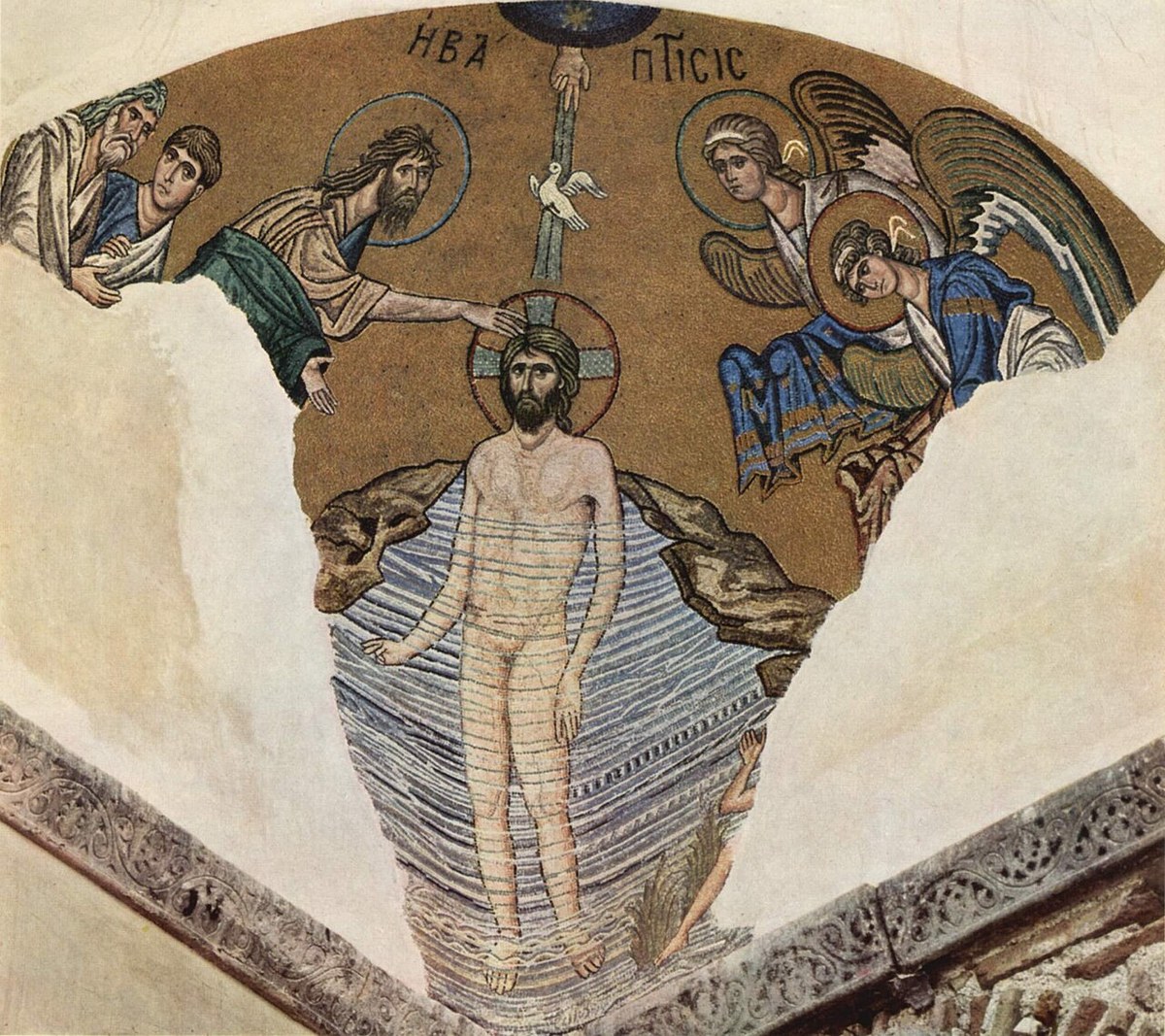
The icon of the Theophany is fixed in its essentials by the sixth century and scarcely varies thereafter. Its centre and its whole meaning is the figure of Christ, standing upright and almost naked in the dark water of the Jordan, which rises about him like a watery grave or a mandorla of shadow — the cleft of the water answering the cave of the Nativity and prefiguring the tomb. He is shown in the act of blessing the stream with his right hand, sanctifying it by his descent rather than being cleansed by it. On the left bank stands John the Forerunner, gaunt and long-haired in his garment of camel's hair, bending forward to lay his right hand on the Lord's head, his face turned up in awe; near him, in many icons, a tree with an axe laid to its root (Matthew 3:10), the Forerunner's own preaching set into the image. On the right bank a company of angels bow toward Christ, their hands veiled in their garments and bearing towels, as servants waiting to receive and robe their Master — the reverence of heaven before the humility of God. At the top of the panel a segment of heaven opens, "rent asunder," and from it a ray descends upon the Lord, and within or at its head the dove of the Spirit comes down; the ray, often threefold, carries the presence of the Father whose voice is heard. In the water at Christ's feet the tradition sets small personified figures — an old man, the river Jordan, and a figure of the Sea, turning and fleeing away, sometimes riding a fish — the visual form of Psalm 113 (114 Hebrew): "The sea saw it, and fled: Jordan was driven back… What ailed thee, O thou sea, that thou fleddest? thou Jordan, that thou wast driven back?" Little fish and the water itself recoil before the Maker who has entered the stream.
The stored image is one of the great examples of the type: a Middle Byzantine mosaic of about the year 1100, from the mosaic programme of the katholikon of the Monastery of Daphni near Athens — among the summits of Byzantine art. Against the gold ground Christ stands frontal in the blue-green water, his hand lowered in blessing; John the Forerunner leans from the rocky left bank, his hand upon the Lord's head; on the right two angels bow with hands veiled in cloths to receive him. From the arc of heaven at the summit a ray descends with the dove upon the Lord, and in the water below, half-immersed, the small personification of the Jordan looks up and back. The composition holds in one golden field the three witnesses of the feast — the Son in the water, the Spirit in the dove, and, in the ray from the opened heaven, the Father who names him.