
Igor of Chernigov
The Holy Passion-bearer Igor-George, in monastic schema Gabriel, Grand Prince of Chernigov and Kiev
Passion Bearer · Prince · Venerable · d. 1147
Commemorated 5 June — Translation of the relics from Kiev to the Saviour cathedral at Chernigov, 1150, 19 September — Murder by the Kiev mob in 1147
Igor Olgovich (†1147), of the princely house of Chernigov, held the throne of Kiev for a fortnight in 1146, was defeated and imprisoned, and in prison asked for and received the monastic tonsure with the name Gabriel, and then the great schema. Two years later, while he was standing at the Liturgy in the monastery church of St Theodore in Kiev, the Kiev mob — inflamed by rumours of a conspiracy of his kinsmen, and against the pleading of the metropolitan, the clergy and the prince's own brother — dragged him from the church, beat him, and killed him, leaving his body naked in the marketplace. He is venerated as a passion-bearer: a prince who had already given up the world and who did not resist. His murder is kept on September 19 and the translation of his relics to Chernigov in 1150 on June 5.

The Olgovichi and the throne of Kiev
Igor was a son of Oleg Svyatoslavich of Chernigov and so one of the Olgovichi, the Chernigov branch of the descendants of Yaroslav the Wise, whose long quarrel with the Mstislavichi of Volhynia and the heirs of Vladimir Monomakh is the political substance of twelfth-century Rus. His baptismal name was George; Igor was his princely name.
His elder brother Vsevolod Olgovich held Kiev from 1139 to 1146, and, dying, required the Kievans to swear that they would receive Igor after him. They swore, and they did not mean it. The Olgovichi were resented in Kiev as outsiders and as hard masters, and the city's grievances against Vsevolod's officials were unredressed. Within days of Igor's accession in August 1146 the Kievan veche sent secretly to Izyaslav Mstislavich, prince of Pereyaslavl and grandson of Monomakh, inviting him to take the city.
Defeat, imprisonment and tonsure
Izyaslav came. At the battle outside Kiev on 13 August 1146 Igor's own Kievan levies went over to the enemy or melted away; he fled, his horse foundered in a marsh near the Dnieper, and after four days he was taken. Izyaslav became Grand Prince and had Igor shut up first in a cell at the monastery of St John at Pereyaslavl, then in a log prison, where he fell dangerously ill.
Facing death, Igor sent to Izyaslav asking to be allowed to become a monk — a thing he said he had long desired. Izyaslav consented, and in January 1147 Igor was carried to Kiev and tonsured in the monastery of St Theodore, receiving the name Gabriel; a little later, recovering, he was clothed in the great schema. From that point he was no longer a claimant. He remained in the monastery, reading and praying, and by every account bore his fall without bitterness.
The murder, 19 September 1147
In the autumn of 1147 Izyaslav marched against Chernigov, and word came back to Kiev that the Olgovichi had broken faith and were treating with Yuri Dolgoruky of Suzdal, and — the rumour that did the damage — that they meant to seize Izyaslav by treachery. The city rose. The veche declared that the whole line of the Olgovichi should be destroyed, and turned first on the one Olgovich within reach: the tonsured monk in St Theodore's.
Three men tried to stop it. Vladimir Mstislavich, Izyaslav's own brother and regent in the city, rode to the monastery, put the monk behind him, and had the gates shut; the metropolitan (the see was in the hands of Clement Smolyatich) and the clergy forbade the crime under pain of sin; the abbot and brethren stood in the way. The mob broke in during the Liturgy, tore Gabriel-Igor from the church — he had just heard the Gospel — beat him in the courtyard, dragged him through the streets by the feet to the Babin Torzhok, the market square, and there killed him. His body was left naked and unburied in the market.
The reaction came almost at once. When the corpse was at last carried to the church of St Michael, candles are said to have kindled of themselves above it, and the city, which had murdered him in a fit of political fury, began to repent of the murder of a monk. He was buried in the monastery of St Simeon in the Kopyrev quarter of Kiev.
Translation of the relics to Chernigov, 1150 — the feast of June 5
In 1150 Igor's brother Svyatoslav Olgovich, having recovered Chernigov, sent to Kiev for the body, and the relics were carried up to Chernigov and laid in the cathedral of the Saviour (the Spassky sobor), the burial church of the Chernigov princes. The relics were found incorrupt. It is this translation that the calendar keeps on June 5, and on the same day the Church commemorates the Igor icon of the Mother of God — the image before which, by the Kievan tradition, the prince made his last prayer in the chapel of St John the Theologian in the Dormition cathedral of the Caves, and which was afterwards named for him.
Veneration
Igor's cult is of the specifically Russian type of the passion-bearer (страстотерпец) — the same category as Boris and Gleb and, later, Michael and Theodore of Chernigov: princes killed not for confessing Christ before pagans but in the internal violence of their own Christian society, and honoured because they did not resist, accepting death in imitation of the Passion. In Igor's case the ground of veneration is doubly clear, since he had already renounced the world and was killed as a monk at prayer. He is styled blagovernyi, "right-believing," in the Slavonic service books, and is counted among the wonderworkers of Chernigov, where his memory is joined to that of the later Chernigov martyr-princes. Churches bear his name in Chernigov, Kiev and Moscow, and the Moscow church of the Holy Prince Igor of Chernigov at Novo-Peredelkino is a modern foundation.
Feast and commemoration
September 19 (church date; Old Calendar civil October 2) — the martyrdom — and June 5 (church date; Old Calendar civil June 18) — the translation of the relics to Chernigov in 1150, kept on the same day as the Igor icon of the Mother of God. Both days are Russian and Ukrainian commemorations, kept also by the Orthodox Church in America; they do not appear in the Greek or Antiochian menaia. Chernigov keeps him as one of its own hierarchs' and princes' company, and he is named in the synaxis of the saints of Chernigov and in that of the saints of Kiev.
Hymns
Troparion — Tone 4 (common of a passion-bearer)
Having exchanged the crown of a prince for the habit of a monk, and the throne of Kiev for a cell of prayer, thou didst not flee, O right-believing Igor, when the people rose against thee; but standing before the holy things thou wast taken as a lamb, and didst render good for evil. Wherefore, O passion-bearer Gabriel, entreat Christ our God to grant peace to His people.
Original translation from the Slavonic
Kontakion — Tone 2
Thou wast dragged from the church in the hour of the Gospel, and thy blood was shed in the marketplace of the city that had sworn to serve thee; but the candles kindled of themselves above thy body, and the city that slew thee learned to honour thee. O holy prince and monk, pray for our salvation.
Original translation from the Slavonic
Iconography
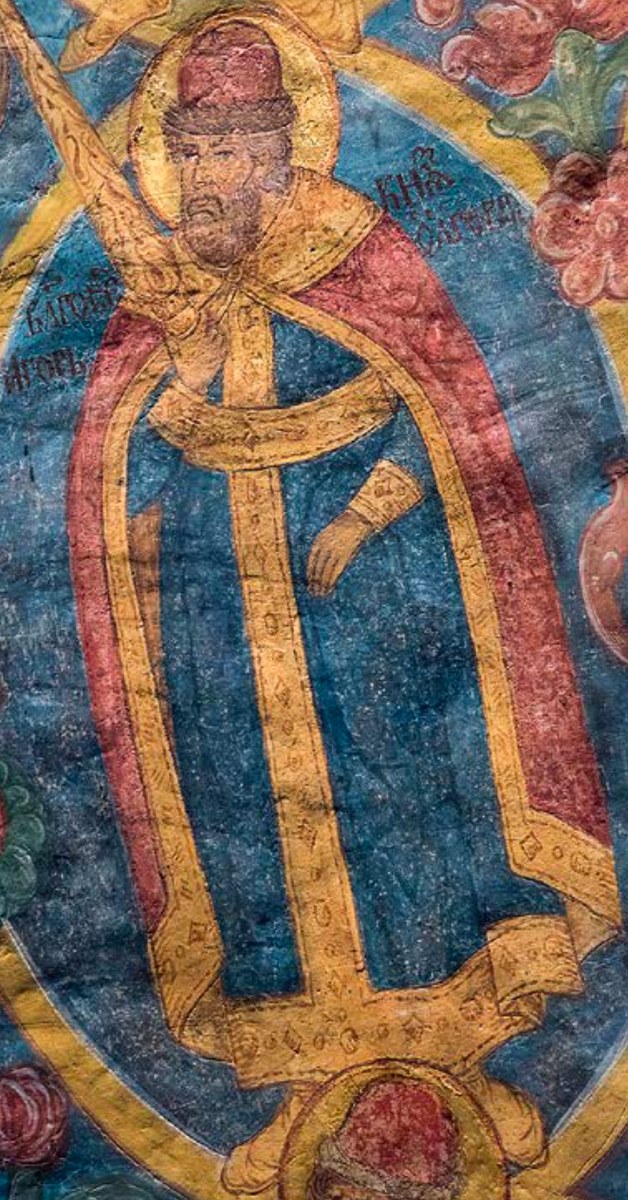
Igor is written in either of two ways, and the choice states an interpretation. As prince he stands in the long princely mantle and gold-worked korzno, with the fur-trimmed cap on his head and a halo about it, holding a cross or a scroll — the form used in the dynastic programmes of Muscovite art, and the form of the seventeenth-century fresco reproduced above, from the genealogical cycle of the Transfiguration cathedral of the Novospassky monastery in Moscow (1680s), where the Slavonic inscription reads Благовѣ[рный] Игорь · Кнѧз Черн[иговский] — "Blessed Igor, Prince of Chernigov." As monk of the great schema he is shown in the black analavos and cowl with the name Gabriel, and this is the form preferred in Chernigov and in the modern Ukrainian icons, since it is as a monk that he died. Fuller compositions add the passion: the mob breaking into the church, the saint dragged by the feet, and the candles burning of themselves above the body in St Michael's.
The stored image is a photograph, freely licensed by its photographer, of a fresco of the 1680s: the underlying wall-painting is long out of copyright, and the photographic licence is recorded because the shot is of a wall surface rather than a flat panel. No earlier image of the saint has been located; a media search of Wikimedia Commons under the Russian form of his name returned, besides this fresco, only the seventeenth-century Tsarskii Titulyarnik portrait miniature (a dynastic portrait rather than an icon) and modern painted icons, which are not stored here.
Disputed questions
- The principal feast. Russian and OCA calendars keep him on both days: September 19, the day of his murder in 1147, and June 5, the translation of his relics to Chernigov in 1150. September 19 is treated here as the primary feast, June 5 as the translation of relics, following the ordinary rule that the day of the passion ranks first. Some calendars print the June date first, and the fact that the Igor icon of the Mother of God is also kept on June 5 gives that day the greater popular observance in some places.
- Date of the translation. 1150 is the usual date; a few accounts place it in 1149 or later, and one strand holds that the relics were moved during Svyatoslav Olgovich's brief recovery of Kiev rather than sent from it.
- Culpability. The chronicles are unanimous that Izyaslav Mstislavich did not order the killing and that his brother Vladimir tried to prevent it; the veche acted on its own. Later polemical writing on both sides of the Olgovich–Mstislavich quarrel has assigned the blame differently, and the Church's veneration of Igor has never involved a condemnation of Izyaslav.
- Not to be confused with the pagan Igor of Kiev (†945), husband of Olga and father of Svyatoslav, who is not a saint; nor with Michael and Theodore of Chernigov, the prince and boyar martyred at the Horde in 1246, with whom he is grouped in the Chernigov synaxis.